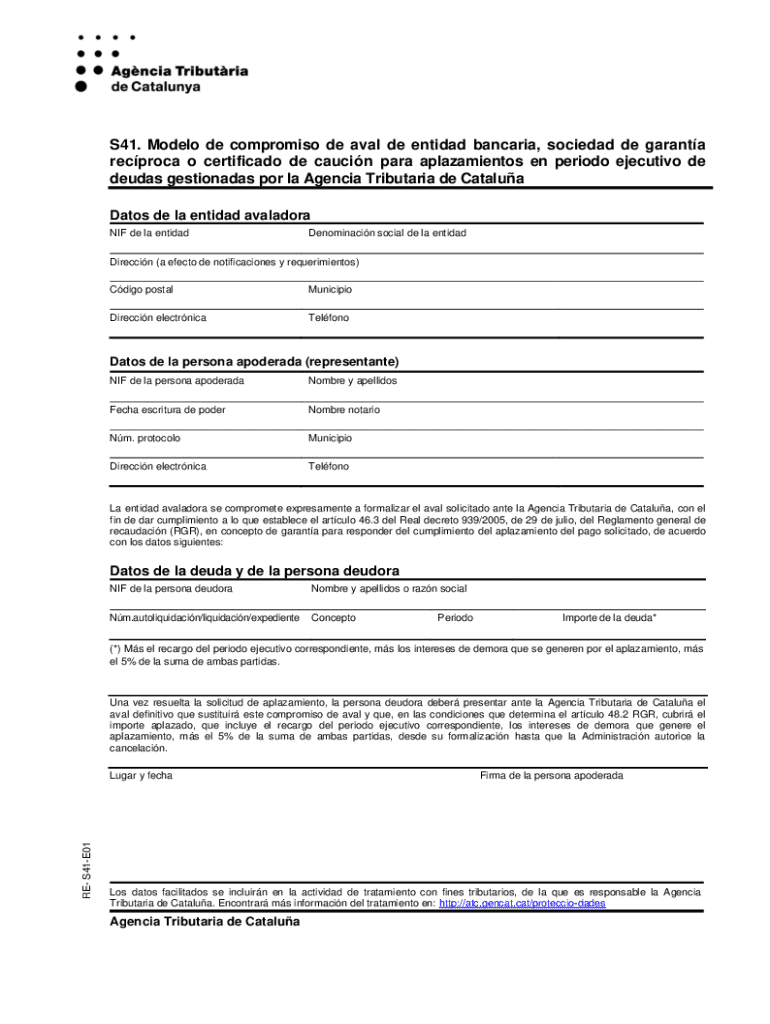
Utaria de Catalu a Datos de la entidad avaladora NIF de la entidad Denominaci n social de la entidad Direcci n (a efecto de notificaciones y requerimientos) C digo postal Municipio Direcci n electr nica Tel fono Datos de la persona apoderada (representante) NIF de la persona apoderada Nombre y apellidos Fecha escritura de poder Nombre notario N m. protocolo Municipio Direcci n electr nica Tel fono La entidad avaladora se compromete expresamente a formalizar el aval solic.

Open form follow the instructions

Easily sign the form with your finger

Send filled & signed form or save
How to fill out the 2018 ES ATC S41 online
This guide provides detailed instructions for users on how to effectively fill out the 2018 ES ATC S41 form online. By following these steps, you will ensure accurate completion of the form for your submission to the tax agency.
Follow the steps to successfully complete the form.
- Click the ‘Get Form’ button to acquire the form and open it in the online editor.
- Begin by entering the details of the guarantor entity. Include the NIF (Tax Identification Number) of the entity, its social name, notification address, postal code, municipality, electronic address, and telephone number.
- Provide the information for the authorized representative. Fill in the NIF, full name, date of the power of attorney, notary's name, protocol number, municipality, electronic address, and telephone number.
- The guarantor entity will need to explicitly commit to formalizing the guarantee requested before the Tax Agency of Catalonia, in compliance with Article 46.3 of Real Decreto 939/2005.
- Enter details of the debt and the debtor. This includes the NIF of the debtor, their full name or business name, self-assessment number, concept, period, and total amount of the debt. Ensure to include any additional charges and interest as detailed.
- Confirm that, once the deferral request is resolved, the debtor must submit a definitive guarantee to replace this commitment, covering the deferred amount along with related charges, as specified by Article 48.2 RGR.
- Indicate the location and date at the end of the form, ensuring all information is correct before proceeding.
- Finally, sign the form as the authorized representative. Once complete, you can proceed to save changes, download, print, or share the form.
Complete your documents online with confidence by following these structured steps.
Experience a faster way to fill out and sign forms on the web. Access the most extensive library of templates available.
Related content
by T Formánek · 2024 · Cited by 7 — Evidence suggests reduced survival rates...
Jun 3, 2021 — Recipient's Catalog No. 4. Title and Subtitle. Urban Air Mobility Study:...
Global Consensus Guidelines for the Injection of. Diluted and Hyperdiluted Calcium...
Get answers to your most pressing questions about US Legal Forms API.
What is AO OTA classification of Intertroch?
The AO OTA classification for Intertrochanteric fractures categorizes these injuries based on their characteristics and complexity, serving as a guideline for treatment approaches. This classification highlights the importance of identifying fracture patterns to inform clinicians on the best practices for stabilization and recovery. Leveraging the AO OTA framework alongside the best aspects of the 2018 ES ATC S41 can greatly enhance patient outcomes.
How do you cite AO classification?
Citing AO classification typically involves referring to the original source material provided by the AO Foundation or publications related to the AO classification system. It is important to cite it accurately to ensure clarity in communication and understanding among your peers. Those referencing the findings or principles from the 2018 ES ATC S41 should also include relevant citations to promote a comprehensive understanding.
What is the AO system of classification?
The AO system of classification categorizes fractures based on their anatomy and injury patterns, allowing healthcare providers to effectively communicate about treatment options. This system assists in determining the appropriate surgical and non-surgical interventions needed for successful healing. Utilizing the AO classification system, along with principles from the 2018 ES ATC S41, can significantly enhance the quality of care provided to patients.
What does AO OTA stand for?
AO OTA stands for the 'AO Orthopaedic Trauma Association,' an organization that collaborates with the AO Foundation to enhance trauma care through education and research in orthopaedic injuries. The AO OTA classification system is vital for effective treatment planning and decision-making in trauma cases. For those looking to implement best practices in managing fractures, especially using insights from the 2018 ES ATC S41, understanding AO OTA is an important aspect.
What does AO classification stand for?
AO classification refers to a systematic method for categorizing fractures based on various factors, such as the mechanism of injury and the specific anatomical location. This classification system aims to standardize communication among medical professionals and improve treatment outcomes. Familiarity with the AO classification system is crucial for anyone involved in the management of fractures and is particularly relevant when discussing the principles outlined in the 2018 ES ATC S41.
What does AO mean in fractures?
In the context of fractures, AO stands for the 'Arbeitsgemeinschaft für Osteosynthesefragen,' which translates to 'Association for the Study of Internal Fixation.' This organization focuses on developing and promoting standards for fracture treatment. Understanding the AO terminology is essential for healthcare professionals who want to explore effective solutions for fracture management, including the insights derived from the 2018 ES ATC S41.
Use professional pre-built templates to fill in and sign documents online faster. Get access to thousands of forms.
If you believe that this page should be taken down, please follow our DMCA take down process here.