Get Ca Scaqmd Rule 1403 2008-2026
How it works
-

Open form follow the instructions
-

Easily sign the form with your finger
-

Send filled & signed form or save
How to fill out the CA SCAQMD Rule 1403 online
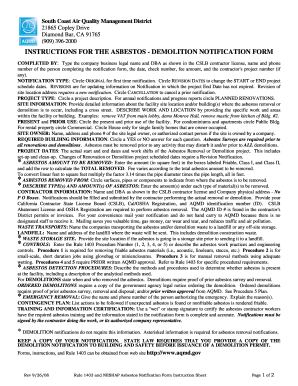
Filling out the CA SCAQMD Rule 1403 form is a critical step in ensuring compliance with regulations surrounding asbestos removal and demolition activities. This guide provides detailed, step-by-step instructions tailored to help you complete the form accurately and efficiently.
Follow the steps to successfully complete your asbestos notification.
- Click ‘Get Form’ button to access the CA SCAQMD Rule 1403 form and open it for completion.
- In the 'Completed By' section, input the company’s legal name and doing business as (DBA) name as listed on the CSLB contractor license. Include the name and phone number of the person completing the form, the current date, check number, fee amount, and contractor's project number, if applicable.
- For 'Notification Type', select 'Original' if this is the first notification, 'Revision' for changes in project dates, and 'Cancellation' if you wish to cancel a previous notification. Indicate accordingly by circling the appropriate option.
- Under 'Project Type', select the description of your project. For annual notifications or progress reports, opt for 'Planned Renovations'.
- In the 'Site Information' section, provide the full address of the site where asbestos removal or demolition will occur. Include a cross street for better location specifics, and describe the work and areas within the site that will be affected.
- Indicate the present and prior use of the facility by selecting from the listed options. For rental properties, select 'Commercial'; for single-family homes, select 'House'.
- Fill out 'Site Owner' details by providing the name, address, and phone number of the legal owner of the site, or the authorized contact person if the site is owned by an entity.
- Answer the 'Required Building Information' questions with a 'Yes' or 'No'. Ensure to highlight that asbestos surveys are required prior to any renovation or demolition.
- Enter the actual start and end dates for the Asbestos Removal or Demolition project in the 'Project Dates' section, including the work shifts.
- Specify the amount of asbestos to be removed in square feet in the respective boxes for Friable, Class I, and Class II asbestos. Add to calculate the total amount removed.
- Circle the surfaces, pipes, or components from which asbestos is being removed in 'Asbestos Removed From'.
- In 'Describe Type(s) and Amount(s) of Asbestos', enter the amount(s) for each type of material being removed.
- Complete the 'Contractor Information' section with the contractor's name, DBA, physical address (no P.O. Boxes), California Contractor State License Board number, Cal/OSHA Registration, and AQMD identification number.
- List the waste transport companies in the 'Waste Transports' section and provide the landfill name and address for where the waste will be disposed.
- In 'Controls', provide the Rule 1403 Procedure Number or describe the asbestos work practices and engineering controls that will be used.
- Detail the 'Asbestos Detection Procedures', including any methods used to confirm the presence of asbestos.
- Complete the emergency removal section if necessary, explaining the reason and identifying the authorizing person.
- Draft a contingency plan that outlines actions to take if unexpected asbestos is encountered during the project.
- Sign the form with a 'wet' or stamp signature in the 'Training and Information Certification' section, certifying the accuracy of information provided.
- After completing the form, save changes, then proceed to download or print the form. It is advisable to keep a copy of your notification for your records.
Complete your CA SCAQMD Rule 1403 notification online today to ensure compliance with asbestos regulations.
Related links form
The rule for asbestos in the SCAQMD, primarily governed by CA SCAQMD Rule 1403, sets standards for the handling and removal of asbestos in construction and demolition activities. It requires notification to the SCAQMD prior to any asbestos-related work and mandates the use of licensed contractors. Following this rule is crucial for protecting both worker safety and public health. Always stay informed about these regulations to ensure compliance on your projects.