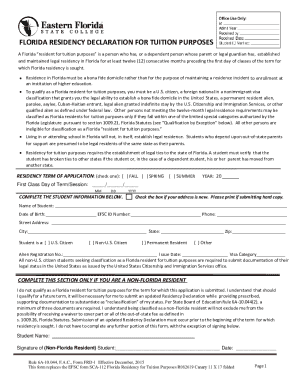
Egal residency in Florida for at least twelve (12) consecutive months preceding the first day of classes of the term for which Florida residency is sought. Residence in Florida must be a bona fide domicile rather than for the purpose of maintaining a residence incident to enrollment at an institution of higher education. To qualify as a Florida resident for tuition purposes, you must be a U.S. citizen, a foreign national in a nonimmigrant visa classification that grants you the legal abi.
Open form follow the instructions
Easily sign the form with your finger
Send filled & signed form or save
How to fill out the FL FRD-1 online
Filling out the FL FRD-1 form is essential for establishing residency in Florida for tuition purposes. This guide offers clear, step-by-step instructions to help users complete the form without confusion, ensuring that all necessary information is provided accurately.
Follow the steps to successfully complete the FL FRD-1 online.
- Click ‘Get Form’ button to obtain the form and open it in your online editor.
- Select the residency term of application by checking the appropriate box for FALL, SPRING, or SUMMER.
- Enter the year, the first class day of the term/session, and then provide your complete student information, including your name, date of birth, and EFSC ID number.
- Indicate if your address is new by checking the corresponding box. Fill in your street address, city, state, and zip code.
- Select your citizenship status by checking one of the options: U.S. Citizen, Non-U.S. Citizen, Permanent Resident, or Other. If you are a Non-U.S. Citizen, provide your Alien Registration Number, issue date, and visa category.
- If you are a non-Florida resident, complete the designated section by signing and dating where required, and leave the rest of the form blank.
- Select your status as either Initial residency or Residency reclassification appeal, based on your previous attendance at EFSC.
- Choose whether you are a dependent or independent student, and provide necessary details depending on your classification.
- Fill out the qualification by exception section if applicable, checking the appropriate box and providing required documentation.
- Complete the claimant information section if you are dependent on another individual who is claiming residency.
- In the provision of documents section, ensure you list at least one document from Tier A and any additional documents you may have from Tier B to support your residency claim.
- Finish by signing and dating the form where indicated, affirming that the information provided is accurate.
- After completing the form, save your changes, and choose the options to download, print, or share the form as needed.
Complete your residency declaration online today to secure your eligibility for Florida tuition purposes.
Experience a faster way to fill out and sign forms on the web. Access the most extensive library of templates available.
Related content
This competitive, reimbursement grant program provides financial assistance for...
Dependency status will determine who will submit documentation for at least twelve (12)...
Molina requires prior authorization for specified services as long as the requirement...
Get answers to your most pressing questions about US Legal Forms API.
How to qualify for Florida residency?
Qualifying for Florida residency involves demonstrating physical presence in the state and intent to make it your permanent home. This usually requires you to establish a physical address, obtain a Florida driver's license, and register to vote in the state. Utilizing forms like the FL FRD-1 can facilitate the residency qualification process by outlining the necessary steps and documentation.
What is the declaration of domicile in Florida in accordance with S 222.17 Florida statutes?
The declaration of domicile in Florida, as outlined in S 222.17 Florida statutes, is a legal document that confirms an individual's permanent residency in the state. This document serves various purposes, including establishing tax residency and eligibility for certain benefits. The FL FRD-1 can be useful in this context, as it supports your claim of Florida residency and provides clarity on your domicile status.
How to prove Florida residency for Broward College?
Proving Florida residency for Broward College typically involves presenting documentation that verifies your physical address in Florida. Acceptable documents may include utility bills, bank statements, or lease agreements showing your name and address. Completing the FL FRD-1 process can also simplify this verification, as it is designed to streamline residency proof for educational institutions.
What is a document evidencing family ties in Florida?
A document evidencing family ties in Florida demonstrates relationships between family members, often required for legal or official purposes. This can include birth certificates, marriage licenses, or any legal documents that prove familial connections. When applying for specific services, like the FL FRD-1, these documents are essential for verification and processing.
How to declare Florida residency?
To declare Florida residency, start by obtaining a Florida driver's license or state identification card. Next, establish a permanent address in Florida and register to vote in the state. You may also need to show proof of residency through utility bills or lease agreements. By taking these steps, you can ensure that you meet the requirements set forth by the FL FRD-1 form to officially affirm your status as a Florida resident.
How do I prove my primary residence in Florida?
To prove your primary residence in Florida, consider providing documentation such as your driver’s license, voter registration, and the FL FRD-1 form. These items should reflect your Florida address and confirm your intent to remain in the state. It's important to keep all related documents organized and updated. This proof can assist you in various legal and administrative matters.
What qualifies as proof of residency in Florida?
Proof of residency in Florida can include various documents, like a utility bill, lease agreement, or bank statement showing your name and address. The FL FRD-1 form also serves as a strong declaration of your residency intention. These documents must clearly demonstrate your physical presence in the state. Having proper proof can facilitate processes like registering to vote or obtaining local licenses.
How do I get a Florida residency declaration?
Getting a Florida residency declaration involves filling out the FL FRD-1 form. This form confirms your status as a Florida resident and is essential for many legal purposes. Once completed, submit the form to your county clerk's office to have your residency recognized. This declaration can help you access benefits available to Florida residents.
How to obtain a declaration of domicile in Florida?
To obtain a declaration of domicile in Florida, you need to complete the FL FRD-1 form. This document helps you officially declare your permanent residence in Florida. You can file the form at your local county clerk’s office, where they will record your declaration. After filing, you'll have legal documentation that confirms your intention to establish residency in the state.
What is evidence of verifiable family ties to a Florida resident?
Verifiable family ties to a Florida resident can include various forms of documentation, such as birth certificates, marriage licenses, or adoption papers. These documents must clearly illustrate your relationship to the Florida resident. By providing this evidence, along with the FL FRD-1 form, you can strengthen your residency application. If you need help in gathering these documents, uslegalforms offers reliable support to guide you through the process.
Use professional pre-built templates to fill in and sign documents online faster. Get access to thousands of forms.
If you believe that this page should be taken down, please follow our DMCA take down process here.