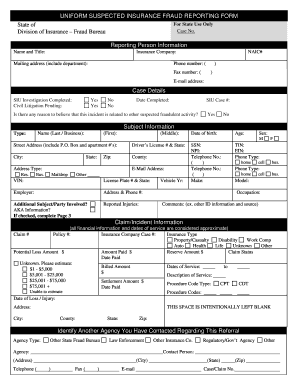
UNIFORM SUSPECTED INSURANCE FRAUD REPORTING FORM State of Division of Insurance Fraud Bureau Reporting Person: Mailing address: Insurance Company: Phone number: ( Fax number: ( E-mail address: Detailed.
Loading
Open form follow the instructions
Easily sign the form with your finger
Send filled & signed form or save
How to fill out the NAIC Uniform Suspected Insurance Fraud Reporting Form online
Filling out the NAIC Uniform Suspected Insurance Fraud Reporting Form online is a crucial step in reporting suspected fraudulent activities within the insurance industry. This guide will provide you with a clear, step-by-step approach to completing the form accurately and efficiently.
Follow the steps to complete the form successfully.
- Click the ‘Get Form’ button to obtain the form and open it in the editor.
- Begin by entering your information in the 'Reporting Person Information' section. Include your name and title, the insurance company you are representing, mailing address, NAIC number, phone number, fax number, and email address.
- In the 'Case Details' section, indicate whether the Special Investigations Unit (SIU) investigation has been completed and if civil litigation is pending by selecting 'Yes' or 'No'. Provide the date of completion and the SIU case number.
- Complete the 'Subject Information' section with the details of the individual or entity involved. Fill in their name, date of birth, sex, street address, driver's license number, city, county, state, and zip code.
- Provide additional details including the type of address, email address, vehicle information (VIN and license plate), employer details, and reported injuries.
- In the 'Claim/Incident Information' section, include any relevant claims, policy numbers, insurance types, potential loss amounts, claim status, and dates of service. Be as specific as possible with the amounts and descriptions of services.
- Specify the agency you contacted regarding this referral in the 'Identify Another Agency' section. Include the agency type, contact person, and phone numbers.
- Indicate the evidentiary materials available, checking all applicable evidence types in the 'Evidence' section.
- In the 'Suspected Fraud Types' section, mark all applicable types of suspected fraud. This is a critical part to ensure proper categorization.
- If more space is required, attach additional pages for the 'Detailed Synopsis' to provide a comprehensive overview of suspected fraud.
- Finally, review all information for accuracy and completeness. Once confirmed, save your changes, download the document, print it, or share it as necessary.
Take the necessary steps to report suspected insurance fraud—complete your form online today!
Experience a faster way to fill out and sign forms on the web. Access the most extensive library of templates available.
Related content
Agent fraud. Application fraud. Billing for services/products not provided. Failure to...
by R Bhowmik · Cited by 58 — The Uniform Suspected Insurance. Fraud Reporting Form...
Get answers to your most pressing questions about US Legal Forms API.
How much evidence is needed for fraud?
The amount of evidence required to establish fraud can vary based on the case's specifics, but generally, significant corroborative documentation is needed. Using the NAIC Uniform Suspected Insurance Fraud Reporting Form, having ample evidence can greatly support the claim. Insurers look for consistent and compelling proof to justify investigations and potential claims denials. Therefore, being aware of the necessary documentation can help individuals prepare more effectively.
What is the NAIC insurance fraud Prevention Act 680?
The NAIC Insurance Fraud Prevention Act 680 provides a framework for preventing and reporting insurance fraud across the United States. It outlines the responsibilities of insurers and mandates the use of tools like the NAIC Uniform Suspected Insurance Fraud Reporting Form to report suspected fraud. This act emphasizes the importance of collaborative efforts in combating fraud, ensuring accountability and transparency within the insurance industry. Understanding the act provides insurers and the public with a clear path toward reducing fraud.
How to investigate insurance fraud?
Investigating insurance fraud requires a systematic approach that includes gathering evidence, interviewing involved parties, and analyzing discrepancies. Using the NAIC Uniform Suspected Insurance Fraud Reporting Form simplifies this process, as it provides a structured method for submitting information. Insurers often collaborate with law enforcement to enhance investigation efforts, ensuring that all leads are pursued diligently. Being informed about the process can empower individuals to report any suspicious activities effectively.
What evidence is needed to prove insurance fraud?
To prove insurance fraud, clear evidence is necessary, such as falsified documents, witness statements, or inconsistencies in claims. When using the NAIC Uniform Suspected Insurance Fraud Reporting Form, providing thorough documentation is crucial for supporting the allegation. Insurers seek concrete proof to substantiate claims of fraud, so having detailed and accurate information is vital. Adequate evidence not only aids investigations but also fosters trust in the insurance process.
What is the burden of proof in insurance fraud?
The burden of proof in insurance fraud typically rests on the insurer, who must demonstrate that fraud occurred by clear and convincing evidence. It requires more than just suspicion; the NAIC Uniform Suspected Insurance Fraud Reporting Form necessitates factual evidence to support allegations. This standard is essential for ensuring that claims are handled fairly while protecting legitimate policyholders. Being aware of this burden can prepare both insurers and consumers for the claims process.
What triggers an insurance fraud investigation?
Insurance fraud investigations can be triggered by several factors, including inconsistencies in claim reports, unusual patterns of behavior, or tips from the public or whistleblowers. The use of the NAIC Uniform Suspected Insurance Fraud Reporting Form plays a significant role in initiating these investigations. When a claim raises red flags, insurers take a detailed look into the circumstances to verify the legitimacy. Understanding what triggers these investigations can help individuals and businesses be more cautious.
What are the 5 elements of fraud insurance?
Fraud insurance requires five key elements: a material misrepresentation, reliance by the insurer, intention to deceive, damages incurred, and causation between the misrepresentation and the damages. Understanding these elements is essential when utilizing the NAIC Uniform Suspected Insurance Fraud Reporting Form to report suspected fraud. These components establish a robust foundation for the investigation process while ensuring that reports are taken seriously. By being aware of these elements, policyholders can act more effectively in addressing fraud.
What are the three components of the fraud triangle, and what concern are they to the fraud examiner?
The three components of the fraud triangle are opportunity, motivation, and rationalization. Each component plays a crucial role in assessing potential fraud. Fraud examiners focus on these areas to identify weaknesses that may allow fraud to occur. Understanding these components helps in developing preventive measures and enhancing overall fraud detection strategies, especially when utilizing the NAIC Uniform Suspected Insurance Fraud Reporting Form.
What information should be included in the explanation of the suspected fraud activity section of the web referral form?
In the explanation section of the web referral form, provide a concise yet thorough description of the suspected fraud activity. Include specific details like dates, locations, involved individuals, and any observed irregularities. Utilizing the NAIC Uniform Suspected Insurance Fraud Reporting Form will guide you to cover all necessary aspects systematically. Clear explanations assist investigators in understanding the context and urgency of the report.
Is there a reward for reporting insurance fraud?
Yes, many states offer rewards for individuals who report insurance fraud, incentivizing the public to come forward. These rewards may vary by state, and you may find specific details on state insurance department websites. Submitting information through the NAIC Uniform Suspected Insurance Fraud Reporting Form can also help in the reward process. By participating, you contribute to fighting fraudulent activities while potentially earning a reward.
Use professional pre-built templates to fill in and sign documents online faster. Get access to thousands of forms.
If you believe that this page should be taken down, please follow our DMCA take down process here.