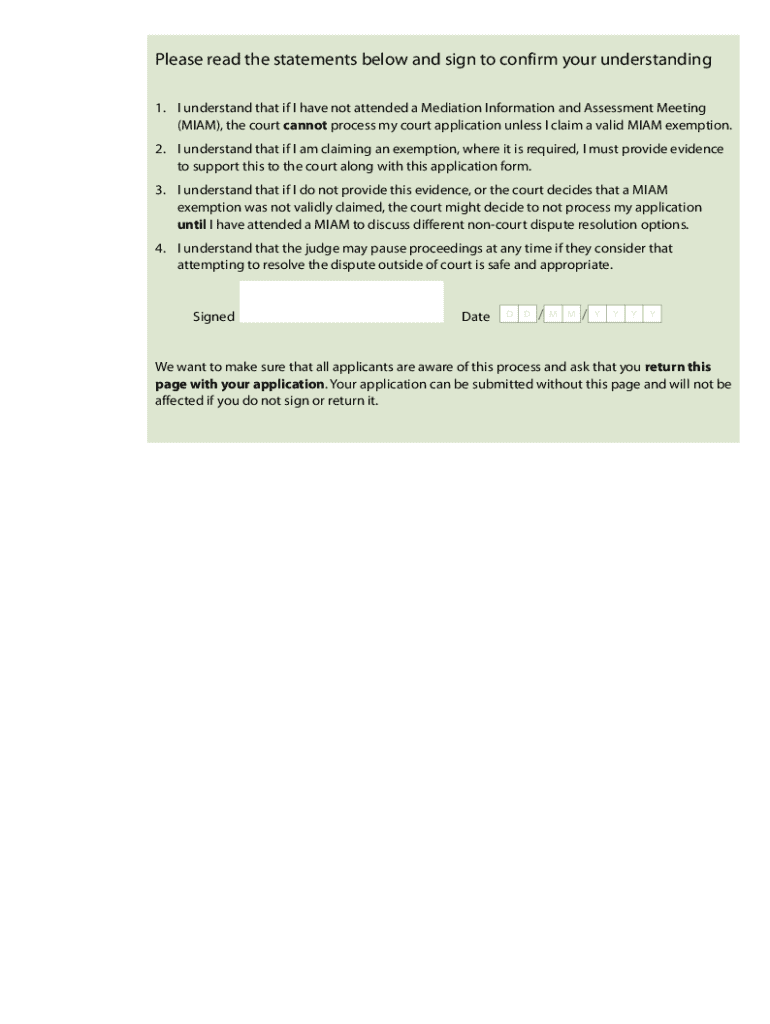
Family court to resolve a dispute about your children or finances. This means that before submitting your application to court, you must meet with an authorised family mediator to find out about mediation and the other different options for resolving your dispute(s) outside of court. Using a third party to help resolve a dispute outside of court is known as non-court dispute resolution, or NCDR. In some circumstances - such as where domestic abuse is involved - you may not need to attend a MIAM.
Loading

Open form follow the instructions

Easily sign the form with your finger

Send filled & signed form or save
How to fill out the UK C100 online
Filling out the UK C100 form is an essential step in applying to the family court regarding child arrangements. This guide provides a clear and supportive walkthrough to assist users in completing the form online, ensuring all necessary sections are accurately filled.
Follow the steps to successfully complete the UK C100 form online.
- Click ‘Get Form’ button to obtain the form and access it in the editor.
- Begin by providing the names of both the applicant(s) and respondent(s) in the appropriate fields. Ensure that the correct spelling is used to avoid complications.
- Specify the nature of your application, including the type of order you are seeking (e.g., Child Arrangements Order, Prohibited Steps Order, Specific Issue Order).
- Answer any inquiries regarding concerns about risk of harm or allegations of domestic abuse by selecting 'Yes' or 'No' as applicable. If 'Yes', complete the supplemental Form C1A.
- Indicate whether you have attended a Mediation Information and Assessment Meeting (MIAM) and complete the relevant sections based on your situation. If claiming an exemption from attending a MIAM, provide evidence with your application.
- Fill out the child(ren) details section, including names, dates of birth, and the relationship of the applicant(s) and respondent(s) to the children. Ensure complete and accurate information is provided.
- Provide additional information or previous agreements related to the child arrangements, including any prior Parenting Plans if applicable.
- Carefully complete sections on any other court proceedings concerning the child(ren), and provide details if there are any international aspects to the case.
- Review all completed sections for accuracy and completeness. Utilize the checklist at the end of the form to confirm all required information has been provided.
- Once all sections have been filled out and reviewed, submit the form online, ensuring to save changes, download, or print copies for your records as needed.
Start your application and complete the C100 form online now to ensure your child's arrangements are addressed.
Experience a faster way to fill out and sign forms on the web. Access the most extensive library of templates available.
Related content
by S Santamaria · 2017 · Cited by 13 — The potent aggrecanase ADAMTS-5 is...
Apr 3, 2024 — The Additional Provisions and Scope of Work is intended to be general in...
Jul 23, 2024 — This medication has been rebranded and was formerly known as: Adven®...
Get answers to your most pressing questions about US Legal Forms API.
Who can apply for a child arrangement order UK?
Any parent, guardian, or person concerned with the child’s welfare can apply for a Child Arrangements Order in the UK. This includes fathers, mothers, and other relatives or caregivers who have a vested interest in the child’s living and contact arrangements. Submitting a C100 application is the first step in formalizing these arrangements legally.
Can a mother refuse 50/50 custody in the UK?
Yes, a mother can refuse a 50/50 custody arrangement in the UK if she believes it is not in the best interest of the child. Concerns may arise regarding the child's welfare, routine, or emotional needs. Nonetheless, such decisions should ideally be made after careful consideration and possibly with legal input, including the guidance of the UK C100 framework.
What is a C100 UK?
The C100 form in the UK is used to apply for a Child Arrangements Order, which governs with whom a child will live or spend time. It’s a critical document for parents seeking legal clarity about custody and visitation rights. By accurately completing the UK C100, parents can ensure their children's best interests are prioritized in legal proceedings.
How to get an S1 form from the UK?
To obtain an S1 form in the UK, you need to contact the relevant authority responsible for issuing social security forms. This form is vital for individuals moving to another country within the European Economic Area, as it proves entitlement to healthcare and benefits. For comprehensive assistance navigating these processes, the UK C100 can serve as a useful guide.
How to get 50/50 custody in the UK?
To achieve a 50/50 custody arrangement in the UK, parents should engage in open discussions to agree on shared responsibilities and parenting plans. If an agreement is difficult to reach, parents can consider mediation or seek help through the UK C100 application process for a Child Arrangements Order. Having clear documentation and a solid plan can significantly increase the likelihood of a favorable custody outcome.
Is 50 50 custody hard?
Maintaining a 50/50 custody arrangement can be challenging as it requires substantial communication and cooperation between both parents. Consistency in parenting styles, logistics, and schedules can create tensions if not managed properly. However, many families find that with clear agreements and respect for each other's roles, it can be a fulfilling arrangement for everyone, resonating with the principles outlined in the UK C100.
What is Cafcass UK?
Cafcass UK, or the Children and Family Court Advisory and Support Service, plays a pivotal role in family law matters involving children. They work with the courts to ensure that the child's welfare is prioritized in legal decisions. Their expertise can be beneficial during the C100 process, assisting families through challenging times. Engaging with Cafcass UK may help facilitate smoother resolutions.
What does battery capacity C20 mean?
Battery capacity C20 means the amount of energy a battery can deliver over a 20-hour period. This rating helps users estimate how long a battery will run a device. Understanding C20 is significant for those looking to maximize battery performance and lifespan. It plays a role in selecting batteries for various applications.
What is the difference between C20 and C100?
The difference between C20 and C100 pertains to how battery capacity is rated over time. C20 refers to the capacity when discharged over 20 hours, while C100 indicates capacity over a longer period. This information is valuable when evaluating which battery to use for your devices. Knowing about these distinctions helps you choose the most suitable option.
What does C100 mean?
C100 generally indicates a specific form or capacity related to certain fields. In UK family law, it signifies the application for child arrangements. In battery terminology, C100 represents a rate of capacity when providing power. It's important to understand the context to grasp its full meaning.
Use professional pre-built templates to fill in and sign documents online faster. Get access to thousands of forms.
If you believe that this page should be taken down, please follow our DMCA take down process here.