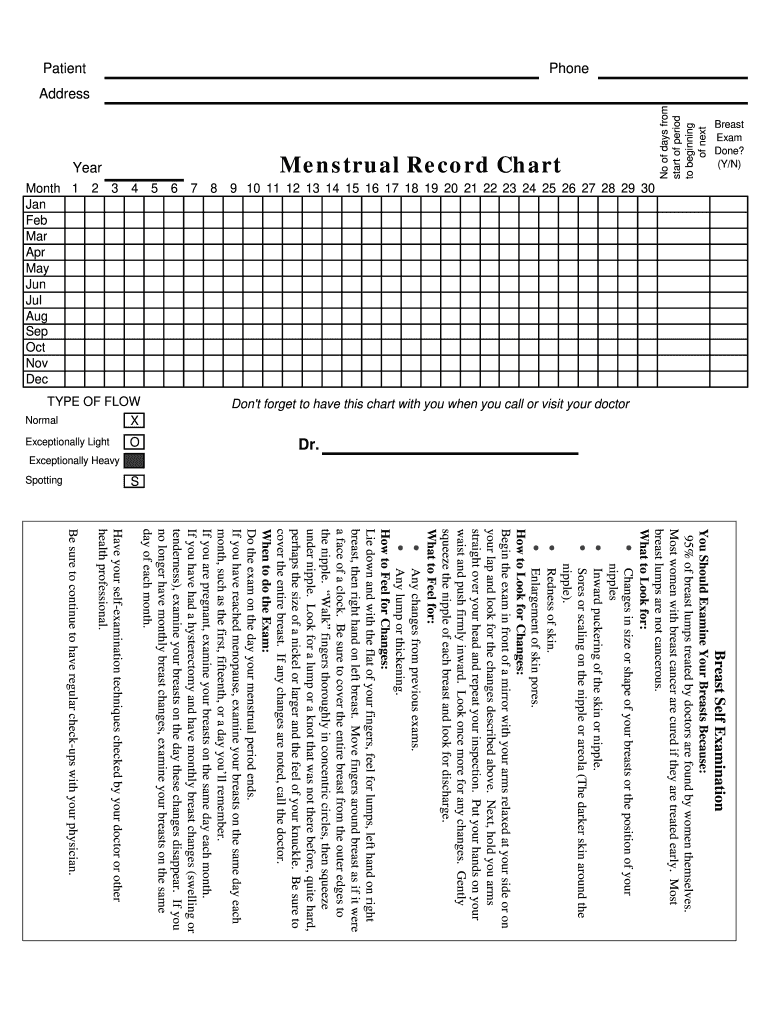
Nning of next Breast Exam Done? (Y/N) Year 9 10 11 12 13 14 15 16 17 18 19 20 21 22 23 24 25 26 27 28 29 30 8 7 6 5 4 3 2 Month 1 Jan Feb Mar Apr May Jun Jul Aug Sep Oct Nov Dec Phone Patient Address Exceptionally Heavy Breast Self Examination You Should Examine Your Breasts Because: 95% of breast lumps treated by doctors are found by women themselves. Most women with breast cancer are cured if they are treated early. Most breast lumps are not cancerous. What to Look for: • Changes in .

Open form follow the instructions

Easily sign the form with your finger

Send filled & signed form or save
How to fill out the Menstrual Record Chart online
Filling out the Menstrual Record Chart online can help you track your menstrual health effectively. This guide provides you with step-by-step instructions to ensure you complete the chart accurately and easily.
Follow the steps to fill out your Menstrual Record Chart online.
- Click the ‘Get Form’ button to access the Menstrual Record Chart and open it in your preferred online editor.
- Begin by entering your personal information at the top of the form, including your name, address, and phone number. Ensure all details are accurate to help with any future reference.
- Select the appropriate year from the dropdown menu to reflect the current year you are documenting your menstrual cycle.
- In the 'Type of Flow' section, mark the description that best matches your menstrual flow for each day of your cycle over the month, including options like 'Normal,' 'Exceptionally Light,' 'Exceptionally Heavy,' and 'Spotting.'
- Record the number of days from the start of your period to the beginning of your next period in the designated area. This will help track the length of your cycle.
- Indicate whether you have performed a breast self-examination by selecting 'Yes' or 'No' for each entry. Remember to document any significant findings as you go.
- Once you have completed all sections, review your entries to ensure they are accurate and comprehensive.
- Finally, you can save your changes, download the chart for your records, print it out for easy access, or share it with your healthcare provider as needed.
Start tracking your menstrual health by filling out the Menstrual Record Chart online today.
Experience a faster way to fill out and sign forms on the web. Access the most extensive library of templates available.
Related content
by BG Reed · 2018 · Cited by 854 — The average duration of menstrual flow is between...
Periods. 1. 2. 3. 4. 5. 6. 7. Standard State at 25oC; 1 atm. Ar – gas. Br - Liquid. Na...
Aug 7, 2025 — The name plate is located on the bottom of the product. The model number...
Get answers to your most pressing questions about US Legal Forms API.
Is a 40 to 45 days menstrual cycle normal?
A menstrual cycle lasting 40 to 45 days can be normal for some individuals, but it is considered longer than the typical range. Documenting your cycle using a Menstrual Record Chart can help you track your patterns and notice any changes over time. If you are consistently experiencing longer cycles, it's wise to speak with a healthcare professional for personalized advice and support.
What is the healthiest menstrual cycle?
A healthy menstrual cycle typically ranges from 21 to 35 days and lasts between two to seven days. Regularity, consistency, and minimal symptoms are key indicators of a healthy cycle, all of which can be tracked with a Menstrual Record Chart. Observing your cycle can help identify any potential issues early on. If your cycle falls outside these ranges consistently, consult with a healthcare provider.
What are the 4 types of menstrual periods?
The four types of menstrual periods include regular, heavy, light, and irregular. Each type can be documented using a Menstrual Record Chart to recognize patterns and changes in your cycle. Understanding these types provides important insights into your health. If you notice significant changes, consider consulting a healthcare professional for advice.
How do I know what phase of my cycle I am in?
To determine what phase of your cycle you are in, monitor the start and end dates of your menstrual flow. The Menstrual Record Chart can help you identify the follicular phase, ovulation, and the luteal phase. Keeping detailed notes on symptoms and changes during each phase adds context and clarity. Understanding these phases improves your awareness and helps in managing your health.
What is the time table for the menstrual cycle?
A typical menstrual cycle lasts between 28 to 35 days, but variations can occur. The cycle begins on the first day of your period and ends the day before your next period starts. Using a Menstrual Record Chart allows you to keep track of your specific cycle length and any irregularities. This information can be beneficial for planning and understanding your body's rhythms.
How do you document your period?
To document your period effectively, you can use a Menstrual Record Chart. This chart allows you to track the start and end dates of your cycle, as well as any symptoms you may experience. Regularly updating your chart helps you identify patterns in your cycle and provides valuable insights for your healthcare provider. Using a dedicated chart can simplify this process and enhance accuracy.
How do I chart my menstrual cycle?
Charting your menstrual cycle can be efficiently done with a Menstrual Record Chart. Begin by marking the first day of your period, and include notes about flow and symptoms throughout the cycle. This organized approach not only helps you understand your cycle better but also serves as a crucial resource when discussing your health with your doctor.
How do you record your period cycle?
Recording your period cycle can be done easily with a Menstrual Record Chart. Simply note the first day of your period and the last day each month. By maintaining this record, you can identify patterns, track symptoms, and share this information with your healthcare provider for better insights into your menstrual health.
How do you calculate period chart?
To calculate your period chart, you need to track the start date of your menstruation for several cycles. Then, using a Menstrual Record Chart, count the number of days between periods. This helps you understand your cycle length and can assist in predicting future periods, making it easier for you to plan ahead.
How do you document a period?
Documenting a period involves noting the start and end dates, along with any related symptoms such as cramps or mood changes. Using a Menstrual Record Chart offers an effective way to keep track of these details consistently. You can also differentiate between light, moderate, and heavy flow, which can provide valuable information for your health care provider.
Use professional pre-built templates to fill in and sign documents online faster. Get access to thousands of forms.
If you believe that this page should be taken down, please follow our DMCA take down process here.