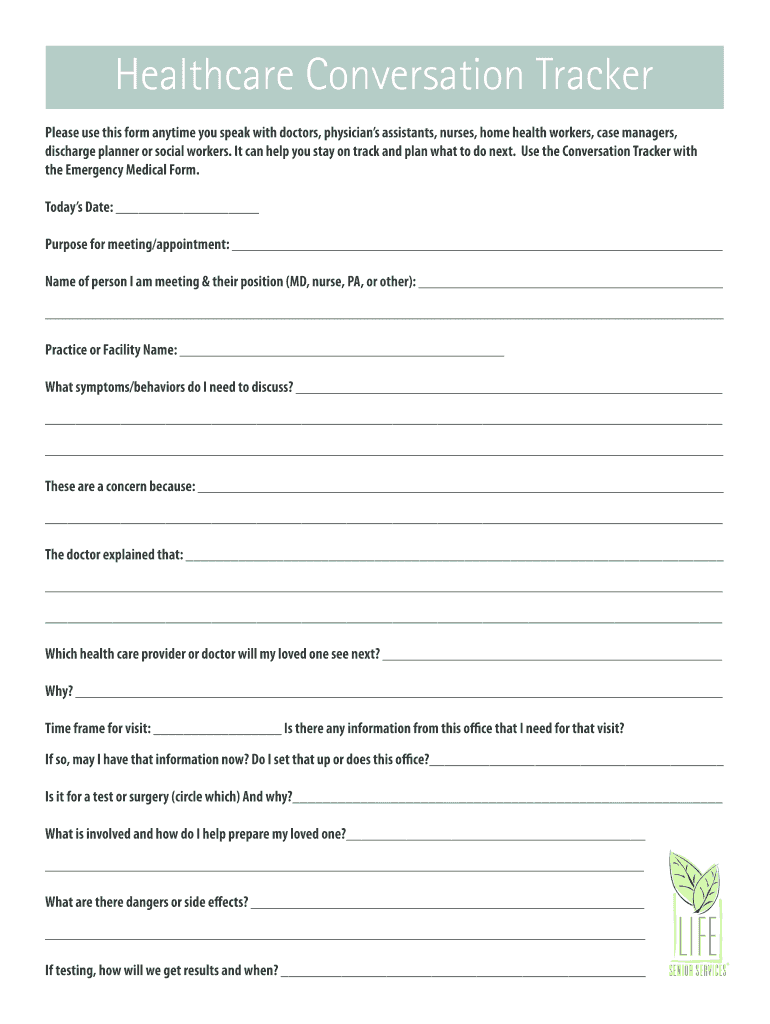
Healthcare Conversation Tracker Please use this form anytime you speak with doctors, physicians assistants, nurses, home health workers, case managers, discharge planner or social workers. It can.
Loading

Open form follow the instructions

Easily sign the form with your finger

Send filled & signed form or save
How to fill out the LIFE Senior Services Healthcare Conversation Tracker online
The LIFE Senior Services Healthcare Conversation Tracker is a valuable tool designed to help individuals manage conversations with their healthcare providers. This guide provides clear, step-by-step instructions on how to effectively fill out the form online, ensuring that all important information is captured during your medical appointments.
Follow the steps to fill out the Healthcare Conversation Tracker.
- Press the ‘Get Form’ button to access the Healthcare Conversation Tracker and open it in your preferred online editor.
- Enter today's date in the designated field. This helps to keep track of your appointments chronologically.
- In the section labeled 'Purpose for meeting/appointment,' clearly state the reason for your visit. This could include symptoms or concerns you'd like to discuss.
- Fill in the name and position of the healthcare provider you will be seeing (e.g., MD, nurse, PA). It's important to know who you are meeting for clarity.
- Provide the name of the practice or facility where your appointment will take place. This information is crucial for future references.
- Detail any symptoms or behaviors you wish to address during your appointment in the corresponding section.
- Explain why these symptoms or behaviors are a concern. This assists your healthcare provider in understanding the context.
- Record what the doctor explained to you regarding your condition or treatment plan during the visit.
- Identify the next healthcare provider or doctor your loved one will see and explain the reason for this visit.
- Indicate the time frame for the next visit and inquire if there is any information needed from the current office for that appointment.
- Determine whether the visit is for a test or surgery and briefly describe the reason.
- List the preparation required for your loved one prior to the visit, including any specific instructions from the healthcare provider.
- Detail any potential dangers or side effects associated with the upcoming treatment or procedure.
- If testing is involved, ask how results will be delivered and the expected time frame.
- If there are new prescriptions, record their names, dosages, purposes, and any known side effects.
- Review the additional topics listed and check all that apply to ensure a comprehensive discussion during your appointment.
- Utilize the notes section to jot down any other information or questions you may have for the healthcare provider.
- After filling out the form, ensure to save any changes, and decide if you want to download, print, or share the form online.
Complete your Healthcare Conversation Tracker online today to ensure a fruitful discussion during your medical appointments.
Experience a faster way to fill out and sign forms on the web. Access the most extensive library of templates available.
Related content
Oct 12, 2023 — Home health care services may be available to help older people with many...
Sep 13, 2023 — NYU Meyers' Tina Sadarangani created a tool to track health and improve...
Healthcare providers always involve caregivers on the care team and refer them to supports...
Get answers to your most pressing questions about US Legal Forms API.
How to convince an elderly parent to move to assisted living?
Convincing an elderly parent to move to assisted living requires patience and empathy. Start by discussing safety, health, and social engagement, which are essential for their quality of life. Utilize the LIFE Senior Services Healthcare Conversation Tracker to highlight the benefits of assisted living, offering a clear comparison of options. Emphasizing that this move could enhance their independence may help in easing their concerns.
What is the elderly services program ESP in Ohio?
The Elderly Services Program (ESP) in Ohio is designed to support seniors in accessing various services that promote independence and well-being. Through this program, elderly individuals can receive assistance with daily activities, transportation, and healthcare needs. For families exploring options, using the LIFE Senior Services Healthcare Conversation Tracker can provide detailed insights into how the ESP can benefit their loved ones.
How to have a conversation with elderly parents about assisted living?
To have a productive conversation about assisted living, begin by choosing a comfortable, private setting. Speak from a place of concern and listen actively to their perspectives. Incorporate the LIFE Senior Services Healthcare Conversation Tracker; it is designed to facilitate such discussions and provide clarity on available options and services. This approach can help foster understanding and cooperation.
How do you talk to your elderly parents about assisted living?
Talking to your elderly parents about assisted living can feel challenging. Start by expressing your care for their well-being and safety. Use the LIFE Senior Services Healthcare Conversation Tracker to guide your discussion, ensuring you cover their needs and feelings. This tool helps create a supportive environment where both sides can openly share their thoughts.
What paperwork do I need for the end of life?
At the end of life, essential paperwork typically includes a will, advance healthcare directive, and living will. These documents provide instructions on your wishes regarding medical treatment and asset distribution. Using the LIFE Senior Services Healthcare Conversation Tracker can enhance these discussions with family and medical professionals, ensuring that all parties understand your preferences and desires.
What are two documents that a caregiver may be required to complete?
A caregiver often needs to complete a caregiver agreement and a health care proxy document. A caregiver agreement outlines the terms of care, while a health care proxy designates someone to make medical decisions on your behalf. Leveraging the LIFE Senior Services Healthcare Conversation Tracker can help caregivers and seniors discuss and prepare these documents effectively.
What legal documents should a senior citizen have?
Senior citizens should consider having a will, durable power of attorney, and medical directives. These legal documents protect your rights and ensure your health and financial decisions align with your wishes. The LIFE Senior Services Healthcare Conversation Tracker can be an invaluable tool in facilitating conversations about these important choices, bringing clarity to potentially difficult discussions.
What are the most important legal documents?
The most important legal documents generally encompass a will, living will, and power of attorney. A will outlines how you want your assets distributed, while a living will specifies your healthcare preferences. The LIFE Senior Services Healthcare Conversation Tracker can assist in organizing these discussions, making it easier to communicate with loved ones and caregivers.
What are the most important legal documents for seniors?
For seniors, key legal documents often include a will, power of attorney, and healthcare proxy. These documents help ensure that your wishes are honored and that a trusted individual can make decisions on your behalf if needed. Utilizing the LIFE Senior Services Healthcare Conversation Tracker can streamline conversations about these essential documents, ensuring clarity and understanding among family members.
Use professional pre-built templates to fill in and sign documents online faster. Get access to thousands of forms.
If you believe that this page should be taken down, please follow our DMCA take down process here.