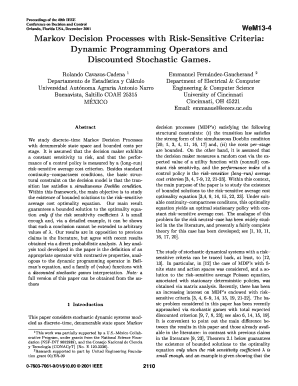
Get Markov Decision Processes With Risk-sensitive Criteria - Smitlab ...
How it works
-

Open form follow the instructions
-

Easily sign the form with your finger
-

Send filled & signed form or save
How to fill out the Markov Decision Processes With Risk-Sensitive Criteria - SMITLab online
This guide provides comprehensive instructions for filling out the Markov Decision Processes With Risk-Sensitive Criteria form online. By following these step-by-step directions, users can confidently complete the document with ease.
Follow the steps to fill out the form efficiently.
- Begin by clicking the ‘Get Form’ button to access the Markov Decision Processes With Risk-Sensitive Criteria form. This will allow you to open the document in your preferred editor for completion.
- Once you have the form open, start by providing the required information, such as your name and affiliation. Ensure that all names and institutions are correctly spelled to avoid any discrepancies.
- Proceed to the sections detailing the structural constraints of your decision processes. Clearly outline how your transition law meets the simultaneous Doeblin condition as specified in the form.
- In the next section, describe the performance index of your control policy. Be specific about the risk-sensitive criteria you are applying and how they relate to the expected utility function.
- Address the optimality equation within the form by explaining the existence of bounded solutions for your specific case. Include details about the conditions under which these solutions apply.
- Review each section of the form thoroughly for completeness and accuracy. Double-check that all information aligns with the requirements outlined in the instructions.
- Finally, once you are satisfied with the information provided, choose to save your changes. You will have the option to download, print, or share the completed form as needed.
Complete your Markov Decision Processes With Risk-Sensitive Criteria form online today for efficient documentation management.
Related links form
In stock trading, the reward function assesses the profitability of trades made based on specific strategies. It evaluates performance by considering factors such as returns and risks associated with decisions. This is particularly important within frameworks like Markov Decision Processes With Risk-Sensitive Criteria - SMITLab, where optimizing trades is crucial. A well-designed reward function can lead to more informed trading strategies and better outcomes.