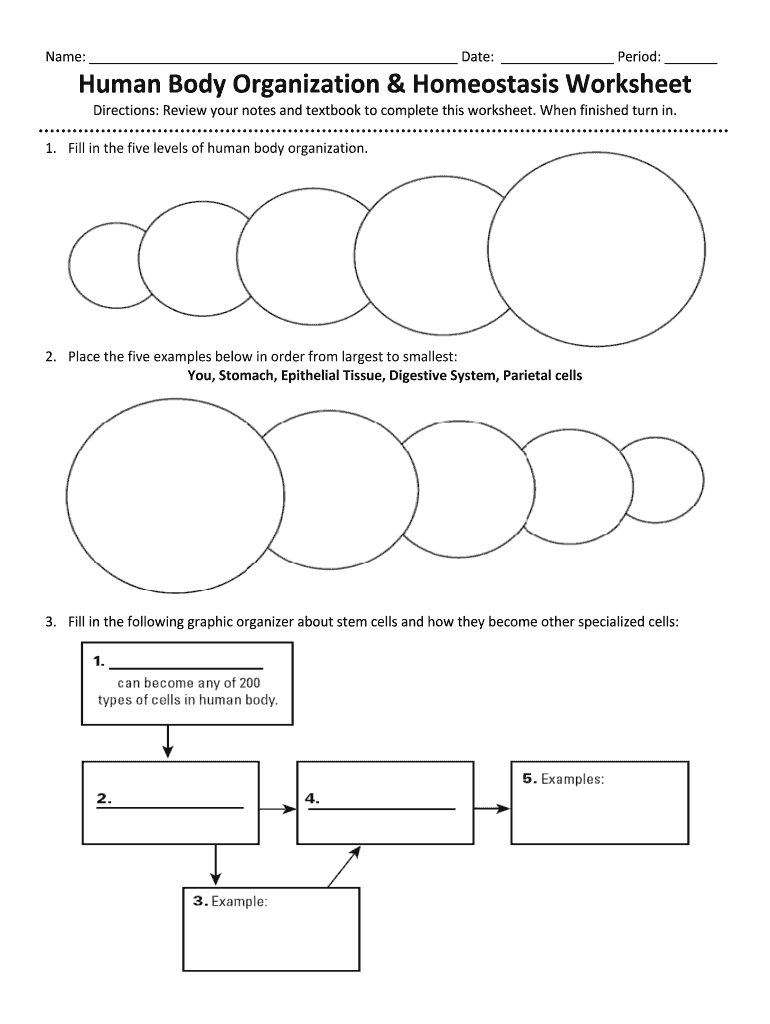
D textbook to complete this worksheet. When finished turn in. 1. Fill in the five levels of human body organization. 2. Place the five examples below in order from largest to smallest: You, Stomach, Epithelial Tissue, Digestive System, Parietal cells 3. Fill in the following graphic organizer about stem cells and how they become other specialized cells: .
Loading

Open form follow the instructions

Easily sign the form with your finger

Send filled & signed form or save
How to use or fill out the Human Body Organization and Homeostasis Worksheet online
This guide provides clear, step-by-step instructions on how to fill out the Human Body Organization and Homeostasis Worksheet online. Users can enhance their understanding of human biology by following these directions, ensuring a comprehensive completion of the document.
Follow the steps to successfully complete the worksheet online.
- Press the ‘Get Form’ button to access the worksheet and open it for editing.
- Begin with section one where you will fill in the five levels of human body organization. You may want to refer to your textbook for this information.
- In section two, arrange the provided examples (You, Stomach, Epithelial Tissue, Digestive System, Parietal Cells) in order from largest to smallest.
- Proceed to section three, where you will use the graphic organizer to explain how stem cells differentiate into specialized cells.
- For section four, label the body parts under the categories of sensor, communication system, control center, or target. Use your notes to assist you.
- In section five, accurately fill in the blanks regarding negative and positive feedback processes.
- Describe an example of thermoregulation in section six, focusing on how the body maintains temperature.
- In section seven, read the listed situations and label them as either positive (+) or negative (−) feedback.
- Once all sections are complete, review your entries for accuracy before saving your changes, downloading, printing, or sharing the form.
Complete your Human Body Organization and Homeostasis Worksheet online today!
Experience a faster way to fill out and sign forms on the web. Access the most extensive library of templates available.
Related content
Which body systems are MOST DIRECTLY interacting as a response to maintain homeostasis? A...
Feb 20, 2021 — Name the two main organ systems that communicate within the body to...
Since the human body rapidly metabolizes 1,4-dioxane to 1,4-dioxane-2-one and HEAA, the...
Get answers to your most pressing questions about US Legal Forms API.
How do the human body systems work together to maintain homeostasis?
The human body maintains stability or homeostasis through the coordinated work of all organ systems, regulated by the nervous and endocrine systems. Homeostasis involves constant adjustments to maintain a stable internal environment, with examples including the respiratory, excretory, and endocrine systems.
What body systems are involved in homeostasis?
Similarly, the cardiovascular, integumentary (skin and associated structures), respiratory, and muscular systems work together to help the body maintain a stable internal temperature. If body temperature rises, blood vessels in the skin dilate, allowing more blood to flow near the skin's surface.
Which 7 body systems are involved in homeostasis?
Some examples of organ systems in the body that are involved in homeostasis include: Cardiovascular system. Respiratory system. Integumentary system. Immune system. Nervous system. Endocrine system. Reproductive system. Skeletal system.
What is the organization of the human body and homeostasis?
All tissues of the body compose organs that comprise organ systems, which do not operate independently and must work together to achieve homeostasis. Each cell benefits from homeostatic control, and contributes to its maintenance as well, providing continuous automaticity to the body.
What are the 12 systems of the body?
They are Integumentary System, Skeletal System, Muscular System, Nervous System, Endocrine System, Cardiovascular System, Lymphatic System, Respiratory System, Digestive System, Urinary System, and Reproductive System (Female and Male).
What are the 5 body functions that monitor homeostasis?
Answer and Explanation: The five body functions that monitor homeostasis are temperature, glucose, blood pressure, toxins, and pH. Any increase in heart rate, breathing or sweating can alter the state of equilibrium.
What are the functions of the 7 body systems?
Nervous System. • Senses the outside world. ... Skeletal System. • Provides support and shape. ... Muscular System. • Allows movement. ... Circulatory System/ Cardiovascular System. • Transports nutrients and wastes. ... Respiratory System. • Gas exchange between body and air. ... Excretory System. ... Digestive System.
What is homeostasis grade 7?
The tendency to maintain a stable, relatively constant internal environment is called homeostasis. The body maintains homeostasis for many factors in addition to temperature. For instance, the concentration of various ions in your blood must be kept steady, along with pH and the concentration of glucose.
Use professional pre-built templates to fill in and sign documents online faster. Get access to thousands of forms.
If you believe that this page should be taken down, please follow our DMCA take down process here.