We use cookies to improve security, personalize the user experience, enhance our marketing activities (including cooperating with our marketing partners) and for other business use.
Click "here" to read our Cookie Policy. By clicking "Accept" you agree to the use of cookies. Read less
Read more
Accept
Loading
Form preview
  • US Legal Forms
  • Form Library
  • More Forms
  • More Multi-State Forms
  • Non-consensual Access To Electronic Communications Records

Get Non-consensual Access To Electronic Communications Records

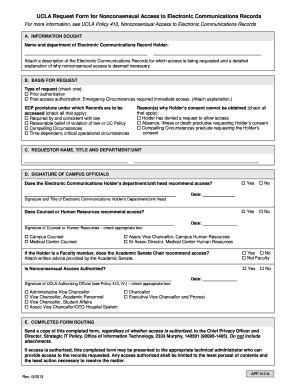
SOUGHT Name and department of Electronic Communications Record Holder: Attach a description of the Electronic Communications Records for which access is being requested and a detailed explanation of why nonconsensual access is deemed necessary. B. BASIS FOR REQUEST Type of request (check one): Prior authorization Post-access authorization: Emergency Circumstances required immediate access.

How it works

  1. Open form

    Open form follow the instructions

  2. Easily sign form

    Easily sign the form with your finger

  3. Share form

    Send filled & signed form or save

How to fill out the Non-Consensual Access To Electronic Communications Records online

This guide provides clear instructions for filling out the Non-Consensual Access To Electronic Communications Records form. It is designed to assist users in navigating the process effectively and ensuring all necessary information is properly submitted.

Follow the steps to complete the form online:

  1. Press the ‘Get Form’ button to obtain the necessary form and open it in your preferred online editor.
  2. In Section A, provide the name and department of the Electronic Communications Record Holder. Be specific and accurate in your entries.
  3. Attach a detailed description of the Electronic Communications Records for which you are requesting access. Include a thorough explanation of why this nonconsensual access is necessary.
  4. In Section B, check the type of request you are making, either ‘Prior authorization’ or ‘Post-access authorization’. If you select post-access authorization, ensure to attach an explanation detailing the emergency circumstances.
  5. Indicate which ECP provisions apply by checking all relevant boxes that justify the request for access, like law requirements or compelling circumstances.
  6. Explain why the Holder’s consent cannot be obtained by checking all applicable reasons.
  7. Proceed to Section C by entering the requestor's name, title, and department or unit information.
  8. In Section D, ensure that the Electronic Communications Holder’s department/unit head completes their response regarding access recommendation, and include their signature and date.
  9. If necessary, obtain recommendations from Counsel or Human Resources, making sure to check the correct box and provide their signature and date.
  10. If the Holder is a faculty member, enter the recommendation from the Academic Senate Chair if applicable.
  11. Finalize this section by indicating whether nonconsensual access is authorized and obtaining the signature of the UCLA Authorizing Official.
  12. In Section E, route the completed form as instructed, ensuring to send a copy to the Chief Privacy Officer and Director of Strategic IT Policy.
  13. If access is authorized, submit the completed form to the appropriate technical administrator for access to the records requested.

Complete your Non-Consensual Access To Electronic Communications Records form online today.

Get form

Experience a faster way to fill out and sign forms on the web. Access the most extensive library of templates available.
Get form

Related content

Electronic Communications Privacy Act of 1986...
The ECPA, as amended, protects wire, oral, and electronic communications while those...
Learn more
UCOP Access Without Consent Request Form
UCOP Access Without Consent Request Form. Use this form to comply with the provisions for...
Learn more
Electronic Surveillance in Communications Networks...
Aug 5, 2011 — In general, the Pen/Trap statute regulates the collection of addressing...
Learn more

Related links form

ESF Camps Chestnut Hill Summer Enrollment Application 2016 UK LABC Warranty W76D 2017 Canada FS882 - British Columbia 2008 India Form 1 Birth Report Package 2019

Questions & Answers

Get answers to your most pressing questions about US Legal Forms API.

Contact support

Many experts argue that the ECPA is somewhat outdated due to rapid technological advances. While it was groundbreaking at its inception, the changing digital landscape may demand updates to keep privacy protections robust. It's essential to stay informed about discussions on Non-Consensual Access To Electronic Communications Records to understand how your rights might evolve.

The Electronic Communications Protection Act prohibits intercepting, accessing, or sharing electronic communications without proper consent. This law aims to protect individuals from unauthorized audiences viewing their communications. For users concerned about Non-Consensual Access To Electronic Communications Records, the ECPA provides crucial legal protections.

The ECPA prohibits unauthorized access to electronic communications and the interception of those communications in transit. This means that accessing someone's emails or messages without their explicit consent is against the law. Understanding this protection is essential to safeguarding yourself from Non-Consensual Access To Electronic Communications Records.

ECPA violations often include unauthorized access to emails or texts without consent, or sharing communications without permission. For example, if an employer secretly monitors personal emails sent from a work computer, this could be a violation of ECPA. These breaches highlight the importance of understanding your rights regarding Non-Consensual Access To Electronic Communications Records.

Under the ECPA, certain actions such as law enforcement accessing communications with a valid warrant are typically allowed. Moreover, employers may access company-owned communications if they have provided notice to employees. Therefore, while ECPA protects individual privacy, it still permits exceptions under specific circumstances that respect legal protocols.

An example of an ECPA violation in the workplace involves an employer monitoring an employee’s private messages on company-provided devices without informing them. This practice is considered non-consensual access to electronic communications records and can lead to serious legal consequences for the employer. Employees should feel empowered to report such violations and seek remedies to protect their privacy.

Examples of ECPA violations include unauthorized access to archived emails, intercepting electronic communications during transmission, or accessing stored messages without consent. Each of these actions reflects non-consensual access to electronic communications records, which can significantly infringe upon individual privacy rights. Knowing these examples helps people recognize potential violations and seek appropriate legal recourse.

The statute of limitations for filing a claim under the ECPA is generally two years from the date of the violation. This time frame allows individuals to seek justice for unauthorized access to their electronic communications records. If you believe you have been a victim of non-consensual access, it’s crucial to act promptly within this period. Legal resources, such as those offered by uslegalforms, can assist you in understanding your options and filing claims.

The Electronic Communications Privacy Act (ECPA) is the federal law designed to regulate surveillance of electronic communications. This law protects your electronic communications records from non-consensual access by requiring law enforcement and other entities to obtain a warrant. Understanding the ECPA helps you recognize your rights regarding your electronic communications and data privacy. If you have concerns about non-consensual access to your records, the ECPA serves as a critical legal foundation.

An example of an ECPA violation is when someone accesses your private emails without your consent. If a person or organization waves the law and gains unauthorized entry to your electronic communications records, that action clearly falls under non-consensual access. Such violations undermine your privacy and can lead to legal repercussions for the violators. It's important to understand your rights under the Electronic Communications Privacy Act.

Get This Form Now!

Use professional pre-built templates to fill in and sign documents online faster. Get access to thousands of forms.
Get form
If you believe that this page should be taken down, please follow our DMCA take down processhere.

Industry-leading security and compliance

US Legal Forms protects your data by complying with industry-specific security standards.
  • In businnes since 1997
    25+ years providing professional legal documents.
  • Accredited business
    Guarantees that a business meets BBB accreditation standards in the US and Canada.
  • Secured by Braintree
    Validated Level 1 PCI DSS compliant payment gateway that accepts most major credit and debit card brands from across the globe.
Get Non-Consensual Access To Electronic Communications Records
Get form
Form Packages
Adoption
Bankruptcy
Contractors
Divorce
Home Sales
Employment
Identity Theft
Incorporation
Landlord Tenant
Living Trust
Name Change
Personal Planning
Small Business
Wills & Estates
Packages A-Z
Form Categories
Affidavits
Bankruptcy
Bill of Sale
Corporate - LLC
Divorce
Employment
Identity Theft
Internet Technology
Landlord Tenant
Living Wills
Name Change
Power of Attorney
Real Estate
Small Estates
Wills
All Forms
Forms A-Z
Form Library
Customer Service
Terms of Service
Privacy Notice
Legal Hub
Content Takedown Policy
Bug Bounty Program
About Us
Help Portal
Legal Resources
Blog
Affiliates
Contact Us
Delete My Account
Site Map
Industries
Forms in Spanish
Localized Forms
State-specific Forms
Forms Kit
Legal Guides
Real Estate Handbook
All Guides
Prepared for You
Notarize
Incorporation services
Our Customers
For Consumers
For Small Business
For Attorneys
Our Sites
US Legal Forms
USLegal
FormsPass
pdfFiller
signNow
altaFlow
DocHub
Instapage
Social Media
Call us now toll free:
+1 833 426 79 33
As seen in:
  • USA Today logo picture
  • CBC News logo picture
  • LA Times logo picture
  • The Washington Post logo picture
  • AP logo picture
  • Forbes logo picture
© Copyright 1997-2025
airSlate Legal Forms, Inc.
3720 Flowood Dr, Flowood, Mississippi 39232
Form Packages
Adoption
Bankruptcy
Contractors
Divorce
Home Sales
Employment
Identity Theft
Incorporation
Landlord Tenant
Living Trust
Name Change
Personal Planning
Small Business
Wills & Estates
Packages A-Z
Form Categories
Affidavits
Bankruptcy
Bill of Sale
Corporate - LLC
Divorce
Employment
Identity Theft
Internet Technology
Landlord Tenant
Living Wills
Name Change
Power of Attorney
Real Estate
Small Estates
Wills
All Forms
Forms A-Z
Form Library
Customer Service
Terms of Service
Privacy Notice
Legal Hub
Content Takedown Policy
Bug Bounty Program
About Us
Help Portal
Legal Resources
Blog
Affiliates
Contact Us
Delete My Account
Site Map
Industries
Forms in Spanish
Localized Forms
State-specific Forms
Forms Kit
Legal Guides
Real Estate Handbook
All Guides
Prepared for You
Notarize
Incorporation services
Our Customers
For Consumers
For Small Business
For Attorneys
Our Sites
US Legal Forms
USLegal
FormsPass
pdfFiller
signNow
altaFlow
DocHub
Instapage
Social Media
Call us now toll free:
+1 833 426 79 33
As seen in:
  • USA Today logo picture
  • CBC News logo picture
  • LA Times logo picture
  • The Washington Post logo picture
  • AP logo picture
  • Forbes logo picture
© Copyright 1997-2025
airSlate Legal Forms, Inc.
3720 Flowood Dr, Flowood, Mississippi 39232