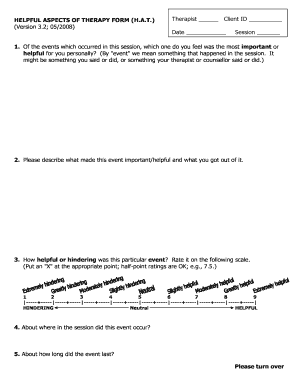
You feel was the most important or helpful for you personally? (By "event" we mean something that happened in the session. It might be something you said or did, or something your therapist or counsellor said or did.) 2. Please describe what made this event important/helpful and what you got out of it. 3. How helpful or hindering was this particular event? Rate it on the following scale. (Put an "X" at the appropriate point; half-point ratings are OK; e.g., 7.5.) 1 2 3 4 5 6 7 8 9 |-----+----.
Open form follow the instructions
Easily sign the form with your finger
Send filled & signed form or save
How to fill out the Helpful Aspects of Therapy Form online
Completing the Helpful Aspects of Therapy Form online provides an opportunity for users to reflect on their therapy sessions and the effectiveness of their experiences. This guide will walk you through the key sections of the form, ensuring you can provide meaningful input.
Follow the steps to complete the form effectively.
- Press the ‘Get Form’ button to access the Helpful Aspects of Therapy Form and open it in your preferred online editor.
- In the first field, input the therapist's name and client ID as requested. This identification will help track your therapy sessions.
- Enter the date of the session in the designated field. This helps provide a timeline for your reflections.
- Record the session number in the specified area to ensure each form corresponds to a specific session.
- Reflect on the therapy session and identify the most significant or helpful event, which could be something you expressed or a noteworthy comment from your therapist. Write it down in the provided space.
- In the next field, describe why you found this event important or helpful, as well as what you gained from it to deepen your insights.
- Evaluate how the identified event impacted you by marking 'X' on a scale from 1 to 9, where 1 indicates hindering and 9 signifies helpful. Ensure your placement reflects your true feelings.
- Specify where in the session this event occurred. This gives context to the feedback you are providing.
- Estimate the duration of the event and fill it in the designated area to indicate how long it lasted.
- Indicate whether any other helpful events occurred during the session by selecting 'YES' or 'NO'.
- If you responded 'YES', rate the helpfulness of this additional event on the scale provided and describe it briefly if necessary.
- Indicate if any events during the session were hindering, again selecting 'YES' or 'NO'.
- If you selected 'YES', rate the hindering event's impact using the scale and provide a brief description.
- Finally, save your changes, and consider downloading, printing, or sharing the completed form as needed.
Take a moment to complete your documents online today!
Experience a faster way to fill out and sign forms on the web. Access the most extensive library of templates available.
Related content
by AJ Gonzalez · 2018 · Cited by 29 — On a weekly basis, the PQ was delivered to the...
by J Nelson · 2008 — Baucom et al. ultimately identified three forms of empirically...
Sometimes a helpful therapy can precipitate real losses. For example, in an ... it still...
Get answers to your most pressing questions about US Legal Forms API.
How to get the most benefit from therapy?
To maximize the benefits of therapy, maintain open communication with your therapist. Be honest about your feelings and experiences; this transparency fosters trust and promotes progress. Actively engage in homework or exercises suggested by your therapist. The Helpful Aspects of Therapy Form can help you track your journey, ensuring you capitalize on your therapeutic efforts.
What is a short term Counselling strategy?
term counseling strategy focuses on specific issues over a limited timeframe. This approach can effectively address immediate concerns, helping clients achieve rapid progress. Techniques such as solutionfocused brief therapy and cognitivebehavioral therapy are often used. If you want to implement a helpful framework, the Helpful Aspects of Therapy Form can guide you and your counselor towards practical goals.
How do I work out what I want from therapy?
To work out what you want from therapy, take time to reflect on your life experiences, emotions, and goals. Journaling or engaging in self-assessment exercises can help you identify important themes. Involving your therapist in this exploration can enhance understanding and set a clear direction. The Helpful Aspects of Therapy Form can serve as a valuable tool in this process.
How do I answer what I want out of therapy?
Answering what you want from therapy involves introspection and honesty. Consider writing down your thoughts and feelings, which can lead to greater clarity. Discussing these reflections with your therapist can help strengthen your therapeutic alliance. The Helpful Aspects of Therapy Form can assist you in organizing your thoughts, making it easier to communicate your needs.
What do I want to get out of therapy?
Understanding what you want to gain from therapy is a powerful step toward healing. People often seek therapy to improve mental health, resolve conflicts, or gain coping strategies. Establishing personal goals can enhance your session's effectiveness. Utilizing the Helpful Aspects of Therapy Form can help outline your desired outcomes, ensuring focused discussions with your therapist.
What do I want from my therapy session?
Identifying what you want from your therapy session is crucial for effective progress. Consider any specific issues or challenges you face that you want to address. Reflecting on your feelings and experiences can guide you in clarifying your goals. By using the Helpful Aspects of Therapy Form, you can articulate your thoughts and set clear intentions for your session.
How to write a good psychotherapy note?
Writing a good psychotherapy note requires clarity, conciseness, and compliance with legal standards. Focus on documenting the helpful aspects of therapy form, including client goals, session content, and observed changes. This not only maintains accurate records but also enhances the quality of care provided to each client.
How do I sell my therapy practice?
Selling your therapy practice involves proper valuation, understanding market demand, and preparing for the transition of client relationships. It can be beneficial to highlight the helpful aspects of therapy form in your practice, making it more appealing to potential buyers. Consulting with professionals who specialize in practice sales can also provide valuable guidance.
What is the most important aspect of therapy?
The most important aspect of therapy is the relationship between therapist and client. This connection facilitates trust and openness, allowing clients to engage fully in the process. Recognizing the helpful aspects of therapy form can enhance this relationship, helping therapists understand and address client needs better.
How do I fill my therapy practice?
To fill your therapy practice, consider using various marketing strategies such as social media presence, community workshops, and networking with healthcare professionals. It is essential to communicate the helpful aspects of therapy form clearly to attract clients. Additionally, leveraging testimonials and maintaining an informative website can effectively draw in prospective clients.
Use professional pre-built templates to fill in and sign documents online faster. Get access to thousands of forms.
If you believe that this page should be taken down, please follow our DMCA take down process here.