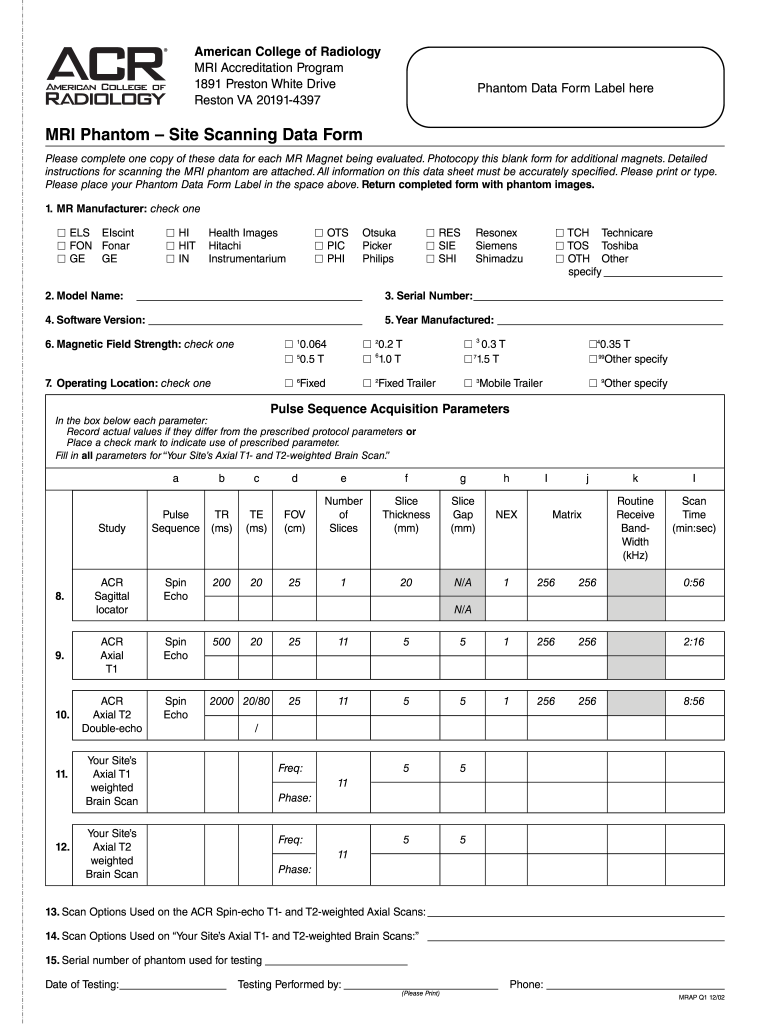
these data for each MR Magnet being evaluated. Photocopy this blank form for additional magnets. Detailed instructions for scanning the MRI phantom are attached. All information on this data sheet must be accurately specified. Please print or type. Please place your Phantom Data Form Label in the space above. Return completed form with phantom images. 1. MR Manufacturer: check one ELS EIscint FON Fonar GE GE 2. Model Name: HI HIT IN Health Images Hitachi Instrumentarium OTS PIC PHI Otsuka P.

Open form follow the instructions

Easily sign the form with your finger

Send filled & signed form or save
How to fill out the ACR MRAP Q1 online
The ACR MRAP Q1 form is essential for submitting data related to MRI phantom testing. This guide provides clear, step-by-step instructions to help users complete the form accurately and efficiently online.
Follow the steps to complete the ACR MRAP Q1 form accurately.
- Click ‘Get Form’ button to access the document and open it for editing.
- Begin by filling in the MR Manufacturer section. Select the appropriate manufacturer from the list provided, including companies such as GE, Siemens, or Fonar.
- Next, input the Model Name of the MRI system you are evaluating. Be sure to specify the exact model for accurate record-keeping.
- In the Serial Number field, enter the unique serial number associated with the MRI magnet.
- For the Software Version, provide the version number of the software currently installed on the MRI machine.
- Indicate the Year Manufactured by entering the year the MRI machine was produced.
- Specify the Magnetic Field Strength by selecting one of the options available. Ensure that you review the range of strengths from 0.064 T to other specified strengths.
- Fill in the Operating Location by indicating whether the magnet is fixed or mobile, selecting from the provided options.
- Complete the Pulse Sequence Acquisition Parameters section. Record the values for TR, TE, and other parameters related to the specified scans.
- In the Scan Options Used section, document any specific options that were utilized during your scans.
- Enter the Serial number of the phantom used for testing in the designated area.
- Finally, fill in the Date of Testing and the information of the person performing the testing. This includes their name and contact number.
- Once all fields are completed, review your entries for accuracy. You can then save changes, download, print, or share the form as needed.
Start filling out the ACR MRAP Q1 form online to ensure your MRI accreditation process is seamless.
Experience a faster way to fill out and sign forms on the web. Access the most extensive library of templates available.
Related content
The Annual State of the Reservation Report describes the nature and extent of military...
4257 genes with high or low expression in c2c12 relative to other cell types and tissues...
Get answers to your most pressing questions about US Legal Forms API.
Which substances are contained in the ACR phantom fluid?
The ACR phantom fluid consists of various substances that mimic human tissue characteristics, including water, gelatin, and specific contrast agents. These materials replicate the behavior of biological tissues under MRI scanning, enabling effective testing. By using the right substances, the ACR phantom fluid enhances the realism of the imaging process, supporting high-quality diagnostics.
What is a phantom ACR?
A phantom ACR refers to a standard tool used to test and improve MRI technologies according to the guidelines established by the American College of Radiology. These phantoms provide controlled conditions for assessing system accuracy and performance. By regularly utilizing a phantom ACR, facilities can ensure their imaging practices align with the best industry standards.
What is ACR in MRI?
ACR in MRI stands for the American College of Radiology, an organization dedicated to improving medical imaging standards. The ACR sets guidelines and provides accreditation for MRI facilities, ensuring they meet high-quality standards. By adhering to these guidelines, medical providers can enhance diagnostic accuracy, benefiting both doctors and patients.
What is the ACR phantom used to simulate?
The ACR phantom simulates various types of human tissue to support MRI technology. This allows for precise calibration while ensuring that the imaging system provides realistic results. By mimicking different tissue characteristics, the ACR phantom helps improve the overall quality and reliability of MRI scans.
How big is the ACR MRI Phantom?
The ACR MRI Phantom typically measures around 30 centimeters in diameter and is designed to fit standard MRI machines. Its dimensions allow it to replicate human anatomy while facilitating easy usage in clinical settings. The compact size ensures that it can be easily handled while still providing accurate results during testing.
What does an MRI phantom do?
An MRI phantom serves as a standard reference tool for magnetic resonance imaging. It mimics human tissue, enabling technicians to calibrate machines and ensure consistency in imaging. Using an MRI phantom, operators can assess image quality, improve performance, and enhance diagnostic accuracy, all of which contribute to more reliable patient outcomes.
What is an ACR phantom?
An ACR phantom is a specially designed object used in MRI testing to simulate human tissue or other imaging conditions. It plays a critical role in quality assurance and enables radiology facilities to ensure compliance with ACR standards. Utilizing an ACR phantom that meets the ACR MRAP Q1 criteria can elevate the standard of care in your imaging practice.
How much does the ACR MRI Phantom weigh?
The weight of the ACR MRI Phantom often depends on its design, but most models weight between 10 to 30 pounds. This weight is ideal for ease of handling while ensuring it provides accurate results during scans. Selecting the right ACR MRI Phantom, especially those adhering to ACR MRAP Q1 standards, can ensure reliable imaging outcomes.
What is an ACR process?
The ACR process refers to the steps your facility must follow to gain accreditation from the American College of Radiology. This process typically involves submitting applications, meeting quality standards, and undergoing evaluations. Engaging with resources related to ACR MRAP Q1 can significantly enhance your chances of a successful accreditation.
How long does it take to get ACR accreditation?
The time it takes to obtain ACR accreditation can range from a few weeks to several months, depending on your facility’s current practices and readiness. The process involves meeting specific standards, submitting documentation, and potentially undergoing an inspection. Having a clear plan and ensuring compliance with ACR MRAP Q1 can streamline this journey.
Use professional pre-built templates to fill in and sign documents online faster. Get access to thousands of forms.
If you believe that this page should be taken down, please follow our DMCA take down process here.