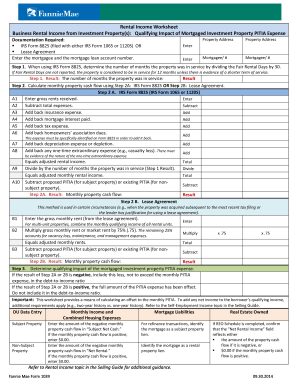
Ress Documentation Required: IRS Form 8825 (filed with either IRS Form 1065 or 1120S) OR Lease Agreement Enter the mortgagee and the mortgage loan account number. Property Address Mortgagee/ # Mortgagee/ # Enter Enter Step 1. When using IRS Form 8825, determine the number of months the property was in service by dividing the Fair Rental Days by 30. If Fair Rental Days are not reported, the property is considered to be in service for 12 months unless there is evidence of a shorter t.
Open form follow the instructions
Easily sign the form with your finger
Send filled & signed form or save
How to fill out the Fannie Mae 1039 online
The Fannie Mae 1039 is a crucial document used to assess rental income from investment properties. This guide will walk you through the steps required to accurately complete this form online, ensuring clarity and ease in your filing process.
Follow the steps to successfully complete the Fannie Mae 1039 online.
- Click 'Get Form' button to obtain the form and open it in the editor.
- Enter the property address and the details of the mortgagee and mortgage loan account number for all relevant investment properties.
- If you are using IRS Form 8825, determine the number of months the property was in service by dividing the Fair Rental Days by 30. If Fair Rental Days are not reported, assume the property is in service for 12 months unless evidence suggests otherwise.
- Calculate the monthly property cash flow using either Step 2A (IRS Form 8825) or Step 2B (Lease Agreement). For Step 2A, proceed by entering the gross rents received, total expenses, and various adjustments (such as insurance and mortgage interest). The final result will yield the adjusted monthly rental income after subtracting PITIA expenses.
- For Step 2B using a Lease Agreement, enter the gross monthly rent, adjust for vacancy loss, and then subtract the proposed PITIA for the property.
- Determine the qualifying impact of the mortgaged investment property PITIA expense by assessing whether the result from Step 2A or 2B is positive or negative. Use these values in your debt-to-income ratio calculations accordingly.
- Finalize any necessary entries in DU data entry fields for the monthly income and mortgage liabilities for both the subject and non-subject properties.
- Review all entries for accuracy, and save changes. Download, print, or share the completed Fannie Mae 1039 form as needed.
Complete your Fannie Mae 1039 online today for a seamless rental income assessment.
Experience a faster way to fill out and sign forms on the web. Access the most extensive library of templates available.
Related content
Fannie Mae. 986. 1,018. 1,077. 1,050. 1,040. 1,118. Freddie Mac. 904. 914. 1,039. 1,029...
by D Reiss · 2008 · Cited by 101 — In particular, it proposes that Fannie and Freddie...
This packet contains: • Instructions for completing the. Form 511: Oklahoma resident...
Get answers to your most pressing questions about US Legal Forms API.
How to prove rental income for a mortgage?
To prove rental income for a mortgage under Fannie Mae 1039, you need to document actual lease agreements and provide copies of your previous tax returns showing rental income. Additionally, bank statements reflecting these deposits will further support your claims. Using the US Legal Forms platform can streamline this process, ensuring you have the right documentation in place.
How do I self-report to Fannie Mae?
Self-reporting to Fannie Mae 1039 involves formally submitting relevant financial information and disclosures directly to them. This process can include providing income documentation or updates on your financial health. It’s essential to keep thorough records and ensure that your submission is accurate and complete to avoid potential issues.
What is the maximum debt to income for Fannie Mae?
The maximum debt-to-income (DTI) ratio for Fannie Mae 1039 is generally set at 43%. This ratio is critical in determining your ability to manage monthly payments. However, special circumstances can sometimes allow for a higher DTI, especially if you have substantial reserves or strong creditworthiness.
What tax returns are required for Fannie Mae?
For Fannie Mae 1039, borrowers must provide at least two years of personal tax returns to demonstrate their financial stability. This documentation includes all attached schedules and forms. If you are self-employed or have complex financial situations, more extensive tax documentation may be necessary, so prepare accordingly.
What is the Fannie flip rule?
The Fannie flip rule applies to properties that are resold within a short period. Generally, Fannie Mae 1039 establishes a timeframe of less than 90 days, during which buyers may face restrictions on financing. This rule aims to prevent property flipping that could artificially inflate market prices and protect consumers.
What is an acceptable source of down payment Fannie Mae?
An acceptable source of down payment for Fannie Mae 1039 includes personal savings, gifts from family members, and funds from a retirement account. To qualify, the source must be properly documented, ensuring that it is verifiable. Additionally, Fannie Mae allows down payment assistance programs in some cases, which can further help buyers secure their funds.
How to calculate net rental income?
Net rental income is calculated by subtracting all operating expenses associated with the rental property from the gross rental income. This includes costs such as property management fees, maintenance, taxes, and insurance. For Fannie Mae 1039 transactions, it's vital to clearly document these expenses, ensuring transparency and accuracy when presenting your financial situation to lenders.
How do you calculate rental income for a mortgage?
To calculate rental income for a mortgage, first, determine the total rental amount received from your properties over a specific period, typically a year. Then, you can consider factors such as vacancy rates and operating expenses to provide an accurate determination. Remember, when applying to Fannie Mae 1039, they may require you to show consistent rental income documentation to support your mortgage application.
What does it mean when a property is a Fannie Mae property?
A Fannie Mae property refers to homes that have been acquired by Fannie Mae due to foreclosure. The organization manages these properties to sell them to buyers, often through the HomePath program. Understanding that these properties are typically sold as-is can help you prepare for the buying process. Utilizing resources like UsLegalForms can provide valuable guidance when navigating the complexities of a Fannie Mae 1039 property.
What are the rules for 1031 exchange in Fannie Mae?
A 1031 exchange allows investors to defer capital gains taxes by reinvesting in similar properties. When dealing with Fannie Mae properties, specific rules must be followed to qualify for the exchange. It's crucial to follow IRS regulations and consult with a tax advisor to ensure compliance while navigating the complexities associated with a Fannie Mae 1039 transaction.
Use professional pre-built templates to fill in and sign documents online faster. Get access to thousands of forms.
If you believe that this page should be taken down, please follow our DMCA take down process here.