
Open form follow the instructions

Easily sign the form with your finger

Send filled & signed form or save
How to fill out the Canada Form 56.10A online
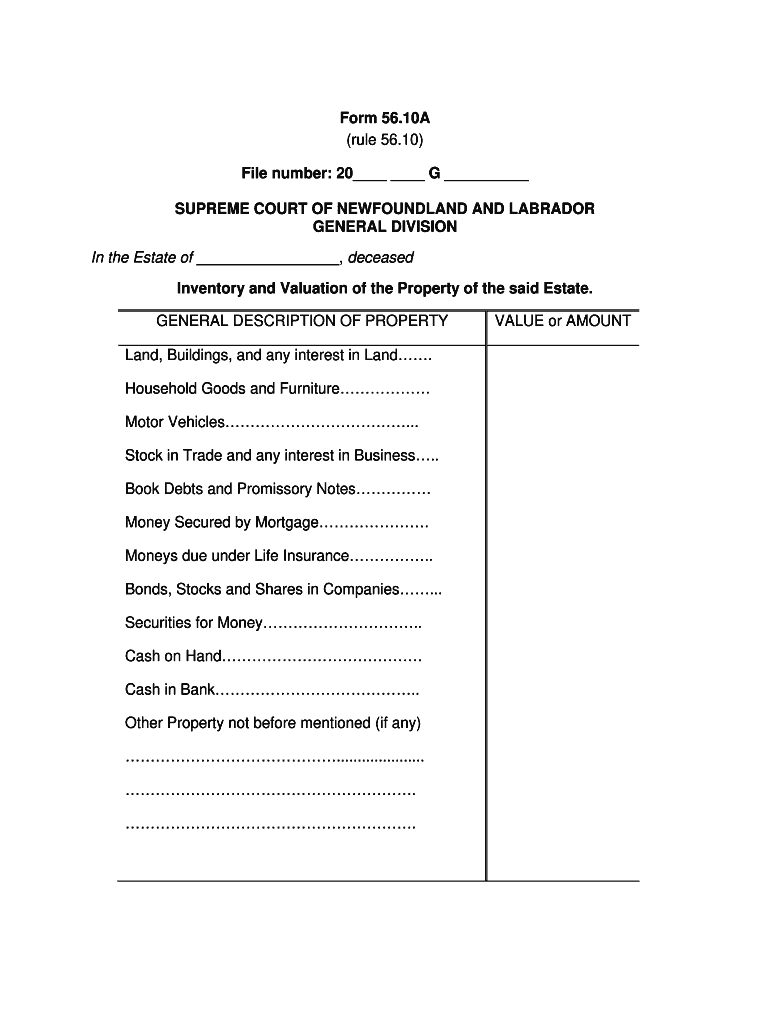
Completing the Canada Form 56.10A online is an essential task for managing the inventory and valuation of an estate. This guide provides you with clear and detailed instructions on how to accurately fill out the form to ensure compliance with legal requirements.
Follow the steps to fill out the Canada Form 56.10A effectively.
- Press the ‘Get Form’ button to access the form and open it in your digital editor.
- In the section labeled 'File number', enter the unique identifier assigned to the estate you are handling. This number is crucial for record-keeping.
- In the title 'In the Estate of _________________, deceased', fill in the name of the deceased individual whose property you are inventorying.
- Proceed to the 'General Description of Property' section. Here, list all relevant assets including: land, buildings, household goods, motor vehicles, and any interests related to a business. Be thorough and accurate in your descriptions.
- Next to each category, input the corresponding value or amount. For example, under 'Household Goods and Furniture', specify the estimated worth of these items.
- Once you have filled out all categories for each asset, ensure that you also add any other property not previously mentioned in the designated space provided.
- In the declaration section, fill in your name and relationship to the deceased. Acknowledge the accuracy of your inventory and valuation by affirming it is true to the best of your knowledge.
- Complete the oath or affirmation details which include the city or town, province, or country where you are swearing, along with the date.
- Lastly, make sure both you and the commissioner or notary public sign the declaration to validate the document.
- After filling out the form, save your changes, and choose an option to download, print, or share the completed form as necessary.
Complete your Canada Form 56.10A online today to ensure a seamless estate management process.
Experience a faster way to fill out and sign forms on the web. Access the most extensive library of templates available.
Related content
Section 56.10 of the Civil Code is amended to read: 56.10. (a) No provider of health care...
by L Determann · 2020 · Cited by 48 — The General Data Protection. Regulation...
56.21 How application for service may be made; conditions of service. 56.22 Filing of...
Get answers to your most pressing questions about US Legal Forms API.
How much are probate fees in Ontario for $1,000,000?
Value of EstateProbate Fee $50,000 $250 $100,000 $1,000 $500,000 $7,000 $1,000,000 $14,5002 more rows
How much are probate fees in Canada?
ing to the Estate Administration Tax Act of Ontario, there is no probate fee for estates with assets up to and including $50,000. For estates valued at more than $50,000, tax is charged at a rate of 1.5%, so $15 for each $1,000 of the estate's value.
What is probate fee in Canada?
Probate fees in Canada by province ProvinceProbate fees on $1 millionProbate fees on $2 million Alberta $525 $525 Saskatchewan $7,000 $14,000 Manitoba $0 $0 Ontario $14,250 $29,2509 more rows
Can a bank release funds without probate in Canada?
Although probate is not compulsory except in very specific cases, most financial institutions require probate before they will release a deceased person's assets because it assures the institution that it is handing over the deceased's assets to the person who is lawfully entitled to receive them.
How can I avoid probate fees in Canada?
Getting a will helps your estate better avoid probate. Avoiding probate saves time, reduces fees, and protects your estate's privacy. Strategies to avoid probate and probate fees include making a will, joint ownership, naming beneficiaries, early inheritances, and creating a trust.
Do all wills in Canada have to be probated?
Do All Wills Go Through Probate? Not all wills go through probate. In some situations, the executor named in the will can administer a deceased person's estate without the need for a probate application.
How do I avoid probate tax in Canada?
FOUR WAYS TO AVOID PROBATE GET RID OF ALL OF YOUR PROPERTY. ... USE JOINT OWNERSHIP WITH RIGHTS OF SURVIVORSHIP OR TENANCY BY THE ENTIRETY. ... USE BENEFICIARY DESIGNATIONS. ... USE A ALTER EGO TRUST.
How much does an estate have to be worth to go to probate in Canada?
For estates valued above $50,000, the standard probate process applies. The probate fees (officially known as the Estate Administration Tax) are calculated based on the total value of the estate's assets.
Use professional pre-built templates to fill in and sign documents online faster. Get access to thousands of forms.
If you believe that this page should be taken down, please follow our DMCA take down process here.