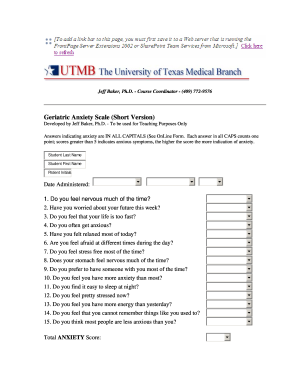
Jeff Baker Ph. D. - Course Coordinator - 409 772-9576 Geriatric Anxiety Scale Short Version Developed by Jeff Baker Ph. D. - To be used for Teaching Purposes Only Answers indicating anxiety are IN ALL CAPITALS See OnLine Form* Each answer in all CAPS counts one point scores greater than 5 indicates anxious symptoms the higher the score the more indication of anxiety. Student Last Name Student First Name Patient Initials Date Administered 1. Do you feel nervous much of the time 2. Have you worried about your future this week 3. Do you feel that your life is too fast 4. Do you often get anxious 5. Have you felt relaxed most of today 6. Are you feel afraid at different times during the day 7. Do you feel stress free most of the time 8. Does your stomach feel nervous much of the time 9. Do you prefer to have someone with you most of the time 10. Do you feel you have more anxiety than most 11. Do you find it easy to sleep at night 12. Do you feel pretty stressed now 15. D. - To be used for ....
Open form follow the instructions
Easily sign the form with your finger
Send filled & signed form or save
How to fill out the UTMB Geriatric Anxiety Scale (Short Version) online
Filling out the UTMB Geriatric Anxiety Scale (Short Version) online is a straightforward process designed to assess anxiety levels for educational purposes. This guide provides clear, step-by-step instructions to help users complete the form accurately and effectively.
Follow the steps to successfully complete the form.
- Press the ‘Get Form’ button to access the document and open it in your chosen editor.
- Begin with the identification section by filling in your details: start with the student's last name, followed by the student's first name and patient initials. Ensure that the information is accurate for proper record-keeping.
- Enter the date the form is being administered. This date will help contextualize the responses and track any changes over time.
- Proceed to the questions listed on the form. Answer each question by indicating your response using capital letters. For example, if your answer is 'Yes,' you would write 'YES' in all caps. Each capitalized answer counts as one point toward your total anxiety score.
- After completing all the questions, calculate your total anxiety score by counting the number of questions answered in capital letters. A score greater than 5 indicates the presence of anxious symptoms, with higher scores reflecting greater anxiety.
- Review your filled-out form for accuracy, ensuring all responses are completed and legible.
- Once you are satisfied with the content, you can save your changes, download a copy for your records, print the document, or share it as needed.
Start filling out the UTMB Geriatric Anxiety Scale online today to assist in identifying anxiety levels.
Experience a faster way to fill out and sign forms on the web. Access the most extensive library of templates available.
Related content
by GV Ostir · 2006 · Cited by 62 — For the current study the anxiety scale was used as...
Assessment Documents · Folstein Mini Mental Status Exam · Neuro Mental Status Exam ·...
by DS Jones · 2009 · Cited by 1 — The document you are about to read emerged from a...
Get answers to your most pressing questions about US Legal Forms API.
How is the anxiety about aging scale scored?
The anxiety about aging scale is scored by calculating the total points from an individual’s responses. This score provides insights into their concerns regarding aging. Integrating the UTMB Geriatric Anxiety Scale (Short Version) can further enrich the evaluation, giving a more detailed perspective on an older adult's anxiety related to aging.
How do you score an anxiety scale?
Scoring an anxiety scale involves summing up the responses given for each item. The total score can then be compared against established clinical standards. Utilizing the UTMB Geriatric Anxiety Scale (Short Version) enhances this process, as it is specifically calibrated for older adults and offers clear scoring metrics.
What are the cutoffs for geriatric anxiety inventory?
Cutoffs for a geriatric anxiety inventory vary, but they generally serve as benchmarks to indicate the severity of anxiety. With the UTMB Geriatric Anxiety Scale (Short Version), practitioners can utilize established cutoff scores to determine whether further assessment or intervention is necessary.
How to score a geriatric anxiety scale?
To score a geriatric anxiety scale, first, tally the responses to each question, typically rating them based on severity. The UTMB Geriatric Anxiety Scale (Short Version) makes this process straightforward, offering clear guidelines for interpreting the total score, which can then inform treatment options.
What is the Ageing Anxiety Scale?
The Ageing Anxiety Scale evaluates an individual's worries and fears related to aging. It helps identify specific areas of concern that may affect mental health. Using tools like the UTMB Geriatric Anxiety Scale (Short Version) can provide a more nuanced understanding of aging-related anxieties for seniors.
What are the short anxiety scales?
Short anxiety scales provide quick assessments of anxiety levels, enabling efficient evaluations without overwhelming the respondent. The UTMB Geriatric Anxiety Scale (Short Version) is an excellent example, designed specifically for older adults, ensuring its relevance and effectiveness in understanding their unique anxieties.
How is the geriatric depression scale scored?
The geriatric depression scale is scored by totaling the responses to each item, which typically range from 0 to 1. Higher scores indicate more severe depressive symptoms. For optimal assessment, consider using the UTMB Geriatric Anxiety Scale (Short Version) alongside the depression scale to gain a more comprehensive understanding of an older individual's mental health.
What is the GAD-7 scale for anxiety?
The GAD-7 is a widely used scale to assess generalized anxiety disorder through seven specific questions. While it is effective for many, the UTMB Geriatric Anxiety Scale (Short Version) is uniquely tailored to meet the needs of older adults. This allows for a more targeted assessment of concerns specific to that age group. Choosing the right scale can make a significant difference in understanding and addressing patient needs.
Which scale is used for anxiety?
Several scales are used for measuring anxiety, but the UTMB Geriatric Anxiety Scale (Short Version) stands out for older adults. This scale provides a reliable way to assess anxiety levels and identifies possible mental health issues among seniors. Using this scale allows healthcare providers to focus on the unique needs of the geriatric population. It ensures that interventions are both effective and relevant.
What is the anxiety scale?
An anxiety scale measures the severity or presence of anxiety symptoms. The UTMB Geriatric Anxiety Scale (Short Version) is an effective tool utilized to gauge anxiety in older adults, taking into account their unique experiences. This scale categorizes anxiety into various levels, helping professionals identify those who may require further evaluation or support. Accurate measurement is essential for appropriate intervention.
Use professional pre-built templates to fill in and sign documents online faster. Get access to thousands of forms.
If you believe that this page should be taken down, please follow our DMCA take down process here.