Loading
Form preview
  • US Legal Forms
  • Form Library
  • Industry Forms
  • Industry Academic Forms
  • Mccsc Threat Assessment And Response Protocol 2016

Get Mccsc Threat Assessment And Response Protocol 2016-2026

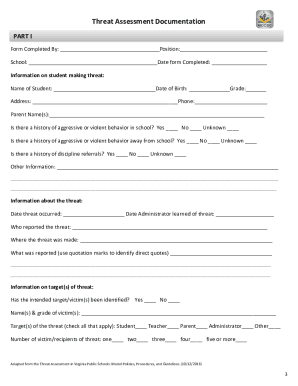
Intent to harm someone that may be spoken, gestured, or communicated in some other form, such as via text messaging, email, or other electronic means. An expression of intent to harm someone is considered a threat regardless of whether it is communicated to the intended victim(s) and regardless of whether the intended victim is aware of the threat. This protocol does NOT address threats to damage property, threats made by non-students, fights with no threat, or verbiage such as slurs, insults, o.

How it works

  1. Open form

    Open form follow the instructions

  2. Easily sign form

    Easily sign the form with your finger

  3. Share form

    Send filled & signed form or save

How to fill out the MCCSC Threat Assessment and Response Protocol online

Filling out the MCCSC Threat Assessment and Response Protocol online is an important step in ensuring the safety and well-being of students and staff. This guide will provide you with clear, step-by-step instructions on how to effectively complete the form and address any potential threats in a supportive and structured manner.

Follow the steps to complete the protocol effectively.

  1. Click the 'Get Form' button to obtain the MCCSC Threat Assessment and Response Protocol and open it in your preferred editor.
  2. Begin filling out Part I by entering your name, position, the school name, and the date the form is completed.
  3. In the section for information on the student making the threat, fill in the student's name, date of birth, grade, address, and phone number. Include the names of parents or guardians.
  4. Indicate if the student has a history of aggressive or violent behavior, both in and out of school, as well as any history of discipline referrals.
  5. Once you gather information about the threat, complete the section detailing the date the threat occurred, the date the administrator learned of it, and who reported it.
  6. Document where the threat was made and provide a direct quote if applicable, capturing the essence of the threat accurately.
  7. Collect information about the target(s) of the threat, confirming if they have been identified and providing their names and grades.
  8. Fill out Part II by conducting interviews with the student who made the threat, witnesses, and recipients of the threat, recording exact quotes and relevant details.
  9. Analyze the findings in Part III, addressing the motives and goals of the student, as well as any potential indicators of violence.
  10. In Part IV, assess the level of threat based on your evaluation, marking it as transient, substantive-serious, or substantive-very serious.
  11. Complete Part V by following the prescribed responses based on the assessed level of threat, detailing appropriate actions taken.
  12. Ensure all sections are thoroughly reviewed, make necessary revisions, and submit the completed form.

Complete the MCCSC Threat Assessment and Response Protocol online to ensure a safe and supportive environment for everyone.

Get form

Experience a faster way to fill out and sign forms on the web. Access the most extensive library of templates available.
Get form

Related content

Appendix A: Model Program for the State School ...
A comprehensive environmental assessment protocol (areas of assessment include: energy...
Learn more
Monroe County Community School Corporation...
We provide explicit instruction through small group and individual intervention...
Learn more

Related links form

Smartsvn 7 Manual Form Winprop Mimo Form Chemical Information Profile For O Phthalaldehyde Ncptl Form

Questions & Answers

Get answers to your most pressing questions about US Legal Forms API.

Contact support

Typically, a threat assessment is conducted by a team including school officials and mental health professionals. By following the MCCSC Threat Assessment and Response Protocol, these individuals ensure a comprehensive evaluation of the situation. Their collaborative effort helps identify risks and develop interventions, creating a safer educational environment for all students.

Creating a threat assessment involves gathering data about the individual or situation, analyzing their behavior, and assessing risk factors. Schools should follow the MCCSC Threat Assessment and Response Protocol, which provides a structured method for documenting findings and implementing actions. With a clear process in place, teams can effectively manage potential threats and support student safety.

Threat assessments can be conducted by trained professionals, such as school counselors, psychologists, or law enforcement officials. Importantly, these individuals should be familiar with the MCCSC Threat Assessment and Response Protocol to ensure effective evaluation and intervention. Collaboration among team members enhances the quality and reliability of the assessment.

Threat assessment involves a systematic process of identifying, evaluating, and managing potential threats. Using the MCCSC Threat Assessment and Response Protocol, the school team collects information, assesses the severity of the threat, and determines appropriate actions to address it. This thorough approach helps protect students and staff while fostering a culture of safety.

A threat assessment specialist is a trained professional who evaluates situations to determine the risk of violence or other harmful behaviors. They play a crucial role in implementing the MCCSC Threat Assessment and Response Protocol, guiding schools through assessments and providing insights on prevention strategies. Their expertise helps ensure that the school maintains a safe and supportive environment for all students.

The members of a school threat assessment team typically include administrators, school counselors, teachers, and law enforcement personnel. This diverse team brings different perspectives and expertise to the process. Together, they work efficiently under the MCCSC Threat Assessment and Response Protocol to identify and mitigate potential threats in a school environment.

The threat assessment process in schools aims to evaluate and address potential threats to safety. Under the MCCSC Threat Assessment and Response Protocol, school staff work together to identify concerning behaviors, assess risk factors, and determine appropriate interventions. This collaborative effort promotes a safer learning environment for all students and staff.

The four steps of the threat assessment process include identifying the threat, assessing the risk, developing a response, and monitoring the outcomes. Following the MCCSC Threat Assessment and Response Protocol allows schools to carry out these steps efficiently and effectively. This structured approach helps ensure that threats are taken seriously and addressed in a timely manner.

The comprehensive school threat assessment guidelines, or CSTAG, provide a framework for schools to assess and manage potential threats effectively. The MCCSC Threat Assessment and Response Protocol aligns with CSTAG principles by offering clear steps for evaluation, intervention, and follow-up. This comprehensive approach emphasizes the importance of teamwork among school personnel, law enforcement, and mental health professionals to ensure safety.

The threat assessment protocol involves a systematic process designed to evaluate threats and determine appropriate responses. Under the MCCSC Threat Assessment and Response Protocol, a team assesses the reported threats, gathers data, and collaborates with relevant authorities. This structured approach facilitates timely interventions and promotes a collaborative safety effort within schools.

Get This Form Now!

Use professional pre-built templates to fill in and sign documents online faster. Get access to thousands of forms.
Get form
If you believe that this page should be taken down, please follow our DMCA take down processhere.
Get MCCSC Threat Assessment and Response Protocol
Get form
  • Adoption
  • Bankruptcy
  • Contractors
  • Divorce
  • Home Sales
  • Employment
  • Identity Theft
  • Incorporation
  • Landlord Tenant
  • Living Trust
  • Name Change
  • Personal Planning
  • Small Business
  • Wills & Estates
  • Packages A-Z
  • Affidavits
  • Bankruptcy
  • Bill of Sale
  • Corporate - LLC
  • Divorce
  • Employment
  • Identity Theft
  • Internet Technology
  • Landlord Tenant
  • Living Wills
  • Name Change
  • Power of Attorney
  • Real Estate
  • Small Estates
  • Wills
  • All Forms
  • Forms A-Z
  • Form Library
  • Legal Hub
  • About Us
  • Help Portal
  • Legal Resources
  • Blog
  • Affiliates
  • Contact Us
  • Delete My Account
  • Site Map
  • Industries
  • Forms in Spanish
  • Localized Forms
  • State-specific Forms
  • Forms Kit
  • Real Estate Handbook
  • All Guides
  • Notarize
  • Incorporation services
  • For Consumers
  • For Small Business
  • For Attorneys
  • USLegal
  • FormsPass
  • pdfFiller
  • signNow
  • altaFlow
  • DocHub
  • Instapage
Form Packages
  • Adoption
  • Bankruptcy
  • Contractors
  • Divorce
  • Home Sales
  • Employment
  • Identity Theft
  • Incorporation
  • Landlord Tenant
  • Living Trust
  • Name Change
  • Personal Planning
  • Small Business
  • Wills & Estates
  • Packages A-Z
Form Categories
  • Affidavits
  • Bankruptcy
  • Bill of Sale
  • Corporate - LLC
  • Divorce
  • Employment
  • Identity Theft
  • Internet Technology
  • Landlord Tenant
  • Living Wills
  • Name Change
  • Power of Attorney
  • Real Estate
  • Small Estates
  • Wills
  • All Forms
  • Forms A-Z
  • Form Library
Customer Service
  • Legal Hub
  • About Us
  • Help Portal
  • Legal Resources
  • Blog
  • Affiliates
  • Contact Us
  • Delete My Account
  • Site Map
  • Industries
  • Forms in Spanish
  • Localized Forms
  • State-specific Forms
  • Forms Kit
Legal Guides
  • Real Estate Handbook
  • All Guides
Prepared for you
  • Notarize
  • Incorporation services
Our Customers
  • For Consumers
  • For Small Business
  • For Attorneys
Our Sites
  • USLegal
  • FormsPass
  • pdfFiller
  • signNow
  • altaFlow
  • DocHub
  • Instapage
Social Media
Call us now toll free:
+1 833 426 79 33
As seen in:
© Copyright 1999-2026 airSlate Legal Forms, Inc. 3720 Flowood Dr, Flowood, Mississippi 39232
  • Your Privacy Choices
  • Terms of Service
  • Privacy Notice
  • Content Takedown Policy
  • Bug Bounty Program