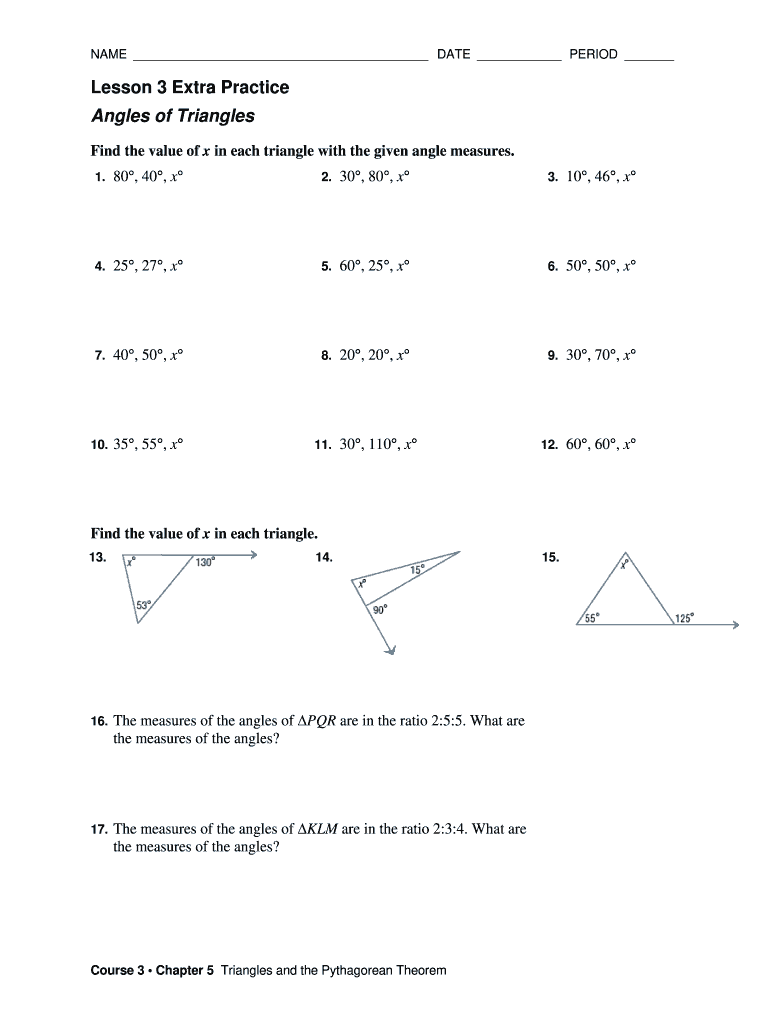
NAME DATE PERIOD Lesson 3 Extra Practice Angles of Triangles Find the value of x in each triangle with the given angle measures. 1. 80, 40, x 60 2. 30, 80, x 70 3. 10, 46, x 124 4. 25, 27, x 128 5.
Loading

Open form follow the instructions

Easily sign the form with your finger

Send filled & signed form or save
How to fill out the Lesson 3 Extra Practice Angles of Triangles online
This guide aims to provide detailed, step-by-step instructions on how to effectively fill out the Lesson 3 Extra Practice Angles of Triangles form online. With this support, users can navigate the process with clarity and confidence.
Follow the steps to complete your online form
- Click the ‘Get Form’ button to access the form and launch it in your online editor.
- Begin by entering your name in the designated NAME field at the top of the form. Ensure you input your full name clearly for record-keeping purposes.
- Next, input the DATE in the specified field. Use the format provided or ensure the date is understandable and appropriately formatted.
- Proceed to the PERIOD section. Enter your class period or any relevant designation that identifies the context for this form.
- Focus on the angle problems listed numbered from 1 to 12. For each triangle, calculate the value of x based on the provided angle measures. Write your answers clearly in the x° fields next to each problem.
- Continue working through problems 13 to 16, ensuring to solve for x and any angle measures in ratio forms as described.
- Once all sections have been accurately completed, review your entries for any errors or omissions.
- You are now ready to save your work, download, print, or share the completed form as needed.
Complete your Lesson 3 Extra Practice Angles of Triangles form online today!
Experience a faster way to fill out and sign forms on the web. Access the most extensive library of templates available.
Related content
In this lesson, students will use facts about the angle sum and exterior angles of...
In Exercises 1 and 2, determine which of the two acute angles has the given trigonometric...
Solve problems involving the measures of sides and angles in right triangles in real life...
Get answers to your most pressing questions about US Legal Forms API.
How do you find the extra angle of a triangle?
To find the extra angle of a triangle, you first determine the sum of the known angles. Then, use the angle sum property, which indicates that triangles always total 180 degrees. Simply subtract the total of the known angles from 180 degrees to find the extra angle. This method is an essential skill you will practice with our Lesson 3 Extra Practice Angles of Triangles.
What is the sum of the angles in a triangle lesson note?
In a triangle lesson note, it is important to highlight that the sum of the angles in any triangle is 180 degrees. This note serves as a quick reference for students as they study various triangles. Reinforcing this point throughout lessons will help solidify the key concepts found in our Lesson 3 Extra Practice Angles of Triangles. Such consistent reminders aid in achieving mastery.
What is the exterior angle of a triangle lesson?
The exterior angle of a triangle is formed when one side of the triangle extends beyond the vertex. It is always equal to the sum of the two opposite interior angles. Learning about exterior angles gives students insight into the relationships between angles in triangles. This aligns perfectly with the objectives outlined in our Lesson 3 Extra Practice Angles of Triangles, enhancing understanding of geometric properties.
What is the angle sum for a triangle?
The angle sum for a triangle is always 180 degrees. This fundamental rule applies to all triangles, regardless of type or size. By grasping this concept, you set the stage for understanding more advanced geometric principles. This is a key element taught in our Lesson 3 Extra Practice Angles of Triangles, ensuring that students can apply this knowledge confidently.
What is a triangle with 3 equal sides and 3 equal angles?
A triangle with 3 equal sides and 3 equal angles is known as an equilateral triangle. In this type of triangle, each angle measures 60 degrees, showcasing the perfect balance among its sides and angles. Understanding the properties of equilateral triangles is an important aspect of our Lesson 3 Extra Practice Angles of Triangles, as it sets a foundation for more complex geometric concepts.
What is the angle sum of a triangle lesson plan?
An angle sum of a triangle lesson plan typically includes activities that help students explore the 180-degree rule. Such a plan might involve measuring the angles of various triangles and calculating their sums. This interactive approach enhances comprehension and retention, making it a critical component of our Lesson 3 Extra Practice Angles of Triangles. You will find engaging resources and materials to support this learning.
Do all triangles add up to 180 or 360?
All triangles have angles that sum up to 180 degrees, not 360 degrees. This property is crucial for solving triangle-related problems in geometry. When you learn about triangle properties, understanding this sum helps in various applications, including those presented in our Lesson 3 Extra Practice Angles of Triangles. Remember, every triangle you encounter will adhere to this vital rule.
How to calculate the 3rd angle of a triangle?
To calculate the 3rd angle of a triangle, you can use the angle sum property of triangles. This states that the sum of all angles in a triangle is 180 degrees. So, subtract the sum of the known angles from 180 degrees to find the 3rd angle. For example, if two angles are 50 degrees and 70 degrees, the 3rd angle would be 180 - (50 + 70) = 60 degrees. This concept is fundamental in our Lesson 3 Extra Practice Angles of Triangles.
What is the sum of three angles of a triangle is two right angles?
The sum of the three angles in any triangle equals two right angles, translating to a total of 180 degrees. This fundamental concept is critical for students as they engage in the Lesson 3 Extra Practice Angles of Triangles. It helps reinforce the relationships between angles and provides a strong foundation for more advanced geometric studies. Recognizing this principle can greatly improve problem-solving skills in mathematics.
What are the three angles of a triangle?
A triangle consists of three angles, which can vary in measurement and type. These angles can be classified as acute, obtuse, or right angles, depending on their individual measures. By studying these angles in depth through the Lesson 3 Extra Practice Angles of Triangles, learners can effectively tackle different geometrical challenges. Each type of angle brings its own unique characteristics that are essential for understanding triangle properties.
Use professional pre-built templates to fill in and sign documents online faster. Get access to thousands of forms.
If you believe that this page should be taken down, please follow our DMCA take down process here.