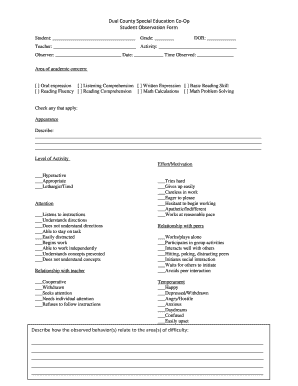
___________________________ Observer: ___________________________ Date: ____________ Time Observed: _______________ Area of academic concern: [ ] Oral expression [ ] Listening Comprehension [ ] Written Expression [ ] Basic Reading Skill [ ] Reading Fluency [ ] Reading Comprehension [ ] Math Calculations [ ] Math Problem Solving Check any that apply: Appearance Describe: _____________________________________________________________________________________________ _______________________________.

How it works
  • Open form

    Open form follow the instructions

  • Easily sign form

    Easily sign the form with your finger

  • Share form

    Send filled & signed form or save

How to fill out the Dual County Special Education Co-Op Student Observation online

Completing the Dual County Special Education Co-Op Student Observation form is an essential step in assessing a student's educational needs. This guide provides clear instructions to assist you in filling out the form accurately and efficiently.

Follow the steps to effectively complete the form.

  1. Press the ‘Get Form’ button to access the document and open it in the online editor.
  2. Begin filling in the student’s information, including their name, grade, date of birth, and the name of their teacher. Ensure accuracy in these details as they are crucial for identification.
  3. Indicate the activity being observed by entering it in the appropriate field. This helps contextualize the observation.
  4. Fill in the observer's name, date, and time of observation. This information establishes the context and timeframe for the observations noted.
  5. Identify the area of academic concern by checking the relevant boxes. Be sure to review each area carefully, as this will guide further assessments.
  6. Assess the student's appearance and describe it in the provided space. Detail any observations that stand out to help illustrate the student's condition.
  7. Evaluate the student's level of activity, effort/motivation, attention, relationship with the teacher, and relationship with peers. Check the statements that apply and note any relevant details in the observation sections.
  8. For each observed behavior, provide detailed descriptions in the space provided. Relate these behaviors to the identified area(s) of difficulty for a comprehensive evaluation.
  9. Once all sections are filled out, review the form for accuracy and completeness. Make any necessary edits.
  10. Finally, save your changes, and choose to download, print, or share the completed form as needed.

Take the time to complete your documents online today for a streamlined process.

Get form

Experience a faster way to fill out and sign forms on the web. Access the most extensive library of templates available.

Related content

And Others TITLE Including Exceptions: A System...

by D Ferguson · 1994 · Cited by 2 — ABSTRACT. The Including Exceptions in Schools...

Learn more
Exploring Teachers' Perceptions of Content/Dual...

by PA Rando · 2024 — The mandated change to the certification requirements of secondary...

Learn more
Apple Classrooms of Tomorrow—Today

ACOT2 follows in the tradition of Apple Classrooms of Tomorrow (ACOT), a research and...

Learn more
Questions & Answers

Get answers to your most pressing questions about US Legal Forms API.

Contact support

What is the observation method and example?

The observation method in education involves watching students engage in learning activities to gather data on their behavior and performance. For example, educators might observe a student during group work to see how they communicate and collaborate with peers. The Dual County Special Education Co-Op Student Observation approach ensures that such observations are systematic and aligned with personalized learning goals.

In special education, the observation method focuses on assessing student interactions, behavior, and progress in various settings. This technique provides essential insights into how students respond to teaching strategies and environmental factors. The Dual County Special Education Co-Op Student Observation framework enhances this method, fostering a tailored educational experience.

One significant issue in special education is the lack of adequate resources and funding, which can hinder program effectiveness. These challenges often affect the quality of support and services provided to students. Emphasizing the importance of initiatives like Dual County Special Education Co-Op Student Observation can help identify these gaps and advocate for necessary changes.

The four primary types of observation methods include participant observation, non-participant observation, structured observation, and unstructured observation. Each type serves different purposes and contexts in the educational environment. Using the Dual County Special Education Co-Op Student Observation framework allows educators to choose the most effective method for their specific needs.

The observation method in education involves systematically watching and recording student behaviors and interactions during learning activities. This technique allows educators to identify strengths and areas for improvement in their teaching approaches. Integrating the Dual County Special Education Co-Op Student Observation into this process can yield rich data to inform instruction.

Observation in special education is vital for understanding each student's unique needs. Through careful observation, educators can tailor their teaching strategies to better fit individual learning styles. The Dual County Special Education Co-Op Student Observation process helps educators gather valuable insights and enhance learning outcomes.

In Texas, the number of students in a special education class can vary based on specific needs and regulations. Generally, classes are limited to 8 to 15 students to ensure effective teaching and individualized attention. Dual County Special Education Co-Op Student Observation helps educators assess these conditions and adjust the learning environment accordingly.

The maximum caseload for special education teachers can vary by state and district, but it generally aims to ensure manageable workloads for educators. In the Dual County Special Education Co-Op Student Observation model, lower caseloads allow teachers to provide more individualized attention and support to their students. This approach ultimately leads to better educational outcomes and fosters a more nurturing learning environment.

Similar to general education classrooms, the number of students with Individualized Education Programs (IEPs) in a general classroom may depend on various factors, including the support available and district guidelines. In Dual County Special Education Co-Op Student Observation, it's crucial to create a balanced environment that accommodates those with IEPs while ensuring all students receive the attention they deserve. This approach not only supports academic success but also promotes social integration.

The number of special education students allowed in a general education classroom varies based on local regulations and specific circumstances. Typically, Dual County Special Education Co-Op Student Observation advocates for inclusive practices that enable a few special education students to learn alongside their peers. This inclusion benefits both groups, fostering a richer learning environment where students can develop essential social skills.

Get This Form Now!

Use professional pre-built templates to fill in and sign documents online faster. Get access to thousands of forms.

If you believe that this page should be taken down, please follow our DMCA take down process here.

Get Dual County Special Education Co-Op Student Observation