Open form follow the instructions
Easily sign the form with your finger
Send filled & signed form or save
How to fill out the Daily Child Behavior Observation Chart online
Filling out the Daily Child Behavior Observation Chart is essential for tracking and understanding children's behavior patterns. This guide provides clear, step-by-step instructions to help you complete the form accurately and efficiently.
Follow the steps to accurately complete your observation chart.
- Click ‘Get Form’ button to obtain the form and open it in the editor.
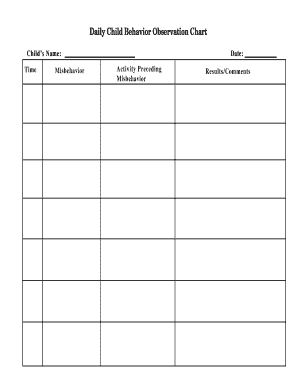
- Begin by entering the child’s name in the designated field. This allows for accurate identification and reference for multiple observations.
- Next, input the date of the observation. This is crucial for tracking behavior over time.
- Record the time of the observation in the specified section, providing context for the behavior.
- In the 'Misbehavior' field, describe the behavior observed. Be specific to ensure clear understanding.
- Refer to the 'Activity Preceding Misbehavior' section to note what the child was engaged in before the observed behavior occurred. This can aid in assessing triggers.
- Finally, use the 'Results/Comments' section to document any outcomes or personal reflections regarding the observed behavior. This helps in analyzing the behavior trends.
- Once all fields are completed, you can save changes, download, print, or share the completed form as necessary.
Complete your Daily Child Behavior Observation Chart online today!
Experience a faster way to fill out and sign forms on the web. Access the most extensive library of templates available.
Related content
Child's Daily Behavior Observation Chart. Use this form to record a child's behavior...
The following steps offer a guide for establishing a successful DRC. Why use a DRC? •...
Assessment Center Online Version. Child Behavior Checklist (CBCL/6-18). Parent, 6-18 y/o...
Get answers to your most pressing questions about US Legal Forms API.
What is a daily behavior form?
A daily behavior form is a document where specific behavioral observations are recorded throughout the day. It serves as a direct way to communicate a child’s behavior, detailing incidents, achievements, or concerns. Using the Daily Child Behavior Observation Chart as a form can streamline this process, simplifying the collection of data and enhancing communication among all parties involved in a child's care.
What is a daily behavior chart?
A daily behavior chart is designed to systematically record a child's behaviors and reactions across daily activities. This kind of chart aids in identifying behavioral trends and supports constructive feedback. By utilizing the Daily Child Behavior Observation Chart, you can create a well-organized way to document daily observations, leading to improved outcomes for the child.
What is a daily chart?
A daily chart is a tool used to track specific behaviors and activities on a day-to-day basis. It helps both caregivers and educators to consistently monitor a child's progress and behavioral changes over time. The Daily Child Behavior Observation Chart is a practical example, offering a simple framework to record observations, which can lead to more effective intervention strategies.
Do behavior charts work for ADHD?
Yes, behavior charts can be particularly effective for children with ADHD by providing clear expectations and routines. By systematically documenting behaviors, the Daily Child Behavior Observation Chart offers insights that can help tailor supportive strategies. This structured approach fosters better communication between caregivers and educators, improving the child’s overall behavior.
What is the purpose of a behavior chart?
The primary purpose of a behavior chart is to monitor and assess a child's behavior in various settings. It serves as a communication tool between parents, teachers, and caregivers, providing a visual representation of behavioral trends. By using the Daily Child Behavior Observation Chart, you can easily identify patterns, reinforce positive actions, and address any challenges a child may face.
What is behavior chart day?
Behavior chart day refers to a designated time when teachers or caregivers review the data collected on a child's behaviors. It is a moment to reflect on the child's progress and discuss their strengths and areas for improvement. This is where the Daily Child Behavior Observation Chart becomes a key tool, as it provides a structured overview of behaviors observed throughout the week.
What are examples of behavioral observations?
Behavioral observations can include noting actions like sharing, helping others, or participating in group activities. For instance, you might record if a child raises their hand to answer questions or interacts positively with peers. The Daily Child Behavior Observation Chart helps track these specific behaviors over time, offering valuable insights into a child's social development.
Why I don't use behavior charts?
Some may choose not to use behavior charts due to their potential focus on negative behaviors. Instead, you might prefer methods that emphasize social skills and emotional intelligence. A Daily Child Behavior Observation Chart can still align with your philosophy, by allowing you to concentrate on celebrating positive involvement and personal growth.
How to create a behavior chart for a child?
To create a behavior chart for a child, start by identifying key behaviors you want to track. Set clear, achievable goals, and use a simple, visual format that engages the child. Incorporating a Daily Child Behavior Observation Chart can streamline this process, providing easy documentation and fostering routine discussions about behavior and goals.
What to use instead of a behavior chart?
You can use alternative methods such as daily check-ins, reward systems, or verbal acknowledgments to encourage positive behavior. These approaches promote open communication and motivation without focusing solely on limitations. A Daily Child Behavior Observation Chart can still serve as a supportive tool, helping to document progress and identify areas for improvement.
Use professional pre-built templates to fill in and sign documents online faster. Get access to thousands of forms.
If you believe that this page should be taken down, please follow our DMCA take down process here.