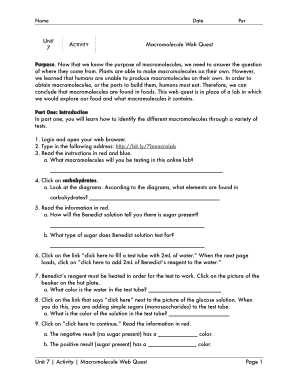
Olecules on their own. However, we learned that humans are unable to produce macromolecules on their own. In order to obtain macromolecules, or the parts to build them, humans must eat. Therefore, we can conclude that macromolecules are found in foods. This web quest is in place of a lab in which we would explore our food and what macromolecules it contains. Part One: Introduction In part one, you will learn how to identify the different macromolecules through a variety of tests. 1. Login and op.

How it works
  • Open form

    Open form follow the instructions

  • Easily sign form

    Easily sign the form with your finger

  • Share form

    Send filled & signed form or save

How to fill out the Crestwood High School Macromolecule Web Quest online

Filling out the Crestwood High School Macromolecule Web Quest online is a straightforward process that requires attention to detail. This guide provides step-by-step instructions to ensure you complete the form accurately and efficiently.

Follow the steps to successfully complete the Macromolecule Web Quest.

  1. Click the ‘Get Form’ button to access the Macromolecule Web Quest form and open it for editing.
  2. Read the introductory sections carefully, which outline the purpose of the web quest and the macromolecules you will be testing.
  3. Begin Part One by logging in and entering the specified web address in your browser to access the online lab.
  4. Follow the instructions provided in the colored text prompts to identify the macromolecules you will be testing, including carbohydrates.
  5. Continue through each section, filling in the answers regarding the elements found in carbohydrates, as well as results from the Benedict solution and iodine tests.
  6. Progress to the section on proteins, following similar steps to note elements present and color changes from the Biuret reagent.
  7. Finally, proceed to the fats section where you will use Sudan IV to determine the presence of lipids and complete the corresponding sections.
  8. After you have filled out all required fields based on your observations, review the information entered for accuracy.
  9. Once you have completed the web quest, save your changes and download or print the document for your records before sharing it as required.

Complete your Macromolecule Web Quest online now to ensure you grasp the fundamental concepts of macromolecules!

Get form

Experience a faster way to fill out and sign forms on the web. Access the most extensive library of templates available.

Related content

Awards FY20-24

We provide an open source web-based system for High Performance Computing (HPC) capable...

Learn more
Undergraduate Bulletin 2012-2013

The Alabama A&M University Undergraduate Bulletin (AAMU Bulletin) is typically published...

Learn more
Questions & Answers

Get answers to your most pressing questions about US Legal Forms API.

Contact support

What are the building blocks of macromolecules?

Monomers are the building blocks of the four basic macromolecules of life- monosaccharides are the monomers of carbohydrates, amino acids are the monomers of proteins, glycerol/fatty acids are the monomers of lipids, and nucleotides are the monomers of DNA.

Within all lifeforms on Earth, from the tiniest bacterium to the giant sperm whale, there are four major classes of organic macromolecules that are always found and are essential to life. These are the carbohydrates, lipids (or fats), proteins, and nucleic acids.

Most macromolecules are made from single subunits, or building blocks, called monomers. The monomers combine with each other using covalent bonds to form larger molecules known as polymers.

It is composed of thousands of covalently bonded atoms. Many macromolecules are polymers of smaller molecules called monomers. The most common macromolecules in biochemistry are biopolymers (nucleic acids, proteins, and carbohydrates) and large non-polymeric molecules such as lipids, nanogels and macrocycles.

This macromolecule is made of carbon, oxygen, hydrogen, nitrogen, and phosphate. The basic building block of this macromolecule are nucleotides. There are two types of this macromolecule: DNA and RNA. The basic building block of all proteins.

b) Pepsin is a macromolecule. It is considered as a protein. Like other proteins, pepsin is composed of amino acid building blocks. These amino acids can be linked together in specific sequences through the formation of peptide bonds.

Get This Form Now!

Use professional pre-built templates to fill in and sign documents online faster. Get access to thousands of forms.

If you believe that this page should be taken down, please follow our DMCA take down process here.

Get Crestwood High School Macromolecule Web Quest