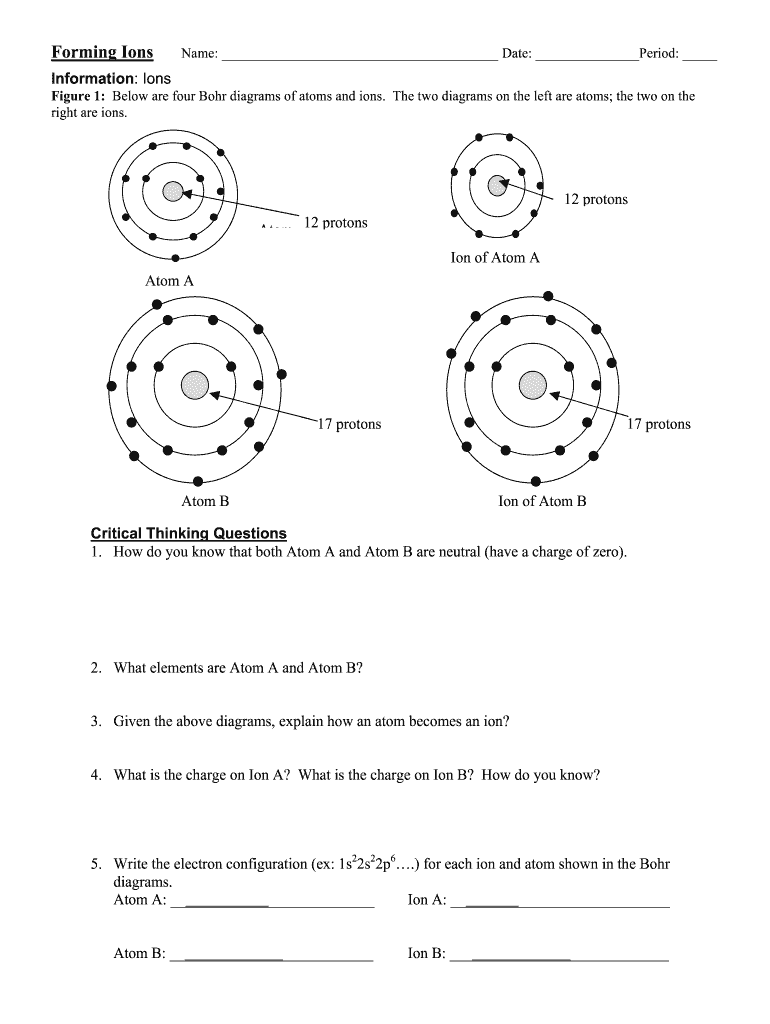
Forming Ions Name: Date: Period: Information: Ions Figure 1: Below are four Bohr diagrams of atoms and ions. The two diagrams on the left are atoms; the two on the right are ions. 12 protons Atom.
Loading

Open form follow the instructions

Easily sign the form with your finger

Send filled & signed form or save
How to fill out the Bell Science Forming Ions online
The Bell Science Forming Ions is an essential educational document designed to help users understand the concepts of ion formation and electron configuration. This guide will provide clear instructions on how to successfully complete this form online.
Follow the steps to effectively complete the Bell Science Forming Ions form online.
- Press the ‘Get Form’ button to access the Bell Science Forming Ions document and open it for editing.
- Begin filling in your name on the designated line. Ensure that your name is spelled correctly.
- Next, provide the date in the specified field, ensuring it is the current date.
- Indicate your class period by entering the appropriate number in the provided box.
- Review the Bohr diagrams in Figure 1, which illustrate atoms and ions. Familiarize yourself with the differences between them.
- Answer the critical thinking questions one by one, using the information from the diagrams and your knowledge of ion formation.
- For questions 1-5, ensure that your answers are clear and concise, referencing the diagrams as needed.
- In the section for writing electron configurations, complete each line thoughtfully, following the example provided.
- For questions 6-15, provide well-considered responses based on your understanding of the elements and their behaviors in forming ions.
- After completing all questions, double-check your responses for accuracy.
- When finished, save your changes, and consider your options to download, print, or share the completed form.
Complete your Bell Science Forming Ions document online to enhance your understanding of ion formation!
Experience a faster way to fill out and sign forms on the web. Access the most extensive library of templates available.
Related content
by MS Weidl · 2019 · Cited by 20 — Abstract. We show that the Bell instability, which...
by MA Rowe · 2001 · Cited by 1569 — Here we have measured correlations in the...
by VV Smith · 2001 · Cited by 10 — Because the Li I and K I lines are formed at nearly...
Get answers to your most pressing questions about US Legal Forms API.
How do you write ion formation?
Writing ion formation involves expressing the reactants and products in a chemical equation. Start with the components involved, clearly showing which atoms lose or gain electrons. By applying the techniques from Bell Science Forming Ions, you can create accurate and informative representations of ion formation that enhance your understanding of chemical interactions.
How do you calculate ions produced?
To calculate ions produced during a chemical reaction, identify the total number of electrons lost or gained by the reacting atoms. For example, in a reaction involving sodium and chlorine, sodium loses one electron, while chlorine gains one. By applying the concepts from Bell Science Forming Ions, you can determine the quantity and type of ions generated in a given situation.
What is the pattern for ion formation?
The pattern for ion formation often follows the octet rule, where atoms tend to achieve a full outer shell of electrons. Elements may lose or gain electrons based on their position in the periodic table. Understanding this pattern is crucial when exploring Bell Science Forming Ions, as it reveals why certain elements consistently form specific ions.
What elements form 2+ and 3+ ions?
Common elements that form 2+ ions include magnesium and calcium, while aluminum often forms 3+ ions. These elements are part of specific groups in the periodic table that promote ionization behavior. When studying Bell Science Forming Ions, it's essential to focus on these trends for a clearer understanding of how ions form in different scenarios.
How to predict charges of ions?
Predicting charges of ions relies largely on an element's position within the periodic table. Generally, elements in group one lose one electron, forming +1 ions, while those in group seventeen gain an electron, forming -1 ions. By studying materials on Bell Science Forming Ions, you can enhance your ability to accurately predict ion charges.
How do you find the ions formed?
To find the ions formed in a reaction, examine the chemical equation and identify which elements lose or gain electrons. This process often involves looking at oxidation states and the nature of each element involved. Resources like Bell Science Forming Ions will aid you in interpreting these details effectively.
What is an example of forming ions?
A common example of ion formation is sodium and chlorine. Sodium, a metal, loses one electron to become a sodium ion, while chlorine, a non-metal, gains an electron to become a chloride ion. This interaction underscores the principles illustrated in Bell Science Forming Ions, showcasing how different elements can interact to achieve stability.
How to do the formation of ions?
To form ions, begin with an atom, then determine whether it will gain or lose electrons based on its position in the periodic table. Metals typically lose electrons, forming positively charged ions, while non-metals usually gain electrons, leading to negatively charged ions. Engaging with resources on Bell Science Forming Ions will provide you further insights on how these transformations occur.
How do you get ion formation?
Ion formation occurs when atoms either lose or gain electrons, resulting in charged species. The process usually involves energy changes and specific conditions that drive the transactions within a chemical reaction. With Bell Science Forming Ions, you have access to practical examples that illustrate how ion formation happens in various scenarios, enhancing your learning experience.
How do you predict which ions will form?
You can predict which ions will form by considering the properties of the elements involved, such as their electronegativity and electron configuration. Additionally, understanding how elements interact helps clarify their tendency to lose or gain electrons. Bell Science Forming Ions offers tools that help you accurately model these predictions, simplifying the learning process.
Use professional pre-built templates to fill in and sign documents online faster. Get access to thousands of forms.
If you believe that this page should be taken down, please follow our DMCA take down process here.