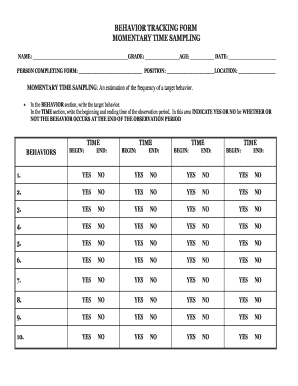
Behavior tracking form momentary time sampling name: grade: age: date: person completing .
Open form follow the instructions
Easily sign the form with your finger
Send filled & signed form or save
How to fill out the Behavior Tracking Form Momentary Time Sampling online
This guide provides a detailed overview of how to accurately fill out the Behavior Tracking Form Momentary Time Sampling online. By following these steps, users can ensure they effectively track and analyze target behaviors during observation periods.
Follow the steps to successfully complete the form.
- Click the ‘Get Form’ button to obtain the form and open it in the designated editor.
- Begin by entering the participant's name, grade, age, and the date in the respective fields at the top of the form.
- In the section labeled 'Person completing form', fill in your name, position, and location to identify who is filling out the form.
- In the 'Behavior' section, clearly write the target behavior you are observing for clarity.
- Next, in the 'Time' section, input the beginning and ending time of your observation period. Ensure that this is recorded accurately for proper tracking.
- Indicate whether the target behavior occurs at the end of the observation period by marking 'Yes' or 'No' in the provided columns.
- Continue to fill out the subsequent rows by repeating steps 4 through 6 for additional time intervals, ensuring that each observation entry is clear and concise.
- Once all observations are documented, review the form for any necessary corrections or adjustments.
- Finally, save your changes, and you can choose to download, print, or share the completed form as needed.
Begin filling out your Behavior Tracking Form online today to enhance your observation tracking.
Experience a faster way to fill out and sign forms on the web. Access the most extensive library of templates available.
Related content
The following datasheet is intended for teachers, paraeducators, counselors, etc. who are...
by JR Olson · 2006 — A momentary time sampling instrument, the Project. AAIMS –...
This mode is useful for condition monitoring, diagnostics, and preventative maintenance...
Get answers to your most pressing questions about US Legal Forms API.
How do you measure momentary time sampling?
To measure momentary time sampling, set clear intervals during which you will observe and record behaviors. For example, you might observe a student for a few seconds every minute during a class. Utilizing the Behavior Tracking Form Momentary Time Sampling enables you to note the behaviors at these intervals, facilitating easier data analysis and informed decision-making.
What is the difference between PIR and MTS?
PIR, or Partial Interval Recording, and MTS, or Momentary Time Sampling, are both observation techniques, but they differ in their approach. PIR records whether a behavior occurs at any point within a designated time interval, while MTS focuses on whether the behavior is occurring at predefined moments. Using the Behavior Tracking Form Momentary Time Sampling allows for a precise analysis of behavior in context.
Does time sampling use behavioral categories?
Yes, time sampling typically employs predefined behavioral categories to simplify data collection and analysis. With the Behavior Tracking Form Momentary Time Sampling, you can classify behaviors into distinct groups, such as engagement, avoidance, or interaction. This categorization helps educators and professionals to interpret behavior patterns systematically.
What is an example of a momentary time sample?
An example of a momentary time sample could involve observing a student in a classroom setting during a five-minute period. Let's say you check their engagement every minute. If the student is on-task at the 1, 3, and 5-minute marks, you can report those instances. The Behavior Tracking Form Momentary Time Sampling provides a structured way to record these observations accurately.
What is momentary time sampling on-task behavior?
Momentary time sampling on-task behavior involves checking whether a subject is engaged in expected activities during specified intervals. With the Behavior Tracking Form Momentary Time Sampling, you can take a snapshot of on-task behavior, providing valuable data on engagement levels. This technique helps identify trends and supports better educational strategies.
What are the three ways in which behavior can be sampled?
Behaviors can be sampled through three primary methods: continuous observation, time interval recording, and event recording. Continuous observation provides a thorough look at all behaviors occurring in real time. Time interval recording and event recording, on the other hand, allow you to capture specific behaviors over designated periods, particularly useful in the Behavior Tracking Form Momentary Time Sampling.
What are the behaviors for momentary time sampling?
Momentary time sampling focuses on specific behaviors that are observable during predetermined intervals. Common behaviors include on-task behavior, off-task behavior, and engagement levels. By using the Behavior Tracking Form Momentary Time Sampling, you can categorize and measure these actions effectively, ensuring you capture a comprehensive view of individual performance.
What is sampling behavior?
Sampling behavior refers to the process of observing and recording specific actions or responses over time. In the context of the Behavior Tracking Form Momentary Time Sampling, this method allows you to gain insights into how often certain behaviors occur within a set timeframe. By capturing snapshots of behavior, you can evaluate patterns and make informed decisions about interventions or support.
How to record behavior data?
To record behavior data effectively, you can use a structured form, such as the Behavior Tracking Form Momentary Time Sampling. Begin by defining the behaviors you will observe and the intervals for recording. This organized method allows you to capture accurate data and makes analysis easier in the long run.
When to use momentary time sampling in ABA?
Momentary time sampling is best used in Applied Behavior Analysis (ABA) when you need to measure behaviors that have clear on-and-off states. It is particularly effective in settings such as classrooms or therapy sessions where continuous observation isn't feasible. The Behavior Tracking Form Momentary Time Sampling is an ideal tool to streamline this process and enhance your data accuracy.
Use professional pre-built templates to fill in and sign documents online faster. Get access to thousands of forms.
If you believe that this page should be taken down, please follow our DMCA take down process here.