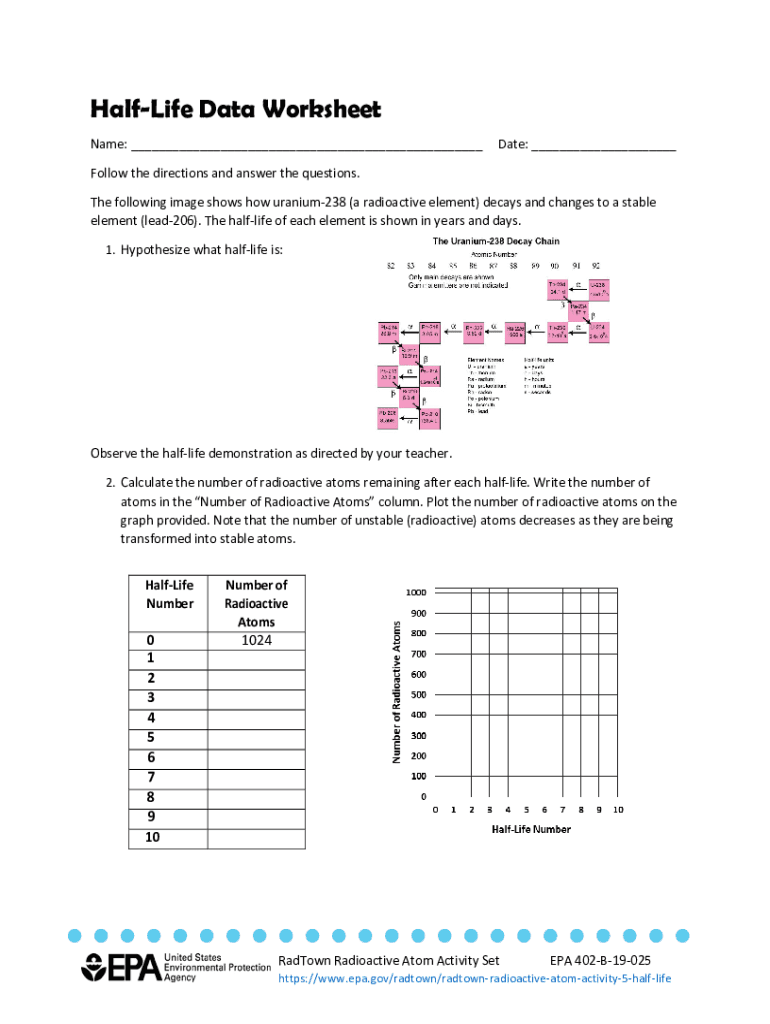
Ent) decays and changes to a stable element (lead 206). The half life of each element is shown in years and days. 1. Hypothesize what half life is: Observe the half life demonstration as directed by your teacher. 2. Calculate the number of radioactive atoms remaining after each half life. Write the number of atoms in the Number of Radioactive Atoms column. Plot the number of radioactive atoms on the graph provided. Note that the number of unstable (radioactive) atoms decreases a.

Open form follow the instructions

Easily sign the form with your finger

Send filled & signed form or save
How to fill out the EPA Half-Life Data Worksheet online
The EPA Half-Life Data Worksheet is a valuable tool for understanding the concept of half-life and its implications. This guide will provide you with clear, step-by-step instructions on how to fill out the worksheet accurately and efficiently online.
Follow the steps to effectively complete the worksheet.
- Click the ‘Get Form’ button to obtain the worksheet and open it in your preferred editor.
- Begin by filling in your name and the date at the top of the form. This ensures that your submission is properly identified.
- In the first section, hypothesize about what half-life means based on your observations. Take your time to think through this concept before typing your response.
- Proceed to the calculations section. For each half-life listed, calculate the number of radioactive atoms remaining. Enter the corresponding number in the 'Number of Radioactive Atoms' column provided.
- Utilize the graph section to plot the number of radioactive atoms. Ensure your graph accurately reflects the decreasing number of unstable atoms as time progresses.
- Answer the remaining questions regarding specific scenarios involving radioactive atoms. Be sure to provide clear and concise explanations for each question to demonstrate your understanding.
- After completing all sections of the worksheet, you can save your changes, download a copy, print it for your records, or share it as needed.
Get started with your EPA Half-Life Data Worksheet online to deepen your understanding of radioactive decay.
Experience a faster way to fill out and sign forms on the web. Access the most extensive library of templates available.
Related content
Half‐life is the amount of time it takes for approximately half of the radioactive atoms...
by JE Parks · 2001 · Cited by 4 — occur nearly simultaneously. This problem, referred...
For example, techniques based on isotopes with half lives in the thousands of years, such...
Get answers to your most pressing questions about US Legal Forms API.
How do you calculate half-life?
Determine the initial amount of a substance. ... Determine the final amount of a substance - for instance, N(t) = 2.1 kg . Measure how long it took for that amount of material to decay. ... Input these values into our half-life calculator.
What is half-life of an element?
Half-life (symbol t1 2) is the time required for a quantity to reduce to half of its initial value. The term is commonly used in nuclear physics to describe how quickly unstable atoms undergo radioactive decay or how long stable atoms survive.
What does half-life tell you?
Half-life is defined as the amount of time it takes for half of an isotope to change into another isotope. ... This means that, like the decay constant, the half-life gives an estimate of the stability of a particular radioactive substance, and it can thus be used to identify unknown isotopes.
What is a half-life in math?
Half-life is defined as the amount of time it takes a given quantity to decrease to half of its initial value.
How do you solve half-life problems?
How many half-lives would it take for 6.02 x 10²³ nuclei to decay to 6.25% (0.376 x 10²³) of the original number of nuclei? - 6.02 3.01 - 15.05 = 75 37625/4 hoff 2 .
Why is it called Half-Life?
The name Half-Life was chosen because it was evocative of the theme, not clichéd, and had a corresponding visual symbol: the Greek letter (lower-case lambda), which represents the decay constant in the half-life equation.
What is meant by half-life?
Half-life, in radioactivity, the interval of time required for one-half of the atomic nuclei of a radioactive sample to decay (change spontaneously into other nuclear species by emitting particles and energy), or, equivalently, the time interval required for the number of disintegrations per second of a radioactive ...
What is meant by Half-Life answer key?
Half life is the amount of time it takes for approximately half of the radioactive atoms in a sample to decay into a more stable form. Every radioactive element has a different half life. ... Note that the number of unstable (radioactive) atoms decreases as they are being transformed into stable atoms.
How do you determine half-life?
The half-life is then determined from the fundamental definition of activity as the product of the radionuclide decay constant, , and the number of radioactive atoms present, N. One solves for and gets the half-life from the relationship = ln2/T1/2.
What is a half-life in science?
Half-life, in radioactivity, the interval of time required for one-half of the atomic nuclei of a radioactive sample to decay (change spontaneously into other nuclear species by emitting particles and energy), or, equivalently, the time interval required for the number of disintegrations per second of a radioactive ...
Use professional pre-built templates to fill in and sign documents online faster. Get access to thousands of forms.
If you believe that this page should be taken down, please follow our DMCA take down process here.