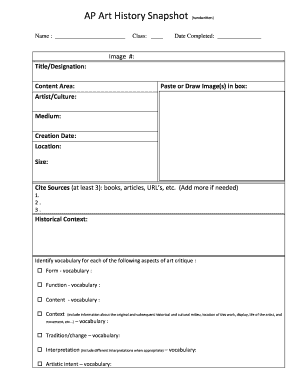
AP Art History Snapshot Name : Class: (handwritten) Date Completed: Image #: Title/Designation: Content Area: Paste or Draw Image(s) in box: Artist/Culture: Medium: Creation Date: Location: Size:.
Loading
Open form follow the instructions
Easily sign the form with your finger
Send filled & signed form or save
How to fill out the AP Art History Snapshot (handwritten) online
Filling out the AP Art History Snapshot is an essential task for capturing and critiquing significant works of art. This guide provides step-by-step instructions for successfully completing the form online, ensuring users understand each section's requirements.
Follow the steps to complete your AP Art History Snapshot efficiently.
- Click ‘Get Form’ button to obtain the form and open it in the editor.
- Begin by entering your name in the designated field labeled 'Name:' and clearly indicate the class you are enrolled in.
- In the 'Date Completed' section, write the current date to mark when you filled out the snapshot.
- Proceed to the 'Image #' field and assign a number for the artwork you are critiquing.
- Fill in the 'Title/Designation' by writing the title of the artwork you are analyzing, followed by the 'Content Area.'
- In the box provided, paste or draw the image(s) related to your critique, ensuring it is a clear representation.
- Complete the sections for 'Artist/Culture,' 'Medium,' 'Creation Date,' 'Location,' and 'Size' using relevant information for the artwork.
- Cite at least three sources of reference in the 'Cite Sources' area, ensuring you include books, articles, or URLs.
- In the 'Historical Context' section, describe the historical and cultural background relating to the artwork.
- Identify vocabulary for the aspects of art critique in the specified sections: Form, Function, Content, Context, Tradition/change, Interpretation, and Artistic intent.
- For the Snapshot critique, address the components in Organization, Interpretation, and Judgment, responding thoughtfully to each prompt.
- List possible connections with at least three other works in the Image Set in the 'Possible connections with other works' section.
- Identify Learning Objective(s) relevant to the artwork and include any Enduring Understandings and Essential Knowledge Statements.
- Draft a comprehensive composition summarizing your insights based on the previous items and ensure clarity and thoroughness.
- Finally, review the completed form for accuracy, completeness, and neatness before saving changes, downloading, printing, or sharing it.
Take action now and complete your AP Art History Snapshot online!
Experience a faster way to fill out and sign forms on the web. Access the most extensive library of templates available.
Related content
by A Baillot · 2023 · Cited by 14 — This narrative has its starting point in the late...
Historians of photography are looking for a way to study and historicize vernacular...
Kaelar divine gateway concept art. When this creation of Verra occurred, the Goddess of...
Get answers to your most pressing questions about US Legal Forms API.
Is it possible to get a 6 on AP art?
Once again, there is no possibility of receiving a score of 6 on any AP exam, including AP Art. The highest score remains a 5, which reflects mastery of the course material. Focus on understanding the exam format and criteria to achieve your best score. By leveraging resources like the AP Art History Snapshot (handwritten), you can prepare effectively and boost your confidence.
Is it hard to get a 5 on AP Art History?
Getting a 5 on the AP Art History exam can be challenging, but it is achievable with dedicated study and practice. You need to master a wide range of content, from key artworks and their contexts to critical theories and methodologies. Engage with study groups, practice exams, and utilize the AP Art History Snapshot (handwritten) to help you clarify complex ideas. With consistent effort, you can reach your goal.
Can you get a 6 on AP Art?
As mentioned previously, there is no score of 6 on any AP exam, including AP Art exams. The scoring system is designed to evaluate student performance on a scale of 1 to 5. Aim for a score of 5 for recognition of your efforts and knowledge in the subject. To enhance your preparation, consider referencing the AP Art History Snapshot (handwritten) to further strengthen your understanding.
Is AP Art History the hardest AP?
Many students consider AP Art History to be one of the more challenging AP courses, primarily due to the breadth of art movements and concepts covered. While it requires substantial study time and dedication, your passion for art can make the learning process enjoyable. Additionally, utilizing resources like the AP Art History Snapshot (handwritten) can help simplify complex topics and make study sessions more efficient. Remember, with the right tools and determination, you can succeed.
What is the highest AP art score?
The highest score achievable on an AP exam, including AP Art History, is a 5. This score indicates that you have an exceptional understanding of the subject and can apply your knowledge effectively. It’s essential to develop strong analytical skills and preparation strategies to reach this level. Utilizing resources like the AP Art History Snapshot (handwritten) can provide valuable insights as you study.
Is a 6 possible on an AP exam?
In general, AP exams use a scale of 1 to 5, with 5 being the highest score. Some students wonder if they can achieve a 6, but unfortunately, this score does not exist in the AP grading system. Instead, aim for the highest possible score of 5 to represent your knowledge effectively. If you're preparing for the AP Art History Snapshot (handwritten), focus on mastering the material to maximize your score potential.
What format are art history papers written in?
Art history papers typically follow a structured format that includes an introduction, body paragraphs, and a conclusion. In the introduction, you present your thesis statement, outlining what your paper will discuss. The body paragraphs then delve into the analysis of artworks, historical context, and critiques, often supported with evidence. For students seeking to impress their readers, understanding the AP Art History Snapshot (handwritten) can enhance the presentation of ideas.
Can you use photography for AP Art?
Yes, you can use photography in your AP Art portfolio. It is a legitimate medium that allows for creative expression when aligned with your artistic vision. Incorporating photographs can enrich your submissions, especially within the context of the AP Art History Snapshot (handwritten), where you can explore various themes and narratives.
What can you submit for AP Art?
For your AP Art portfolio, you can submit a wide range of original artworks, including paintings, drawings, sculptures, and photographs. Each piece should reflect your skills and artistic development. The AP Art History Snapshot (handwritten) requires you to present your art in a way that tells your story, so choose pieces that resonate with your journey.
Can you submit photos for AP Art?
You can submit photographs as part of your AP Art portfolio, but they must demonstrate your artistic intent and creativity. Ensure that the photographs showcase your unique perspective and align with the guidelines of the AP Art History Snapshot (handwritten). This allows you to express your artistic vision effectively.
Use professional pre-built templates to fill in and sign documents online faster. Get access to thousands of forms.
If you believe that this page should be taken down, please follow our DMCA take down process here.