Loading
Form preview
  • US Legal Forms
  • Other Templates
  • Miscellaneous Forms
  • Multi-State Miscellaneous Forms
  • Worksheet 5.1 - The History Of Oceanography

Get Worksheet 5.1 - The History Of Oceanography

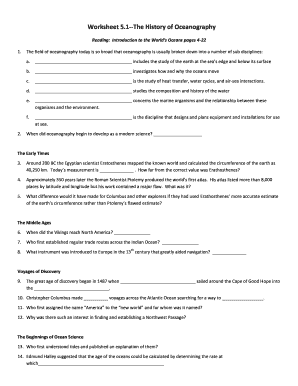
number of sub disciplines: a. b. ________________________________________ investigates how and why the oceans move c. ________________________________________ is the study of heat transfer, water cycles, and air-sea interactions. d. ________________________________________ studies the composition and history of the water e. ________________________________________ concerns the marine organisms and the relationship between these organisms and the environment. f. 2. _____________________.

How it works

  1. Open form

    Open form follow the instructions

  2. Easily sign form

    Easily sign the form with your finger

  3. Share form

    Send filled & signed form or save

How to fill out the Worksheet 5.1 - The History of Oceanography online

This guide provides clear and comprehensive instructions for users on how to fill out Worksheet 5.1 - The History of Oceanography online. By following these steps, you will navigate the form's components efficiently and effectively.

Follow the steps to complete the worksheet effectively.

  1. Press the ‘Get Form’ button to access the worksheet and open it in your preferred online document editor.
  2. Begin by filling out the first section, which focuses on the various sub-disciplines of oceanography. Identify and write in the correct terms for each sub-discipline based on your knowledge.
  3. Proceed to detail the historical context of oceanography. Reference specific figures such as Eratosthenes and Ptolemy, and provide their contributions along with any inaccuracies noted.
  4. Continue by addressing the Vikings' explorations and the instruments that aided navigation during the Middle Ages, filling in the answers to the corresponding questions.
  5. Elaborate on the Voyages of Discovery, documenting significant events and figures in ocean exploration, including Columbus and the establishment of the Northwest Passage.
  6. Provide insights into the advancements in ocean science and the contributions of notable figures such as Captain Cook and Benjamin Franklin. Complete the questions based on your research or knowledge.
  7. Conclude by filling out the Marine Archaeology section, detailing discoveries such as the Titanic wreck and the significance of underwater exploration.
  8. Once all answers are complete, check the document for accuracy and completeness. Save your changes, and you may choose to download, print, or share the filled-out worksheet as needed.

Complete your Worksheet 5.1 - The History of Oceanography online to enhance your understanding of this fascinating field!

Get form

Experience a faster way to fill out and sign forms on the web. Access the most extensive library of templates available.
Get form

Related content

World Ocean Database 2023 - the NOAA Institutional...
by AV Mishonov · 2024 · Cited by 28 — 5.1. INTRODUCTION ... Center (WDC) for...
Learn more
History of oceanography worksheet
Worksheet 5.1 the history of oceanography answer key. History of oceanography pdf. History...
Learn more
Polar Bear Conservation Management Plan - ECOS
Dec 20, 2016 — This plan outlines actions by the USFWS to contribute to the conservation...
Learn more

Related links form

INSTRUCTIONS TO COMPLETE THE NURSING FACILITY TRACKING FORM ... - Dhcfp Nv Pub 536 United Healthcare Fj1 Plan Form NEIGHBORHOOD WATCHBLOCKMAP - Cobb County Police ... - Police Cobbcountyga

Questions & Answers

Get answers to your most pressing questions about US Legal Forms API.

Contact support

The four branches of aquatic science are limnology, marine biology, oceanography, and aquaculture. Each branch focuses on different aspects of water ecosystems, from freshwater systems to marine environments. By exploring these branches through Worksheet 5.1 - The History of Oceanography, you will appreciate the diversity and importance of aquatic life and resources. This understanding is vital for anyone interested in environmental preservation.

The history of oceanography can be broken down into four main stages: the ancient explorations, the Age of Enlightenment, the modern era, and the technological revolution. Each stage marks significant advancements in our understanding of the ocean and its importance to the planet. In Worksheet 5.1 - The History of Oceanography, you can delve into how these stages have shaped our current knowledge and practice in this fascinating field.

Oceanography consists of four main types: physical oceanography, chemical oceanography, geological oceanography, and biological oceanography. Each type explores different elements of the ocean, such as water movement, chemical composition, seabed structure, and marine life. By studying these types in Worksheet 5.1 - The History of Oceanography, you will uncover how they work together to provide a fuller picture of oceanic processes.

The five sciences of oceanography include biological oceanography, chemical oceanography, geological oceanography, physical oceanography, and marine engineering. Each science focuses on different aspects of the ocean and contributes to our comprehensive knowledge of marine environments. You can find more detailed explanations of each science in Worksheet 5.1 - The History of Oceanography. This resource will help you understand the interconnectedness of these fields.

The ocean is typically divided into four main parts: the intertidal zone, the neritic zone, the oceanic zone, and the benthic zone. Each part plays a crucial role in marine ecosystems and has distinct characteristics. Understanding these divisions is essential, and Worksheet 5.1 - The History of Oceanography can guide you through each zone's unique properties. By studying these areas, you gain insight into oceanography as a whole.

Oceanographers study the ocean floor using various methods including sonar mapping, submersible dives, and remotely operated vehicles. These tools help gather detailed information about underwater features, such as mountains and valleys. In Worksheet 5.1 - The History of Oceanography, you can explore how these techniques have evolved over time and contributed to our understanding of the ocean floor. Staying informed about these advancements can enhance your appreciation of oceanographic studies.

Oceanography integrates the basic principles of biology, chemistry, geology, physics, geophysics, mathematics, botany, zoology, meteorology, and geography into scientific research in the marine environment.

Modern oceanography became a field of science approximately two hundred years ago, when scientists started studying ocean life, currents, and the seafloor off of coasts. The first scientific expedition to study the oceans and seafloor was the Challenger Expedition, from 1872 to 1876, aboard the British HMS Challenger.

Oceanography can be divided into four branches: Biological Oceanography, Chemical Oceanography, Geological Oceanography, and Physical Oceanography. Biological oceanography is concerned with studying the living aspects of the ocean.

The history of oceanography can be divided into four stages: Ancient Uses and Explorations (5000 B.C. - 800 A.D.) The Middle Ages (800 - 1400) European Voyages of Discovery (1400 - 1700) The Birth of Marine Science (1700 - 1900)

Get This Form Now!

Use professional pre-built templates to fill in and sign documents online faster. Get access to thousands of forms.
Get form
If you believe that this page should be taken down, please follow our DMCA take down processhere.
Get Worksheet 5.1 - The History of Oceanography
Get form

Form categories

Real Estate
  • Home Sale
  • Deeds
  • Leases
  • Landlord Tenant
  • First Refusal Agreement
  • Lis Pendens
  • View all Real Estate
Business & Commercial
  • Small Business
  • Contracts
  • Construction
  • Employment
  • Limited Liability Company
  • Partnerships
  • View all Business & Commercial
Estate Planning
  • Personal Planning
  • Last Will and Testament
  • Living Trust
  • Power of Attorney
  • Living Will (Healthcare Directive)
  • Probate
  • Trusts
  • Small Estate
  • View all Estate Planning

Other Legal Areas

  • Civil Actions
  • Civil Procedure
  • Animals
  • Affidavits
  • Bill of Sale
  • Oil Gas and Minerals
  • Name Change
  • Other
Family Law
  • Divorce
  • Annulment
  • Adoption
  • Marriage
  • Child Justice
  • View all Family Law
  • Forms Catalog
  • Other Templates

Company

  • About Us
  • Pricing
  • Legal Hub
  • Affiliate Program

Knowledge Base

  • Help Portal
  • Legal Resources
  • Blog
  • Industries
  • Legal Guides
  • Sitemap

Services

  • Notarize
  • Form Selector

Support

  • Contact Us
  • Delete My Account

Products

  • USLegal
  • FormsPass
  • pdfFiller
  • signNow
  • altaFlow
  • DocHub
  • Instapage
Social Media
Call us now toll free:
+1 833 426 79 33
As seen in:
© 2026 US Legal Forms. All rights reserved.
  • Your Privacy Choices
  • Terms of Service
  • Privacy Notice
  • Content Takedown Policy
  • Bug Bounty Program