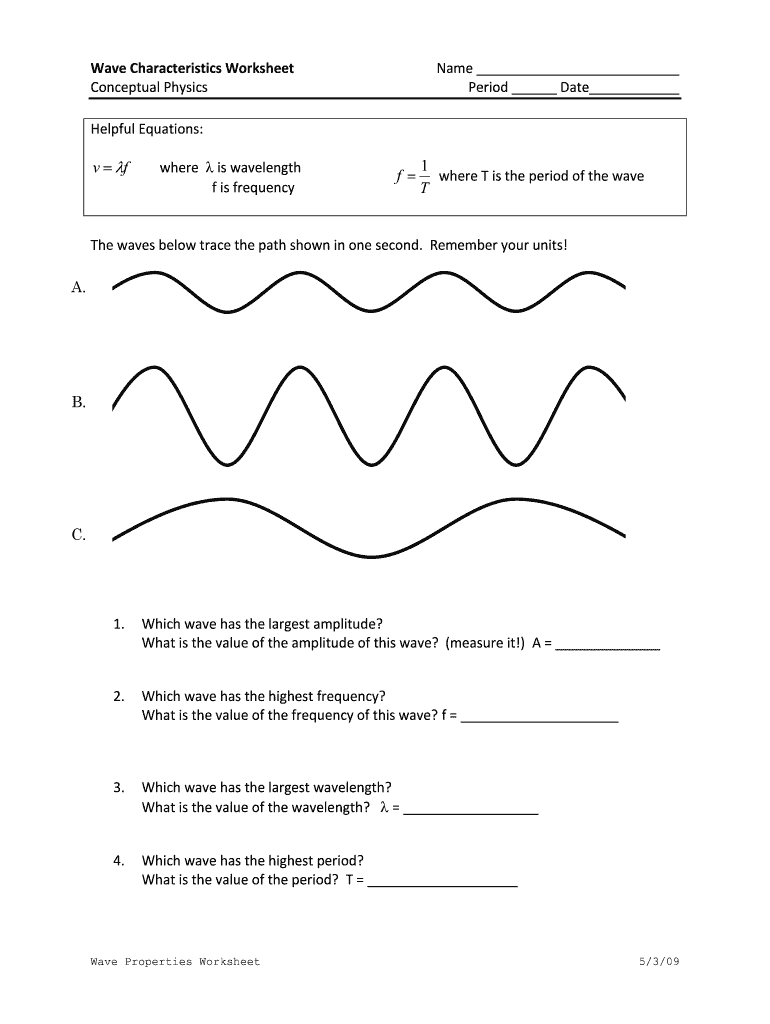
Wave Characteristics Worksheet Conceptual Physics Name Period Date Helpful Equations: v f where is wavelength f is frequency f 1 where T is the period of the wave T The waves below trace the path.

Open form follow the instructions

Easily sign the form with your finger

Send filled & signed form or save
How to fill out the Wave Characteristics Worksheet online
Completing the Wave Characteristics Worksheet online is a straightforward process that helps you analyze wave properties such as amplitude, frequency, and wavelength. This guide will walk you through each step to ensure you fill out the worksheet accurately and efficiently.
Follow the steps to complete the Wave Characteristics Worksheet online.
- Click ‘Get Form’ button to access the Wave Characteristics Worksheet and open it in your online editor.
- Begin by entering your name, period, and date in the designated fields at the top of the worksheet. Accurate identification is crucial for organizing your work.
- Review the helpful equations provided at the beginning of the worksheet. These equations will assist you in calculating wave properties as you answer the subsequent questions.
- Analyze the waves depicted in the worksheet and start answering the questions. For example, when asked about the largest amplitude, measure the height of the wave from the equilibrium position to the crest.
- Proceed to identify and document the highest frequency wave. Record your findings in the appropriate space next to the question regarding frequency.
- Identify which wave has the largest wavelength and write the value in the provided section. Use the wave illustrations for accurate measurements.
- Next, determine which wave has the highest period. Record your calculations in the designated field.
- Follow up by labeling wave #1 for important characteristics including wavelength, amplitude, equilibrium, crest, and trough as instructed.
- Answer the conceptual questions regarding relationships between frequency and wavelength, and how to alter wave properties such as amplitude.
- Finally, save any changes you have made, and consider downloading, printing, or sharing the completed worksheet as needed.
Take the next step in your learning journey by completing the Wave Characteristics Worksheet online.
Experience a faster way to fill out and sign forms on the web. Access the most extensive library of templates available.
Related content
Transverse waves have many characteristics: crest, trough, amplitude, wavelength...
Definitions: Wavelength – The length of a single wave cycle. Frequency - The number of...
The test results are placed in an. Excel worksheet. The saved data includes wave file and...
Get answers to your most pressing questions about US Legal Forms API.
What are the 5 characteristics of EM waves?
Electromagnetic (EM) waves possess five key characteristics: wavelength, frequency, amplitude, speed, and polarization. Wavelength represents the distance between successive peaks. Frequency determines the energy of the wave, with higher frequencies corresponding to greater energy. Amplitude indicates the strength of the wave, while speed denotes how fast the wave moves through a vacuum. Polarization describes the orientation of the wave's electric field.
What are the 4 characteristics that all waves are characterized by?
All waves share four fundamental characteristics: wavelength, frequency, amplitude, and speed. Wavelength represents the distance between wave peaks, while frequency indicates how quickly these peaks occur. Amplitude refers to the height of the wave, thereby impacting its energy. Speed, on the other hand, describes how fast the wave travels through a medium.
Can you list 5 characteristics of sound waves?
Sound waves possess five unique characteristics: frequency, wavelength, amplitude, speed, and phase. Frequency determines the pitch of the sound, while wavelength identifies the distance between sound wave peaks. Amplitude affects volume, with larger amplitudes producing louder sounds. Speed varies depending on the medium sound travels through, and phase indicates the position within a wave cycle.
What are the 7 characteristics of waves?
Waves are characterized by seven key features: wavelength, frequency, speed, amplitude, phase, reflection, and refraction. Wavelength and frequency define a wave’s spatial and temporal features. Speed measures travel within a medium, while amplitude represents energy levels. Phase indicates progression through a cycle, and reflection and refraction detail wave behavior when encountering boundaries.
What are the 5 wave characteristics?
The five essential wave characteristics include speed, frequency, amplitude, wavelength, and phase. Speed indicates how quickly a wave moves through various environments. Frequency reflects the number of waves traversing a point per second, and amplitude signifies the wave's maximum displacement from its rest position. Wavelength represents the distance between similar points on successive waves, while phase details the position of a point in time within a wave cycle.
What are the 5 characteristics of wave motion?
Wave motion has five prominent characteristics: speed, frequency, wavelength, amplitude, and energy. Speed measures how fast a wave travels through a medium. Frequency indicates how many waves pass a point in one second, while wavelength is the spatial length between waves. Amplitude shows the wave’s strength, and energy represents its capacity to perform work.
What are the 5 characteristics of waves?
Waves exhibit five main characteristics: reflection, refraction, diffraction, interference, and dispersion. Reflection occurs when waves bounce off surfaces, while refraction involves the bending of waves as they enter new mediums. Diffraction is the spreading of waves around obstacles, and interference occurs when two or more waves overlap. Dispersion refers to the separation of waves based on their frequencies.
What are the 5 main parts of a wave?
Waves consist of five key parts: crest, trough, wavelength, frequency, and amplitude. The crest is the highest point of the wave, while the trough is the lowest. Wavelength measures the distance between successive crests or troughs. Frequency refers to how often waves occur in a given time, and amplitude indicates the height of the wave, reflecting its energy.
What are the wave characteristics?
Examples of common waves that we come in contact with are sound and light. No matter whether you are talking about vibrations or waves, all of them can be characterized by the following four characteristics: amplitude, wavelength, frequency, and speed.
What are the five 5 characteristic of a transverse wave?
The main characteristics of a transverse wave are amplitude, frequency, period, velocity, and wavelength.
Use professional pre-built templates to fill in and sign documents online faster. Get access to thousands of forms.
If you believe that this page should be taken down, please follow our DMCA take down process here.