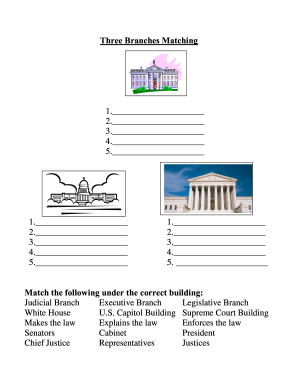
_______________ 4._____________________ 5._____________________ 1._____________________ 2._____________________ 3._____________________ 4._____________________ 5. _____________________ Match the following under the correct building: Judicial Branch Executive Branch Legislative Branch White House U.S. Capitol Building Supreme Court Building Makes the law Explains the law Enforces the law Senators Cabinet President Chief Justice Representatives Justices Directions for Three Branches Matching. .

How it works
  • Open form

    Open form follow the instructions

  • Easily sign form

    Easily sign the form with your finger

  • Share form

    Send filled & signed form or save

How to fill out the Three Branches Matching online

The Three Branches Matching document is an educational tool designed to help users understand the different branches of government and their functions. This guide will provide you with a clear, step-by-step process for filling out the form effectively.

Follow the steps to complete the Three Branches Matching online.

  1. Press the ‘Get Form’ button to access the Three Branches Matching form and open it in your chosen digital platform.
  2. Begin by identifying the first section of the form, which requires the user to input relevant information related to the branches of government. Understand the components: Judicial, Executive, and Legislative Branch.
  3. In each subsection, enter five relevant items or individuals associated with each branch. For example, under the Executive Branch, you may include the President and Cabinet.
  4. Continue to the next section where you match buildings — the White House, U.S. Capitol Building, and Supreme Court Building — with their corresponding branches and functions. Fill in the necessary information based on your understanding.
  5. Once all sections are completed, review your inputs for accuracy. Make any necessary edits to ensure clarity and correctness.
  6. Finally, after confirming that the form is filled out correctly, you can save your changes, download or print the document, or share it as needed.

Start filling out your Three Branches Matching form online today!

Get form

Experience a faster way to fill out and sign forms on the web. Access the most extensive library of templates available.

Related content

3 Branches of Our Government (answers)

What are the 3 branches of our government? Legislative, Executive, Judicial. The...

Learn more
Three Branch Diversity Systems for Multi-Hop IoT...

by SA Chowdhury · 2022 — Neighbor Matching scheme allows nodes to choose best...

Learn more
Regulatory Procedures Manual, Chapter 7

7-1 PURPOSE. This chapter provides definitions, responsibilities, and procedures for...

Learn more
Questions & Answers

Get answers to your most pressing questions about US Legal Forms API.

Contact support

How to remember three branches of government?

One effective way to remember the three branches of government is to think of each branch's primary function: lawmaking, enforcement, and interpretation. You might use acronyms or visual aids to associate each branch with its role. Engaging with educational platforms like US Legal Forms can provide additional tools and materials to aid in your learning journey about Three Branches Matching.

A three branches of government worksheet is an educational tool that helps students learn about the distinct roles of each branch. Typically, these worksheets include questions, fill-in-the-blanks, and matching activities focused on each branch's functions. Such resources promote active learning and serve as a practical application of the Three Branches Matching concept, reinforcing knowledge.

Readworks provides educational materials that explain the three branches of government. Their resources often include articles and activities that engage learners with the functions and responsibilities of each branch. These materials effectively enhance understanding of concepts related to Three Branches Matching, making them useful for students and educators alike.

One example of how the three branches work together is during the law-making process. First, Congress, as part of the legislative branch, creates a bill. The President, representing the executive branch, then has the power to sign the bill into law or veto it. If it is challenged in court, the judicial branch reviews its constitutionality. This example illustrates the vital concept of Three Branches Matching in action.

The three branches of government exist to provide a system of checks and balances, preventing any one branch from gaining too much power. Quizlet offers resources that help learners understand this foundational concept. By utilizing digital flashcards and interactive quizzes, you can enhance your grasp of Three Branches Matching and its importance in maintaining a balanced government structure.

To match up the three branches of government, you can pair each branch with its primary function. The legislative branch corresponds with lawmaking, the executive branch relates to enforcement, and the judicial branch connects to interpretation. This matching process is helpful for students or anyone trying to learn about the government. Tools like US Legal Forms can assist in visualizing these connections through educational resources.

The three branches of government are the legislative, executive, and judicial branches. Each branch serves a unique role in the governance process, ensuring that no single branch becomes too powerful. The legislative branch makes laws, the executive branch enforces them, and the judicial branch interprets them. Understanding these roles is vital for grasping the concept of Three Branches Matching.

Yes, there have been times in history when a president’s party controlled both houses of Congress, resulting in a strong influence over the legislative and judicial branches. This situation allowed for significant policy shifts and the enactment of various laws. The balance of power highlighted in the Three Branches Matching framework can shift during these periods.

The three branches of government—legislative, executive, and judicial—check each other through a system of checks and balances. Each branch has specific powers that can limit the actions of the other branches. For example, Congress can pass laws, but the President can veto them. This Three Branches Matching ensures no single branch becomes too powerful.

When the three branches of government collaborate effectively, it is often referred to as checks and balances. This essential principle ensures that no single branch can dominate the others, thus maintaining equitable governance. The concept of Three Branches Matching highlights how cooperation among the legislative, executive, and judicial branches strengthens democratic ideals. This balance allows government to operate smoothly and uphold the rights of citizens.

Get This Form Now!

Use professional pre-built templates to fill in and sign documents online faster. Get access to thousands of forms.

If you believe that this page should be taken down, please follow our DMCA take down process here.

Get Three Branches Matching