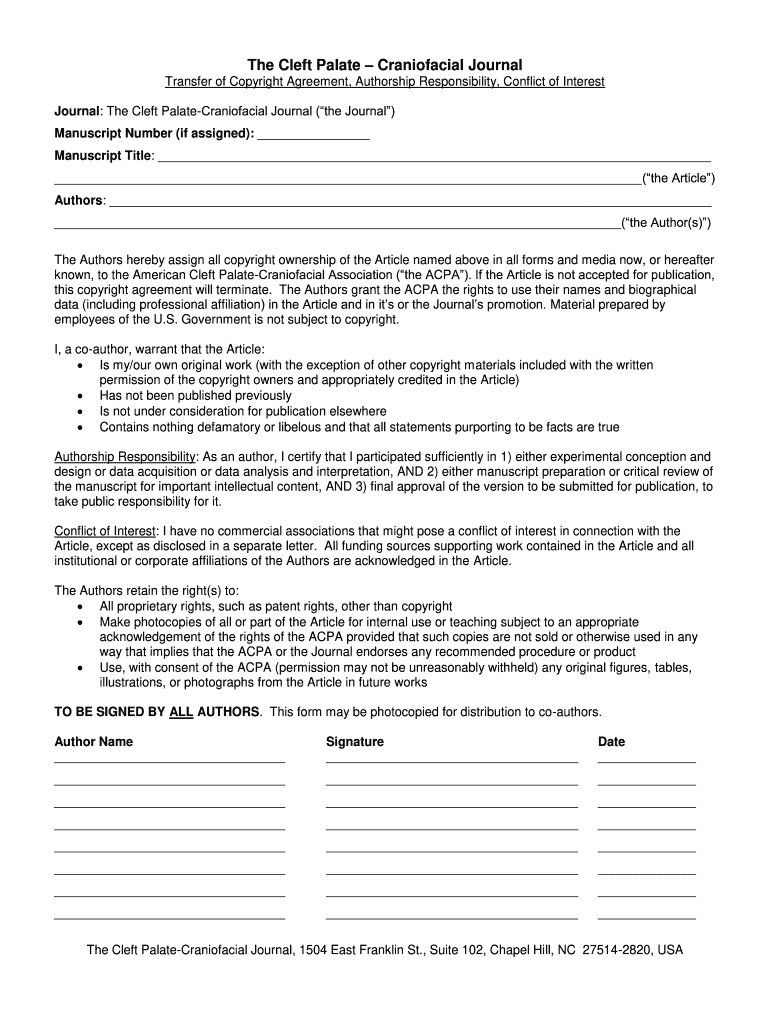
The Cleft Palate Craniofacial Journal Transfer of Copyright Agreement, Authorship Responsibility, Conflict of Interest Journal: The Cleft PalateCraniofacial Journal (the Journal) Manuscript Number.

Open form follow the instructions

Easily sign the form with your finger

Send filled & signed form or save
How to fill out the The Cleft Palate – Craniofacial Journal online
Completing the The Cleft Palate – Craniofacial Journal form is essential for authors wishing to publish their work in this renowned journal. This guide provides a comprehensive walkthrough to help users fill out the form accurately and efficiently.
Follow the steps to complete the form with ease.
- Click ‘Get Form’ button to access the document and open it in the editor.
- Enter the manuscript number if one has been assigned, or leave it blank if not applicable.
- In the 'Manuscript Title' field, provide the full title of the article you are submitting.
- List the names of all authors in the 'Authors' section, ensuring clarity and correct spelling.
- Read the copyright ownership assignment carefully, acknowledging that you are assigning ownership to the American Cleft Palate-Craniofacial Association.
- In the authors' warranty section, certify that the article is original, has not been published before, and is not under consideration elsewhere.
- Affirm authorship responsibility by confirming your participation in various aspects of the manuscript preparation.
- Disclose any potential conflict of interest in the provided section, ensuring transparency about commercial associations.
- Review the rights retained by authors to ensure understanding of what can be done with the article post-publication.
- Each author must sign and date the form where indicated, ensuring complete agreement among all contributors.
- Once all sections are completed and verified, save changes, and download or print the form if needed.
Complete the The Cleft Palate – Craniofacial Journal form online today and take a step toward publishing your research.
Experience a faster way to fill out and sign forms on the web. Access the most extensive library of templates available.
Related content
The Cleft palate-craniofacial journal : official publication of the American Cleft...
The Cleft Palate-Craniofacial Journal is the premiere peer-reviewed, interdisciplinary...
Cladistics (journal) · The Cleft Palate-Craniofacial Journal · Clinical and Experimental...
Get answers to your most pressing questions about US Legal Forms API.
Where do you get cleft palate?
Cleft palate occurs during fetal development and is not something one 'gets' in the traditional sense. Multiple factors can contribute to its occurrence, including genetics and environmental influences. The Cleft Palate – Craniofacial Journal often explores these causes to better understand prevention and treatment strategies. For those seeking support or information, platforms like US Legal Forms can provide resources to navigate legal matters related to medical treatments and support for individuals with cleft palate.
What is the impact factor of the Journal of Cranio Maxillofacial Surgery?
The impact factor of the Journal of Cranio Maxillofacial Surgery is an important measure of its academic significance in craniofacial research. It reflects the frequency with which articles are cited and can shed light on the journal's contribution to the field. For the most updated impact factor, refer to their official site or academic databases. These insights are essential for anyone looking to publish or engage with research in craniofacial studies, including The Cleft Palate – Craniofacial Journal.
What is the impact factor of the journal of craniofacial surgery?
The impact factor of the Journal of Craniofacial Surgery is a crucial metric that indicates its scholarly influence. This journal focuses on the surgical treatment of craniofacial conditions and frequently publishes significant research findings. To grasp the impact factor, consider checking the journal's website or relevant databases for the most current statistics. The Cleft Palate – Craniofacial Journal often intersects with similar topics, enhancing the literature available on this subject.
What is the impact factor of the cleft palate craniofacial journal?
The impact factor of The Cleft Palate – Craniofacial Journal may vary yearly, so checking the latest data is advisable. As a reputable journal, it reflects the quality of research being published and its influence in the field. Reviewing the impact factor can help researchers and practitioners understand the journal's credibility and relevance in the craniofacial domain. Stay updated by visiting the journal's official website for the most accurate figures.
Is cleft palate craniofacial?
Yes, cleft palate is considered a craniofacial condition. It involves a split or opening in the roof of the mouth and can significantly affect facial development. Understanding this relationship is crucial for delivering effective treatment and support for individuals with cleft palate. The Cleft Palate – Craniofacial Journal provides valuable insights into the intricacies of such conditions.
What is the abbreviation for the cleft palate Craniofacial Journal?
The abbreviation for The Cleft Palate – Craniofacial Journal is 'Cleft Palate Craniofac J'. This shortened form is often used in academic writing and references. Using this abbreviation helps in streamlining citations and connecting readers with relevant research. It is essential to use the correct abbreviation when discussing topics related to cleft palate research.
Who is the editor in chief of the cleft palate Craniofacial Journal?
The editor in chief of The Cleft Palate – Craniofacial Journal plays a crucial role in shaping the content and focus of the publication. As a leading voice in the field, they ensure that the journal presents the most relevant and high-quality research. If you are interested in contributions or publications, you can find more information through the journal's official website and submission guidelines.
What is the rule of 10 for cleft palate?
The rule of 10 is a guideline that assists in planning surgical treatment for patients with a cleft palate. It suggests that a child should reach a weight of at least 10 pounds, be at least 10 weeks old, and have a hemoglobin level of 10 grams per deciliter before undergoing surgery. This approach helps ensure the child is ready for the operation and is a topic often explored in The Cleft Palate – Craniofacial Journal.
Is a cleft palate a craniofacial malformation?
Yes, a cleft palate is indeed a type of craniofacial malformation. It occurs when the tissues in the roof of the mouth do not fully come together during fetal development. This condition can lead to difficulties in feeding, speech, and dental issues if not treated. The Cleft Palate – Craniofacial Journal provides valuable insights into the latest research and treatment options for this condition.
Is cleft palate a craniofacial anomaly?
Indeed, cleft palate is classified as a craniofacial anomaly because it alters the normal structure of the face and mouth. These anomalies can influence various aspects, from aesthetics to functionality. The Cleft Palate – Craniofacial Journal contains articles and studies that discuss the challenges associated with craniofacial anomalies and ways to address them effectively.
Use professional pre-built templates to fill in and sign documents online faster. Get access to thousands of forms.
If you believe that this page should be taken down, please follow our DMCA take down process here.