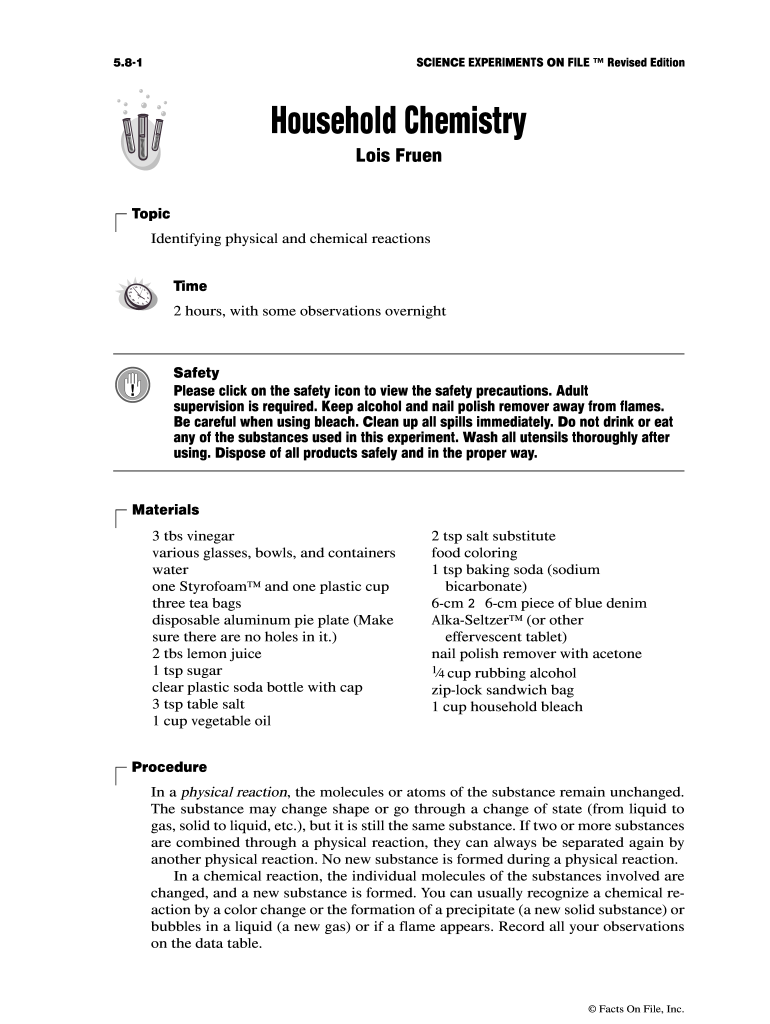
Se click on the safety icon to view the safety precautions. Adult supervision is required. Keep alcohol and nail polish remover away from flames. Be careful when using bleach. Clean up all spills immediately. Do not drink or eat any of the substances used in this experiment. Wash all utensils thoroughly after using. Dispose of all products safely and in the proper way. Materials 3 tbs vinegar various glasses, bowls, and containers water one Styrofoam™ and one plastic cup three tea bags dispos.
Loading

Open form follow the instructions

Easily sign the form with your finger

Send filled & signed form or save
How to fill out the Science Experiments of File online
This guide provides step-by-step instructions for filling out the Science Experiments of File online. It is designed to assist users of all experience levels in completing the form accurately and effectively.
Follow the steps to complete the Science Experiments of File.
- Click ‘Get Form’ button to obtain the document and access it in your preferred format.
- Begin with the 'Topic' section. Clearly state the main focus of your experiment, such as 'Identifying physical and chemical reactions.' Make sure this is concise and specific.
- Next, move to the 'Time' section. Indicate the expected duration for the experiment, ensuring it is accurate. For instance, '2 hours, with some observations overnight' conveys both the preparation time and observation time.
- In the 'Safety' area, carefully review the safety precautions. Make any necessary notes regarding adult supervision, hazardous materials, and proper material disposal.
- Fill in the 'Materials' list with the items required for the experiment, such as '3 tbs vinegar' and '1 cup household bleach.' Ensure all materials are included and properly listed.
- Proceed to the 'Procedure' section. Provide clear, numbered steps detailing how to conduct the experiment. Include observations to be recorded, ensuring clarity in each step.
- Complete the 'Data Table' section as you perform the experiment. Utilize the table to record changes such as state, color, and if gas is released. This will help in analyzing your results.
- Finally, review all sections of the form for accuracy and completeness. Save your changes, and consider options for downloading, printing, or sharing the completed document.
Complete your Science Experiments of File online today for a streamlined documentation process!
Experience a faster way to fill out and sign forms on the web. Access the most extensive library of templates available.
Related content
by V Tyler · 1989 — This book, addressed to students for their independent use as well...
Expressly written for young adults, this collection contains 80 experiments and...
A method to achieve transient gene expression in Taraxacum officinale and Taraxacum...
Get answers to your most pressing questions about US Legal Forms API.
How do you collect data for scientific research?
Collecting data for scientific research requires establishing a clear methodology before proceeding. Decide what information you need to answer your research question, and choose coherent strategies for gathering that data. This may include experiments, surveys, or existing research. Keeping organized science experiments of file enhances your ability to analyze and present your findings effectively.
How do you collect data in data science?
Collecting data in data science involves sourcing information from various databases or performing real-time observations. Data is often collected through surveys, sensors, or web scraping. Once gathered, it must be cleaned and organized for meaningful analysis. These principles align closely with maintaining robust science experiments of file, where data integrity is paramount.
How to collect data in a science experiment?
To collect data in a science experiment, first determine what type of data you're seeking. Use appropriate tools or instruments for measurement, such as rulers, scales, or thermometers, depending on your experiment. As you carry out your experiment, regularly note changes or outcomes for future analysis. This data collection is critical to the success of your science experiments of file.
How do you document a science experiment?
Documenting a science experiment systematically is essential to ensure clarity and reproducibility. Start by writing a clear title, followed by the purpose of your experiment. Each step of your process should be detailed, along with the materials used and the data collected. A well-maintained science experiments of file will serve as an excellent record of your work.
How to find a science fair topic?
Finding a suitable science fair topic can be a fun and enlightening process. Start by exploring your interests in science areas such as biology, chemistry, or physics. Look for questions that pique your curiosity, and consider existing problems you can solve. By connecting your interests to potential science experiments of file, you can choose topics that engage and educate.
How do you collect data from a science experiment?
Collecting data from a science experiment requires careful measurement and record-keeping. You should clearly define what data you need ahead of time, whether it’s quantitative measurements or qualitative observations. During your experiment, document all your findings accurately to ensure the integrity of your data. This practice forms the backbone of effective science experiments of file.
How to make a science project file?
Creating a science project file involves organizing all relevant information and documentation related to your experiment. Start with a title page that reflects your project topic, then include sections for your hypothesis, materials, methods, results, and conclusion. Use clear headings to guide the reader through your process, and make sure to include data collected during your science experiments of file for reference.
How are experiments used to collect data?
Experiments play a crucial role in the scientific method, particularly in the collection of data. By testing hypotheses through careful observation and measurement, you can gather data that reflects the outcomes of various conditions. This data provides valuable insights that help in drawing conclusions about the scientific inquiry. Ultimately, well-structured science experiments of file lead to more reliable information.
What is documentation in experiment?
Documentation in an experiment refers to the comprehensive recording of all processes and findings throughout your study. It includes your research methods, observations, results, and analyses. Effective documentation ensures that others can replicate your work and verify your findings, which is key to the credibility of your science experiments of file. Using platforms like uslegalforms can help streamline this process and improve consistency.
How to organize experimental data?
Organizing experimental data is crucial for clarity and analysis. Start by categorizing your data into tables or charts, which help visualize trends and patterns. Utilize software tools for digital organization, or maintain a structured binder for paper records. A well-organized collection of data is vital for understanding the outcomes of your science experiments of file.
Use professional pre-built templates to fill in and sign documents online faster. Get access to thousands of forms.
If you believe that this page should be taken down, please follow our DMCA take down process here.