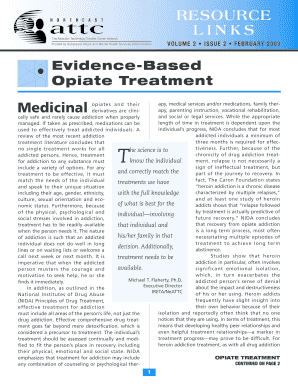
Ilitation, derivatives are cliniand social or legal services. While the appropriate cally safe and rarely cause addiction when properly length of time in treatment is dependent upon the managed. If taken as prescribed, medications can be individual’s progress, NIDA concludes that for most used to effectively treat addicted individuals. A addicted individuals a minimum of review of the most recent addiction three months is required for effectreatment literature concludes that tiveness. Further,.
Open form follow the instructions
Easily sign the form with your finger
Send filled & signed form or save
How to fill out the Resource Links Evidence-Based Opiate Treatment online
This guide provides clear, step-by-step instructions for filling out the Resource Links Evidence-Based Opiate Treatment form online. Whether you are a first-time user or someone with prior experience, this guide is designed to assist you through the process with a supportive and professional approach.
Follow the steps to successfully complete the form.
- Click the ‘Get Form’ button to obtain the form and open it in your preferred online editor.
- Begin by entering your personal information in the designated fields. This may include your full name, degree, address, phone number, and email address. Double-check for accuracy to avoid any complications.
- Continue to the next section, where you may be asked about your license number and any relevant certifications. Ensure that you provide this information completely and accurately.
- Proceed to the evaluation portion of the form. This section may require you to rate your overall experience with the treatment document. Use a scale provided to reflect your level of satisfaction and knowledge gained.
- Sign and date the form in the appropriate areas, confirming your personal completion of the document and your understanding of its content.
- Once all sections are complete, save your changes. You may have the option to download, print, or share the form directly from your online editor.
Complete your documents online today for a seamless submission process.
Experience a faster way to fill out and sign forms on the web. Access the most extensive library of templates available.
Related content
Dec 16, 2022 — Support for providers of substance abuse treatment services with...
Our organization trains and supplies resources to providers regarding addiction as a...
May 10, 2017 — Assessment and Evidence Based Treatments for Opioid Use. Disorder. 6...
Get answers to your most pressing questions about US Legal Forms API.
What is the best evidence-based treatment for addiction?
The best evidence-based treatment for addiction combines medication, therapy, and support systems tailored to individual needs. Approaches like cognitive-behavioral therapy (CBT) and support groups have substantial research backing them. Turning to resource links for evidence-based opiate treatment can help individuals find the most suitable options for lasting recovery.
What is evidence-based practice in addiction treatment?
Evidence-based practice in addiction treatment uses clinical research to implement effective intervention strategies. This practice ensures that treatments are grounded in proven methodologies, thus improving recovery rates. By utilizing resource links for evidence-based opiate treatment, healthcare providers can offer services that truly make a difference.
What is the evidence-based approach to opioid use disorder sbirt?
The evidence-based approach to opioid use disorder involves Screening, Brief Intervention, and Referral to Treatment (SBIRT). This method aims to identify and provide early intervention for individuals at risk of developing opioid use disorder. Resource links related to evidence-based opiate treatment can support the implementation of SBIRT in various healthcare settings.
What is evidence-based prevention for addiction?
Evidence-based prevention for addiction combines research-driven strategies to reduce the onset of substance use. Programs often include community education, outreach, and early intervention to prevent addiction. Resource links that focus on evidence-based opiate treatment can provide valuable programs to help communities combat addiction.
What is evidence-based practice for opioid use?
Evidence-based practice for opioid use focuses on informed decision-making based on scientific research and clinical expertise. This practice aims to minimize risks while effectively managing pain or treating opioid addiction. Utilizing resource links for evidence-based opiate treatment can guide individuals seeking safe and effective options.
What are the evidence-based indications for using opioids?
Evidence-based indications for using opioids include severe pain management, specific surgery recovery, and certain chronic pain conditions. Medical professionals rely on research to determine when opioids are appropriate and beneficial. Responsible prescribing reflects the principles outlined in resource links for evidence-based opiate treatment.
What is the strongest evidence-based treatment for opioid use disorder?
The strongest evidence-based treatment for opioid use disorder is Medication-Assisted Treatment (MAT). This approach combines the use of approved medications with counseling and behavioral therapies. By integrating these elements, resource links provide comprehensive support, enhancing the likelihood of recovery.
What is evidence-based practice for medication?
Evidence-based practice for medication involves using the best available research to guide treatment decisions. This approach helps healthcare providers choose the most effective medications for their patients. When applied to opiate treatment, it ensures that resource links highlight strategies that have proven to be beneficial in reducing dependency.
Which therapeutic approach is considered promising for treating opioid addiction?
Cognitive Behavioral Therapy (CBT) is a promising therapeutic approach for treating opioid addiction. This method helps individuals identify and change negative thought patterns that contribute to substance use. By utilizing Resource Links Evidence-Based Opiate Treatment, you can discover how CBT and other therapies can support your journey to recovery.
What is the best evidence-based practice for substance abuse?
The best evidence-based practice for substance abuse includes integrated treatment that addresses both addiction and co-occurring mental health issues. This practice focuses on personalized care plans tailored to individual needs. To better understand these practices, check Resource Links Evidence-Based Opiate Treatment for comprehensive guidance.
Use professional pre-built templates to fill in and sign documents online faster. Get access to thousands of forms.
If you believe that this page should be taken down, please follow our DMCA take down process here.