Es Yes Yes Yes Yes Yes Yes Yes Yes EEG Date: If abnormal: Temporal lobe Hydrocephalus Autonomic instability Muscle spasm Confusion or delirium Aphasia or dysarthria Anxiety Stiff neck Ataxia Nausea or vomiting Photophobia / blurred vision Other: Other: Microbiological studies / results: HSV CSF PCR NEG POS Not done Pending Enterovirus CSF PCR NEG POS Not done Pending Varicella CSF PCR NEG POS Not done Pending CrAg CSF NEG POS Not done Pending CMV CSF PCR NEG POS Not d.
Loading

Open form follow the instructions

Easily sign the form with your finger

Send filled & signed form or save
How to fill out the CDC 55.30 online
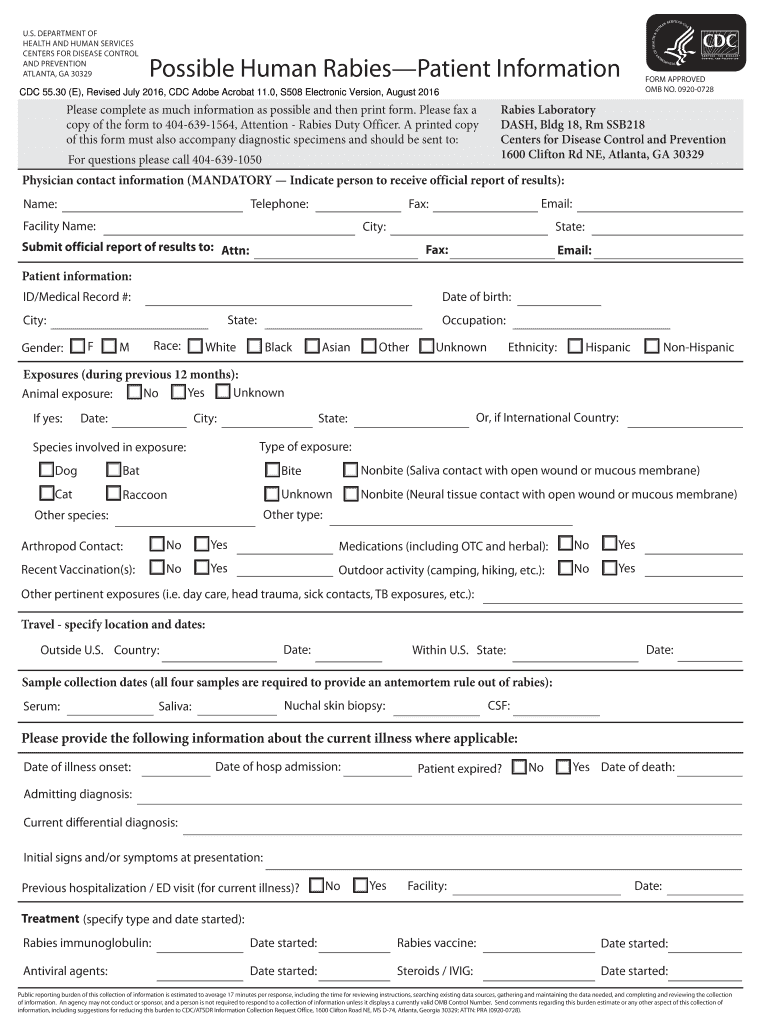
This guide provides clear, step-by-step instructions on how to fill out the CDC 55.30 form online, ensuring that you supply all necessary information for reporting possible human rabies cases. Completing this form accurately is crucial for effective data collection and management.
Follow the steps to complete the CDC 55.30 form online.
- Press the ‘Get Form’ button to retrieve the CDC 55.30 form and open it in the specified editor.
- Begin by providing the physician contact information. Ensure to include mandatory fields such as telephone number, name, email, and facility name.
- Next, fill out the patient information section. This includes the patient ID/medical record number, date of birth, gender, race, and occupation. Be careful to enter accurate and complete details.
- In the exposures section, indicate any animal exposures during the previous 12 months. If applicable, provide specific details such as the date, city, state, or international country of exposure.
- Document the species involved in the exposure. Options include dog, cat, bat, and others. Specify the type of exposure — bite or non-bite.
- Continue with relevant health information, including any recent vaccinations, medications, or other pertinent exposures.
- Provide sample collection dates for required samples necessary to rule out rabies. This includes serum, nuchal skin biopsy, saliva, and CSF.
- Complete the illness section by entering information about the current illness, including date of illness onset, any symptoms, and treatment details.
- Review all sections to confirm accuracy and completeness to avoid errors in submission.
- Once finished, save the completed form. You can also choose to download, print, or share the form as needed.
Complete your documents online with confidence and accuracy today.
Experience a faster way to fill out and sign forms on the web. Access the most extensive library of templates available.
Related content
CDC 55.30 (E), Revised July 2016, CDC Adobe Acrobat 11.0, S508 Electronic Version, August...
by JHC Wong · 2023 · Cited by 1 — This paper studied and compared health disparities...
55.30 Hours/Week (Average). Operating ratio (Good/Attempted to run time) 0.924...
Get answers to your most pressing questions about US Legal Forms API.
When was the last case of rabies in Ohio?
The last human case in Ohio occurred in 1970. About 60 animals are confirmed rabid in Ohio every year. Most cases are in wildlife such as bats, skunks, and raccoons. Since 2000, Ohio has also had rabies confirmed in horses, fox, cat, cow, coyote, groundhog, and opossum.
How long are you contagious after you test positive for COVID-19?
After testing positive for COVID-19, the duration of contagiousness can vary. However, individuals are typically contagious for about 10 days after the onset of symptoms. For those with mild to moderate symptoms, this period can be shorter, often around 5-7 days.
What are the most current CDC guidelines for COVID?
Wearing a mask and putting distance between yourself and others can help lower the risk of COVID-19 transmission. Testing for COVID-19 can help you decide what to do next, like getting treatment to reduce your risk of severe illness and taking steps to lower your chances of spreading COVID-19 to others.
What does CDC mean?
Centers for Disease Control and Prevention. | CDC.
What are the CDC recommendations if you're exposed to someone with COVID?
Recommendation for close contacts of cases If you have new COVID-19 symptoms, you should test and mask right away. If you do not have symptoms, and are at higher risk of severe COVID-19 infection and would benefit from treatment, you should test within 5 days.
Is CDC.gov a reliable source?
The Centers for Disease Control and Prevention (CDC) is committed to applying rigorous scientific standards to ensure the accuracy and reliability of research results. For scientific and technical documents, the scientific community recognizes peer review as the primary means of quality control.
How long should I isolate myself if I have COVID?
ing to the CDC, if you have COVID-19 you should isolate for at least five days. Day 0 is your first day of symptoms or, if asymptomatic, the day you test positive. Day 1 is the first full day after your symptoms developed and so on.
Use professional pre-built templates to fill in and sign documents online faster. Get access to thousands of forms.
If you believe that this page should be taken down, please follow our DMCA take down process here.