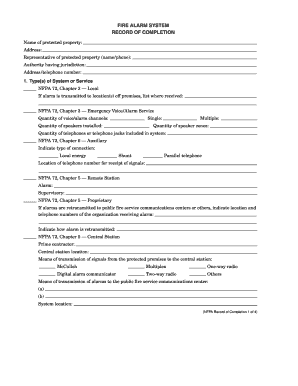
Ction: Address/telephone number: 1. Type(s) of System or Service NFPA 72, Chapter 3 — Local If alarm is transmitted to location(s) off premises, list where received: NFPA 72, Chapter 3 — Emergency Voice/Alarm Service Quantity of voice/alarm channels: Single: Quantity of speakers installed: Multiple: Quantity of speaker zones: Quantity of telephones or telephone jacks included in system: NFPA 72, Chapter 6 — Auxillary Indicate type of connection: Local energy Shunt Parallel telephon.
Open form follow the instructions
Easily sign the form with your finger
Send filled & signed form or save
How to fill out the NFPA Fire Alarm System Record of Completion online
This guide provides a comprehensive overview of how to accurately complete the NFPA Fire Alarm System Record of Completion online. By following the outlined steps, users can ensure all necessary information is captured correctly in the form.
Follow the steps to complete the NFPA Fire Alarm System Record of Completion.
- Locate and select the ‘Get Form’ button to access the NFPA Fire Alarm System Record of Completion. This will open the form for editing.
- Begin by entering the name of the protected property and its address in the appropriate fields. Ensure that the information is accurate and up-to-date.
- Fill out the representative of the protected property, including their name and phone number. This is essential for any communication regarding the fire alarm system.
- Provide the name of the authority having jurisdiction along with their address and telephone number, which is necessary for regulatory compliance.
- In the 'Type(s) of System or Service' section, select the applicable types according to NFPA 72, Chapter 3 — Local, and list any off-premises alarm notifications if applicable. Include quantities for voice/alarm channels, speakers, and zones as required.
- Document the system installation details, indicating the inspection date and signer. Circle the relevant NFPA 72 chapters and confirm that installation is per applicable standards and manufacturer’s instructions.
- For the 'Record of System Operation', note the testing date and findings regarding the system's operational features. Circle the relevant NFPA chapters used during operation testing.
- In the 'Alarm-Initiating Devices and Circuits' section, input the quantities and classes of initiating devices, detailing whether they are manual or automatic.
- Fill in the 'Supervisory Signal-Initiating Devices and Circuits' field with relevant data regarding guard's tour systems and supervisory attachments, detailing quantities for coding and notification.
- Record alarm notification appliances and circuits, ensuring that quantity and class details match the requirements outlined in NFPA 72. Include types of notification appliances installed.
- Complete the 'System Power Supplies' section by specifying primary, secondary, and emergency power options, including electrical ratings and locations.
- Fill out system software revision levels, detailing the operating and application software revisions alongside who completed them.
- Finally, add any additional comments in the last section. If required, ensure signatures and dates are supplied from the appropriate authorities and contractors to validate the completion of the form.
Complete your NFPA Fire Alarm System Record of Completion online today to ensure compliance and safety.
Experience a faster way to fill out and sign forms on the web. Access the most extensive library of templates available.
Related content
Record of System Installation. (Fill out after installation is complete and wiring is...
This form is to be completed by the system installation contractor at the time of system...
An automatic fire alarm system—typically made up of smoke detectors, heat detectors...
Get answers to your most pressing questions about US Legal Forms API.
How do I get a fire alarm certificate?
To acquire a fire alarm certificate, you should have your fire alarm system installed and inspected by licensed professionals who adhere to NFPA standards. After a thorough inspection and testing of the system, they will issue a fire alarm certificate if everything meets regulatory requirements. This certificate is an essential part of maintaining the NFPA Fire Alarm System Record of Completion and is crucial for compliance and safety.
Which of the following are provided to the owner at the completion of a fire alarm installation?
Upon completion of a fire alarm installation, the owner typically receives several key documents. These include an installation certificate, a verification certificate, and an operation manual for the system. Each of these documents plays a crucial role in confirming compliance with NFPA guidelines. Together, they form a comprehensive NFPA Fire Alarm System Record of Completion that is vital for ongoing safety and adherence to regulations.
What is a fire alarm verification certificate?
A fire alarm verification certificate confirms that a fire alarm system complies with all necessary NFPA requirements. This certificate indicates that the system has successfully undergone testing and inspection by qualified professionals. It's important for safety and legal compliance, as it can be required during inspections or audits. This certificate supports your NFPA Fire Alarm System Record of Completion and enhances overall safety.
Is it hard to get NICET certification?
Acquiring NICET certification can be a challenging but rewarding process. It requires proof of experience in fire alarm systems, along with passing a series of exams. Many professionals find that adequate preparation and hands-on experience make the process manageable. Being certified can enhance your credentials, ultimately benefiting those responsible for maintaining an NFPA Fire Alarm System Record of Completion.
How to get a fire test certificate?
To obtain a fire test certificate, you must first ensure that your fire alarm system is installed and operational according to NFPA codes. Then, a certified professional typically conducts a test of the system to confirm its effectiveness. After successful verification, they will issue the fire test certificate, which serves as proof of compliance. This certificate is a key component of your NFPA Fire Alarm System Record of Completion.
What is an alarm certificate?
An alarm certificate is a document that verifies the operational status and compliance of a fire alarm system in accordance with NFPA standards. This certificate is essential for demonstrating that the system has been tested and is functioning correctly. Having this documentation helps in ensuring safety for occupants and compliance with local regulations. It's part of maintaining an up-to-date NFPA Fire Alarm System Record of Completion.
How long is the owner required to keep software records according to NFPA?
According to NFPA guidelines, owners must retain software records for a minimum of five years. This duration ensures that all relevant modifications and updates can be referenced when needed. By maintaining these records, facility managers can uphold compliance and provide necessary documentation during inspections. Therefore, keeping an NFPA Fire Alarm System Record of Completion is crucial for accountability.
What are the requirements for fire alarms under NFPA 101?
Under NFPA 101, fire alarms must provide adequate warning to occupants, be designed for easy accessibility, and ensure proper functionality during emergencies. The standard emphasizes that systems must be routinely tested and maintained to retain effectiveness. Meeting these critical requirements facilitates the creation of an NFPA Fire Alarm System Record of Completion, which is essential for regulatory compliance.
Which of the following are part of a complete fire protection system?
A complete fire protection system typically includes fire alarms, sprinkler systems, and emergency lighting. Each component plays a crucial role in ensuring safety and quick response to fire incidents. An effective installation will yield an NFPA Fire Alarm System Record of Completion, showcasing the system's comprehensive safety features.
What is the NFPA standard for fire alarm systems?
The NFPA standard for fire alarm systems, mainly documented in NFPA 72, outlines the requirements for installation, maintenance, and testing of fire alarm systems. This standard ensures systems function effectively to detect and report fire hazards. Utilizing these guidelines helps generate a proper NFPA Fire Alarm System Record of Completion, which is vital for compliance and safety.
Use professional pre-built templates to fill in and sign documents online faster. Get access to thousands of forms.
If you believe that this page should be taken down, please follow our DMCA take down process here.