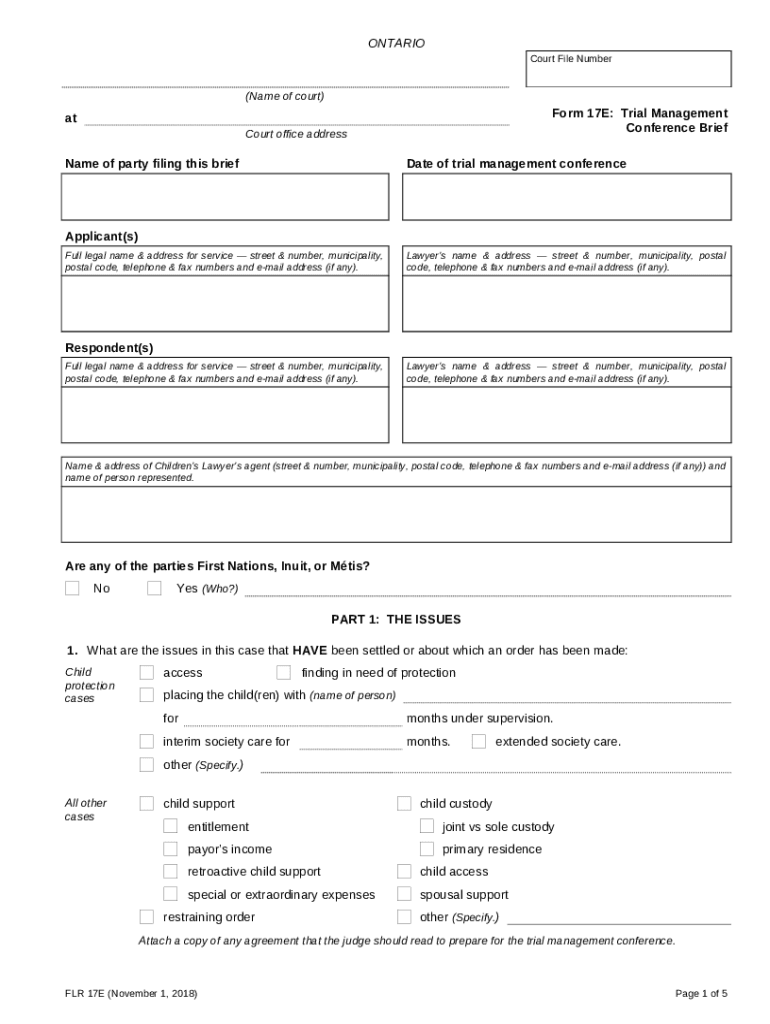
) Full legal name & address for service street & number, municipality, postal code, telephone & fax numbers and e-mail address (if any). Lawyer s name & address street & number, municipality, postal code, telephone & fax numbers and e-mail address (if any). Respondent(s) Full legal name & address for service street & number, municipality, postal code, telephone & fax numbers and e-mail address (if any). Lawyer s name & address street & number, municipality, postal code, te.
Loading

Open form follow the instructions

Easily sign the form with your finger

Send filled & signed form or save
How to fill out the Canada Form 17E - Ontario online
Filling out the Canada Form 17E (Trial Management Conference Brief) online is an important step in the legal process, ensuring that you present your case effectively in court. This guide provides clear, step-by-step instructions to help you navigate the form with ease.
Follow the steps to complete the form online effectively.
- Press the ‘Get Form’ button to retrieve the form and open it in your document editor.
- Begin by entering the court file number at the top of the form, ensuring it corresponds with your case.
- Fill in the name of the court where your case is being heard, and provide the court office address as required.
- Enter your full legal name and address for service, including your street address, municipality, postal code, and contact information.
- List your lawyer's name and address, including their contact details.
- Next, fill in the respondent's full legal name and address for service, along with their legal representative's information.
- If applicable, provide details for the Children's Lawyer's agent, including their contact information and the name of the person represented.
- Indicate whether any parties involved are First Nations, Inuit, or Métis, and provide specifics if applicable.
- In Part 1, detail the issues that have been settled or ordered in your case, selecting relevant categories and providing any necessary specifics.
- Describe where the child is living at the time of the conference.
- State whether there are any urgent issues that require immediate attention and provide details if applicable.
- List any unresolved issues in your case and specify the applicable categories.
- For Part 2, attach an outline of your opening statement for trial and indicate the undisputed facts, your legal theories, evidence summary, and requested orders.
- Identify witnesses planned to testify, including their names, topics of testimony, and time estimates for each.
- Indicate any expert witnesses involved, their areas of expertise, and whether their reports have been filed.
- Estimate the overall trial time necessary for your side and the opposing side.
- In Part 3, answer whether the parties signed a statement of agreed facts and explain if not.
- Confirm completion of document disclosure and witness questioning, indicating any pending actions.
- Provide details of any expert reports intended for trial and confirm distribution to relevant parties.
- List relevant orders in the case and state whether all orders have been implemented.
- Indicate if a joint document brief has been produced and explain if not.
- Confirm whether an order for affidavit evidence has been made.
- Address any preliminary matters requiring resolution before trial.
- Confirm that all parties have been served or provide an explanation if not.
- State whether a request to admit has been served.
- Finally, sign and date the form, ensuring both party and lawyer signatures are present.
Complete your Canada Form 17E - Ontario online today to ensure your case is effectively presented.
Experience a faster way to fill out and sign forms on the web. Access the most extensive library of templates available.
Related content
by LP Phaneuf — PRODUCTS XXViii / C.V.M.A. ADVANCE REGISTRATION FORM, 17TH ANNUAL...
Showing 1 - 20 results of 104 for search 'Ontario,', query time: 0.08s Refine Results...
Sep 4, 2001 — Applicant requests an exemption from section 17(e) and rule 17e-1 to the...
Get answers to your most pressing questions about US Legal Forms API.
Who can write an affidavit in Ontario?
A notary public has all the powers of a commissioner for taking affidavits and, can verify that signatures, marks and copies of documents are true or genuine. Notaries are regulated under the Notaries Act . Every lawyer and paralegal in Ontario is also automatically a commissioner for taking affidavits.
How long does family court take in Ontario?
A trial may take less than one day, multiple days or weeks, depending on multiple factors such as the complexity of the issues, the amount of evidence to be presented by the parties and the availability of counsel and court schedules.
How do you write a convincing affidavit?
How to prepare an affidavit? Speak in the first person. This personalizes your affidavit, giving your personal account and testimony. Remain concise. Keeping your message as short as possible helps you to clearly communicate your message, and can make it more impactful. Restate your claims. ... Notarize your affidavit.
What is a trial management conference in Ontario?
If you and the other party cannot settle your case at the case conference or settlement conference, the judge will schedule a trial management conference. Trial management conferences are covered by rule 17(6) of the Family Law Rules. The trial management conference is intended to get everyone ready for the trial.
What is a good example of an affidavit?
Before me, a Notary Public in and for said County and State, hereby certify that ______________________________, personally known to me to be the affiant in the foregoing affidavit, personally appeared before me this day and having been by me duly sworn deposes and says that the facts set forth in the above affidavit ...
How do I take someone to family court in Ontario?
Next steps Step 1: Prepare your court application form. Complete Form 8: Application (General) and any other forms that are relevant to you and your situation. ... Step 2: Get your application issued. ... Step 3: Serve your application. ... Step 4: Complete proof of service. ... Step 5: File your court documents.
How to write an affidavit for family court in Ontario?
Use clear, simple language when writing your story. Give enough details that the judge can understand what has happened, but not so many that they will become impatient, bored or confused while reading your affidavit. Find someone who is authorized to commission your signature on your affidavit.
How to write an affidavit of support for child custody?
The affidavit typically includes information such as the parent's relationship with the child, their ability to provide for the child's physical and emotional needs, the child's educational and medical history, and any other relevant information that may be helpful to the court in making a custody decision.
Use professional pre-built templates to fill in and sign documents online faster. Get access to thousands of forms.
If you believe that this page should be taken down, please follow our DMCA take down process here.