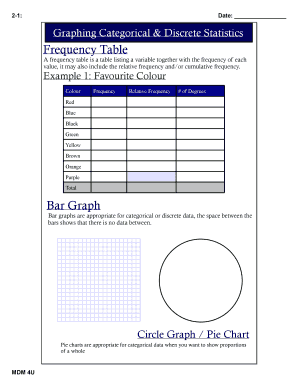
The relative frequency and/or cumulative frequency. Example 1: Favourite Colour Colour Frequency Relative Frequency # of Degrees Red Blue Black Green Yellow Brown Orange Purple Total Bar Graph Bar graphs are appropriate for categorical or discrete data, the space between the bars shows that there is no data between. Circle Graph / Pie Chart Pie charts are appropriate for categorical data when you want to show proportions of a whole MDM 4U 2-1: Date: Example 2: Sum of.
Open form follow the instructions
Easily sign the form with your finger
Send filled & signed form or save
How to fill out the Graphing Categorical & Discrete Statistics Frequency Table online
The Graphing Categorical & Discrete Statistics Frequency Table is a vital tool for organizing and presenting data effectively. This guide provides a straightforward, step-by-step approach to filling out the table online, ensuring that you can create a clear representation of your data.
Follow the steps to complete your frequency table with ease.
- Click ‘Get Form’ button to obtain the form and open it in the editor.
- Begin by entering the date in the designated field at the top of the form. This helps track when the data was collected.
- Next, locate the section labeled 'Colour.' Here, you will input the different categories for your dataset, such as the colors in your survey.
- In the 'Frequency' column, enter the number of occurrences for each corresponding category. This represents how many times each color was selected.
- If applicable, fill in the 'Relative Frequency' column, which expresses the frequency as a proportion of the total. This provides insight into the distribution of responses.
- You may also include a 'Cumulative Frequency' section if you wish to display the running total of frequencies as you progress through the categories.
- After completing all necessary sections, review your entries for accuracy and completeness.
- Finally, you can save your changes, download the completed table, print it for physical records, or share it with others online.
Start filling out your Graphing Categorical & Discrete Statistics Frequency Table online today!
Experience a faster way to fill out and sign forms on the web. Access the most extensive library of templates available.
Related content
by RP Duquia · 2014 · Cited by 84 — As for categorical variables, frequency...
Jul 10, 2024 — In SPSS, the Frequencies procedure can produce summary measures for...
Sep 12, 2023 — Unit 1: Exploring One-Variable Data This is a section on types of...
Get answers to your most pressing questions about US Legal Forms API.
Which is the best way to display categorical data in a frequency distribution?
Frequency tables, pie charts, and bar charts are the most appropriate graphical displays for categorical variables.
How do you construct a frequency distribution for categorical data?
Question: To construct a frequency distribution for categorical data, the observations that appear in each category must be summed up. number of observations that appear in each category must be counted. To construct a frequency distribution for categorical data, the - Chegg Chegg https://.chegg.com › questions-and-answers › constr... Chegg https://.chegg.com › questions-and-answers › constr...
How to display distribution of categorical data?
The distribution of a categorical variable can be displayed using a bar chart. But if the variable is not categorical but quantitative, then the numerical relations between its values have to be taken into account when we create visualizations.
Can frequency distributions be made for categorical data?
There are four types of frequency distributions: Ungrouped frequency distributions: The number of observations of each value of a variable. You can use this type of frequency distribution for categorical variables.
How to construct a categorical frequency distribution table?
0:34 2:51 Set. We will construct a categorical frequency distribution which is a table that uses classes andMoreSet. We will construct a categorical frequency distribution which is a table that uses classes and frequencies to organize the data. Step one is to make a table with headings class tally frequency and
How do you construct a frequency distribution of data?
Answer: We can find frequency distribution by the following steps: First of all, calculate the range of the data set. Next, divide the range by the number of the group you want your data in and then round up. After that, use class width to create groups. Finally, find the frequency for each group.
What is the best way to display categorical data?
Bar Charts and Pie Charts are used to visualize categorical data. Both types of graphs contain variations as displayed in the visual.
What is the best way to display a frequency distribution?
A frequency distribution of data can be shown in a table or graph. Some common methods of showing frequency distributions include frequency tables, histograms or bar charts.
Can you use a frequency table for categorical data?
How to Represent Categorical Data Using a Frequency Table. Step 1: In the first entry of the first column, give a title for the categorical variable, and then list each of the distinct values of the categorial data in the first column below the title (do not list the same element more than once). Representing Categorical Data Using a Frequency Table - Study.com Study.com https://study.com › skill › learn › representing-categorical... Study.com https://study.com › skill › learn › representing-categorical...
What is a graphical display for frequency distributions with categorical data called?
Bar chart. A bar chart is a graph that shows the frequency or relative frequency distribution of a categorical variable (nominal or ordinal). Frequency Distribution | Tables, Types & Examples - Scribbr Scribbr https://.scribbr.com › statistics › frequency-distribut... Scribbr https://.scribbr.com › statistics › frequency-distribut...
Use professional pre-built templates to fill in and sign documents online faster. Get access to thousands of forms.
If you believe that this page should be taken down, please follow our DMCA take down process here.