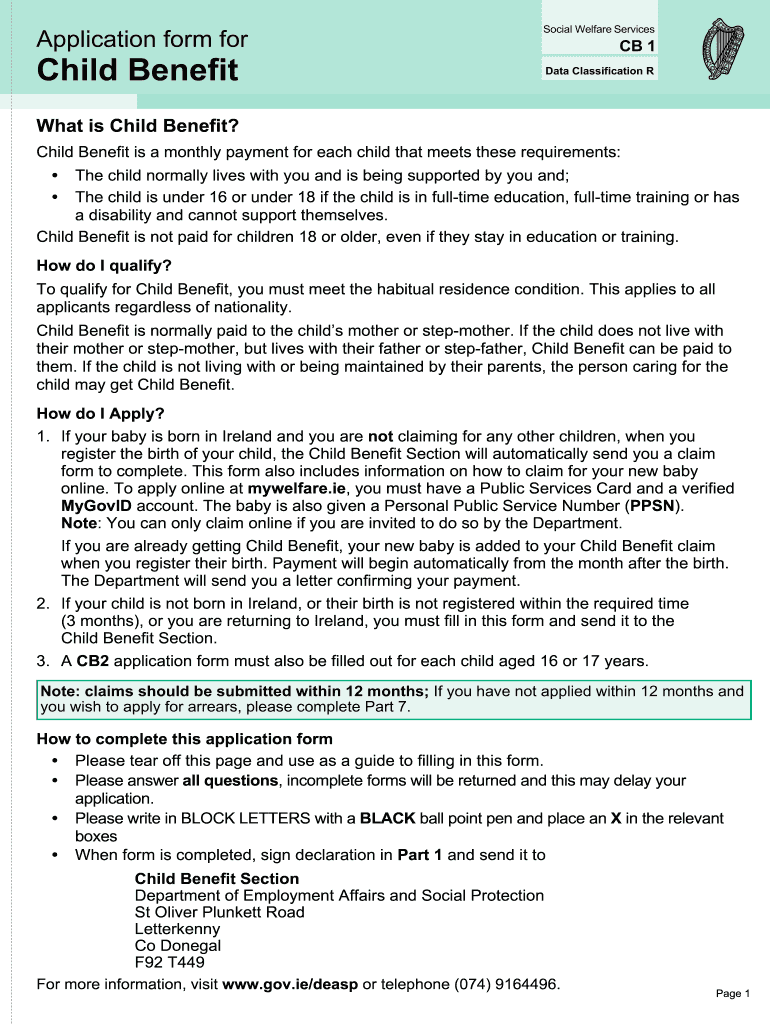
The child normally lives with you and is being supported by you and; The child is under 16 or under 18 if the child is in full-time education, full-time training or has a disability and cannot support themselves. Child Benefit is not paid for children 18 or older, even if they stay in education or training. How do I qualify? To qualify for Child Benefit, you must meet the habitual residence condition. This applies to all applicants regardless of nationality. Child Benefit is normally paid.
Loading

Open form follow the instructions

Easily sign the form with your finger

Send filled & signed form or save
How to fill out the IE CB1 online
This guide provides comprehensive instructions for users on how to accurately complete the IE CB1 application form, which is essential for applying for Child Benefit. It aims to assist users by breaking down each section of the form into manageable steps.
Follow the steps to successfully complete your application.
- Press the ‘Get Form’ button to access the application form and open it for editing.
- Begin by filling in your Personal Public Service Number (PPS Number) in the designated box at the top of the form. Ensure clarity by using BLOCK LETTERS.
- Continue providing your birth information by inserting your birth surname, your mother’s birth surname, and your date of birth using the respective format (DD/MM/YYYY).
- Next, input your contact details including your address, telephone number, and email address. Check for accuracy, as any inconsistencies may delay processing.
- Proceed to Part 1, where you need to provide further personal details, including your civil status. Make sure to check the correct option and provide any necessary dates.
- In Part 2, answer questions regarding your habitual residence condition, including employment status and previous addresses. Include detailed information about any previous countries of residence if applicable.
- Section Part 3 focuses on payment details. Choose your preferred method for receiving payments by filling in either your bank account details or selecting a post office.
- Finally, review the entire form for any errors before saving your changes. You can also download, print, or share your completed application as needed.
Start your online application today by completing the necessary forms for Child Benefit.
Experience a faster way to fill out and sign forms on the web. Access the most extensive library of templates available.
Related content
by S Miller · 2020 · Cited by 10 — 2020 Nov; 200: 108241. ... Cannabinoid CB1 receptor...
by S Miller · 2020 · Cited by 10 — Abstract. The cannabinoid signaling system...
Jun 17, 2024 — Ingeniously created by a further careful back crossing of our famous...
Get answers to your most pressing questions about US Legal Forms API.
What happens when CB1 is activated?
Cannabinoid receptor 1 (CB1). Most common G-coupled-protein receptor in the brain and found throughout the central and peripheral nervous system. Activation leads to decreased cAMP and increased MAP Kinase Pathway activation at the cellular level.
How much is Child Benefit in Northern Ireland?
It's usually paid every 4 weeks. If you're eligible you'll get £25.60 a week for your first child and £16.95 a week for any children after that. You can claim Child Benefit if: you're 'responsible for the child'
How do I contact Child Benefit in Ireland?
If you need any help to complete this form, please contact the Child Benefit section by email at child.benefit@welfare.ie or by calling 0818 300 600 or 074 916 4496. Your local Intreo Centre, Social Welfare Office or any Citizens Information Centre can also help.
How much is Child Benefit per month in Ireland?
How much is Child Benefit? Family sizeMonthly rate of Child Benefit 1 child €140 2 children €280 3 children €420 4 children €5604 more rows • May 1, 2024
Does CBD act on CB1 or CB2?
CBD has little binding affinity for either CB1 or CB2 receptors, but it is capable of antagonizing them in the presence of THC (Thomas et al., 2007). In fact, CBD behaves as a non-competitive negative allosteric modulator of CB1 receptor, and it reduces the efficacy and potency of THC and AEA (Laprairie et al., 2015).
What is the difference between cannabinoids and endocannabinoids?
The word “cannabinoid” usually refers to a chemical found in the cannabis (marijuana or hemp) plant. "Endo," in this context, refers to substances produced inside the body. Endocannabinoids are, in effect, the body's own source of cannabis-like substances.
Is CB1 a cannabinoid?
Cannabinoid receptor 1 (CB1), is a G protein-coupled cannabinoid receptor that in humans is encoded by the CNR1 gene. The human CB1 receptor is expressed in the peripheral nervous system and central nervous system.
Is CB1 an endocannabinoid?
Introduction. The cannabinoid receptor type 1 (CB1) is a critical component of the endocannabinoid system and the most abundantly expressed G protein-coupled receptor (GPCR) in the brain1.
Use professional pre-built templates to fill in and sign documents online faster. Get access to thousands of forms.
If you believe that this page should be taken down, please follow our DMCA take down process here.