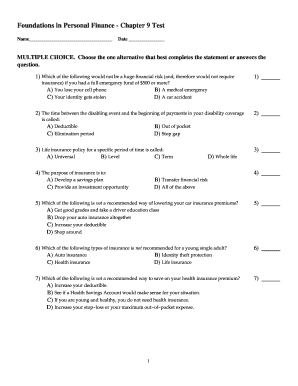
D, therefore would not require 1) insurance) if you had a full emergency fund of $500 or more? A) You lose your cell phone B) A medical emergency C) Your identity gets stolen D) A car accident 2) The time between the disabling event and the beginning of payments in your disability coverage is called: A) Deductible 2) B) Out of pocket D) Stop gap C) Elimination period 3) Life insurance policy for a specific period of time is called: .
Open form follow the instructions
Easily sign the form with your finger
Send filled & signed form or save
How to fill out the Foundations in Personal Finance - Chapter 9 Test online
Completing the Foundations in Personal Finance - Chapter 9 Test online provides an excellent opportunity to assess your understanding of key financial concepts. This guide will walk you through each step of filling out the test, ensuring that you can complete it efficiently and accurately.
Follow the steps to complete the test effectively.
- Click the ‘Get Form’ button to access the test and open it for completion.
- Begin by entering your name in the designated field at the top of the form. Ensure that your name is spelled correctly, as this will be used for identification purposes.
- Next, fill in the date in the provided space. Use the format MM/DD/YYYY to ensure clarity.
- Proceed to the multiple-choice section. For each question, read the statement carefully and select the answer that best completes it by marking the corresponding box.
- After completing the multiple-choice section, move on to the true/false questions. Write 'T' for true and 'F' for false in the spaces provided.
- In the vocabulary section, define each term or phrase by writing your answers clearly in the designated spaces.
- Continue to the short answer section. Here, provide detailed responses to each question in the spaces provided.
- Review your answers carefully to ensure all questions are answered and that your responses are clear and complete.
- Once you are satisfied with your answers, you can save your changes, download the completed test, print it for your records, or share the form as required.
Complete your Foundations in Personal Finance - Chapter 9 Test online today!
Experience a faster way to fill out and sign forms on the web. Access the most extensive library of templates available.
Related content
Apr 11, 2011 — The Actuarial Foundation: Building Your Future helps students easily...
Chapter 9 in Dave Ramsey's materials typically focuses on advanced money management...
1.5. The Secretariat has five main divisions: the Air Navigation Bureau, the Air...
Get answers to your most pressing questions about US Legal Forms API.
What is a deductible in Ramsey chapter 9?
In Chapter 9 of Ramsey's program, a deductible is defined as the initial amount you are responsible for paying before your insurance coverage applies. This section highlights the importance of understanding deductibles when making financial decisions regarding insurance. By familiarizing yourself with this term, you can better prepare for the Foundations in Personal Finance - Chapter 9 Test. Resources from platforms like US Legal Forms can further deepen your understanding of this essential aspect of personal finance.
What is the rule of 72 Chapter 8 Foundations in personal finance?
The rule of 72, explained in Chapter 8 of Foundations in Personal Finance, is a straightforward formula that helps you estimate how long it will take for an investment to double. Simply divide 72 by the annual rate of return, and you'll get the approximate number of years needed. Mastering this concept prepares you for the Foundations in Personal Finance - Chapter 9 Test, as it’s crucial for evaluating investment choices. Utilizing resources like US Legal Forms can enhance your understanding of investment fundamentals.
What is a deductible Ramsey Classroom?
In Ramsey Classroom, a deductible is similarly defined as the sum you are responsible for before your insurance company contributes. This concept is essential in managing personal finances effectively, particularly when planning for unforeseen circumstances. As you work through the Foundations in Personal Finance - Chapter 9 Test, grasping this idea will help you navigate insurance options more confidently. Ramsey Classroom offers interactive tools that make this learning process engaging and impactful.
Will renters insurance cover you and your belongings if there is ever a fire theft or vandalism?
Yes, renters insurance typically covers your possessions in events such as fire, theft, or vandalism. It offers a safety net, allowing you to recover losses and replace valuables effectively. While obtaining renters insurance, it's wise to review the policy details to understand coverage limits and specific protections. If you want comprehensive coverage options, consider our platform to help you find the right renters insurance for your situation.
What is the 3rd foundation in personal finance?
The 3rd foundation in personal finance is about the significance of investing for future benefits. This building block teaches you how to allocate resources efficiently and take calculated risks. Through the Foundations in Personal Finance - Chapter 9 Test, you will learn essential investment principles that can secure your financial independence. It sets the stage for tackling greater financial challenges while ensuring a prosperous future.
What are key personal finance topics?
Let's look at six big personal finance topics—budgeting, saving, debt, taxes, insurance, and retirement—and discuss a helpful principle for each.
What is the best way to avoid running out of money too quickly?
Stop the cycle of running out of money by following these five steps. Step 1: Review Your Spending. It's time to get serious and take an inventory of your money. ... Step 2: Create a Budget. ... Step 3: Pay Your Important Bills. ... Step 4: Find Ways to Cut Spending. ... Step 5: Find Ways to Make Extra Money.
What are the 5 financial foundations?
What Are the 5 Foundations of Personal Finance & Why Are They Important? Save a $500 emergency fund. Get out of debt/loans. Pay cash for your car. Pay cash for college. Build wealth and give.
What are the 5 key aspects of personal finance?
Areas of Personal Finance. The five areas of personal finance are income, saving, spending, investing, and protection.
Use professional pre-built templates to fill in and sign documents online faster. Get access to thousands of forms.
If you believe that this page should be taken down, please follow our DMCA take down process here.