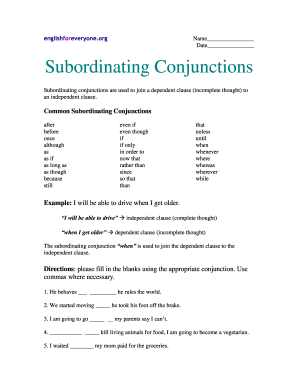
Common Subordinating Conjunctions after before once although as as if as long as as though because still even if even though if if only in order to now that rather than since so that than that unless until when whenever where whereas wherever while Example: I will be able to drive when I get older. “I will be able to drive”  independent clause (complete thought) “when I get older”  dependent clause (incomplete thought) The subordinating conjunction “when” is used to join t.

How it works
  • Open form

    Open form follow the instructions

  • Easily sign form

    Easily sign the form with your finger

  • Share form

    Send filled & signed form or save

How to fill out the EnglishForEveryone Subordinating Conjunctions online

Filling out the EnglishForEveryone Subordinating Conjunctions form is a key step in enhancing your understanding of subordinating conjunctions and their usage in English sentences. This guide provides comprehensive instructions to help you effectively complete the form online.

Follow the steps to successfully fill out the form.

  1. Click ‘Get Form’ button to obtain the form and open it in the editor.
  2. Begin filling out the form by entering your name and the date at the top of the document, as these details personalize your submission.
  3. Proceed to the section that explains subordinating conjunctions. Take a moment to read the definitions and examples provided, as they will assist you in answering the questions accurately.
  4. In the first set of directions, fill in the blanks with the appropriate subordinating conjunctions from the list. Remember to use commas where necessary, as indicated in each example.
  5. After completing the first set, move on to the section that invites you to create your own sentences using the given conjunctions. Thoughtfully construct sentences that reflect your understanding.
  6. Once you have filled out all fields, review your answers for accuracy and completeness before finalizing the form.
  7. Finally, save your changes, and choose whether to download, print, or share the completed form as needed.

Start filling out your EnglishForEveryone Subordinating Conjunctions form online today!

Get form

Experience a faster way to fill out and sign forms on the web. Access the most extensive library of templates available.

Related content

(A bibliography of paperbacks costing under a...

nouns, verbs, subordinating conjunctions, or past perfect progressives. Instead it will...

Learn more
Combining Sentences: Coordinating Conjunctions

Directions: On the line below each group of sentences, copy the sentences and combine them...

Learn more
Questions & Answers

Get answers to your most pressing questions about US Legal Forms API.

Contact support

How do you memorize subordinating conjunctions?

To memorize subordinating conjunctions effectively, consider using flashcards or repetition techniques. Write down the EnglishForEveryone subordinating conjunctions and their definitions, then regularly quiz yourself. This active recall strategy can reinforce your memory, making these critical words part of your linguistic toolkit.

A simple shortcut for identifying subordinating conjunctions is to remember their usage in sentence structures. Focus on how EnglishForEveryone subordinating conjunctions connect dependent and independent clauses. This understanding will allow you to quickly recognize these words in your writing, streamlining your composition process.

Teaching subordinating conjunctions effectively involves using examples and practice exercises. Begin with clear definitions and demonstrate how EnglishForEveryone subordinating conjunctions function within complex sentences. Engage students with activities that encourage them to create their own sentences, enhancing their understanding and application of these vital grammatical tools.

You can use the mnemonic 'ABBI SAW A WUWU' to remember subordinating conjunctions. Each letter stands for a word: 'Although,' 'Because,' 'Before,' 'If,' 'Since,' 'Although,' 'When,' 'Until,' 'While.' This EnglishForEveryone subordinating conjunctions mnemonic helps learners recall these essential connecting words more effortlessly.

An effective acronym to remember subordinating conjunctions can be 'ABSOLUTELY.' This stands for 'Although,' 'Because,' 'Since,' 'Unless,' 'That,' 'Whether,' 'While,' and 'Even if.' Using this acronym with EnglishForEveryone subordinating conjunctions makes it easier for learners to grasp and identify these words within sentences.

A helpful trick to remember subordinating conjunctions is to focus on their function in a sentence. EnglishForEveryone subordinating conjunctions link dependent clauses to independent clauses, showing relationships between ideas. By associating these words with their purpose, you will find it easier to recall them when constructing your sentences.

The 12 most common subordinating conjunctions include 'although,' 'because,' 'before,' 'even though,' 'if,' 'in case,' 'once,' 'provided that,' 'since,' 'that,' 'unless,' and 'while.' Understanding these EnglishForEveryone subordinating conjunctions helps enhance your writing by connecting ideas smoothly. You will find these words crucial in creating complex sentences that add depth to your work.

Punctuation with subordinating conjunctions depends on their position in a sentence. If the dependent clause comes first, a comma should separate it from the independent clause. Conversely, when the independent clause appears first, no comma is necessary with the follow-up dependent clause. Mastering the punctuation rules related to EnglishForEveryone Subordinating Conjunctions elevates your writing and creates clarity.

The primary rule for using subordinating conjunctions is that they introduce dependent clauses, which cannot stand alone. They connect thoughts, providing additional context. When using EnglishForEveryone Subordinating Conjunctions, ensure that the dependent clause is placed correctly in relation to the independent clause. This structure clarifies the relationship between ideas and improves sentence flow.

The 20 examples of subordinating conjunctions include: although, because, since, after, before, unless, while, whenever, even though, if, in case, whenever, although, once, as, as soon as, unless, in order that, so that, and while. Incorporating these into your sentences enhances your writing cohesiveness. Using EnglishForEveryone Subordinating Conjunctions can profoundly improve clarity in your communication.

Get This Form Now!

Use professional pre-built templates to fill in and sign documents online faster. Get access to thousands of forms.

If you believe that this page should be taken down, please follow our DMCA take down process here.

Get EnglishForEveryone Subordinating Conjunctions