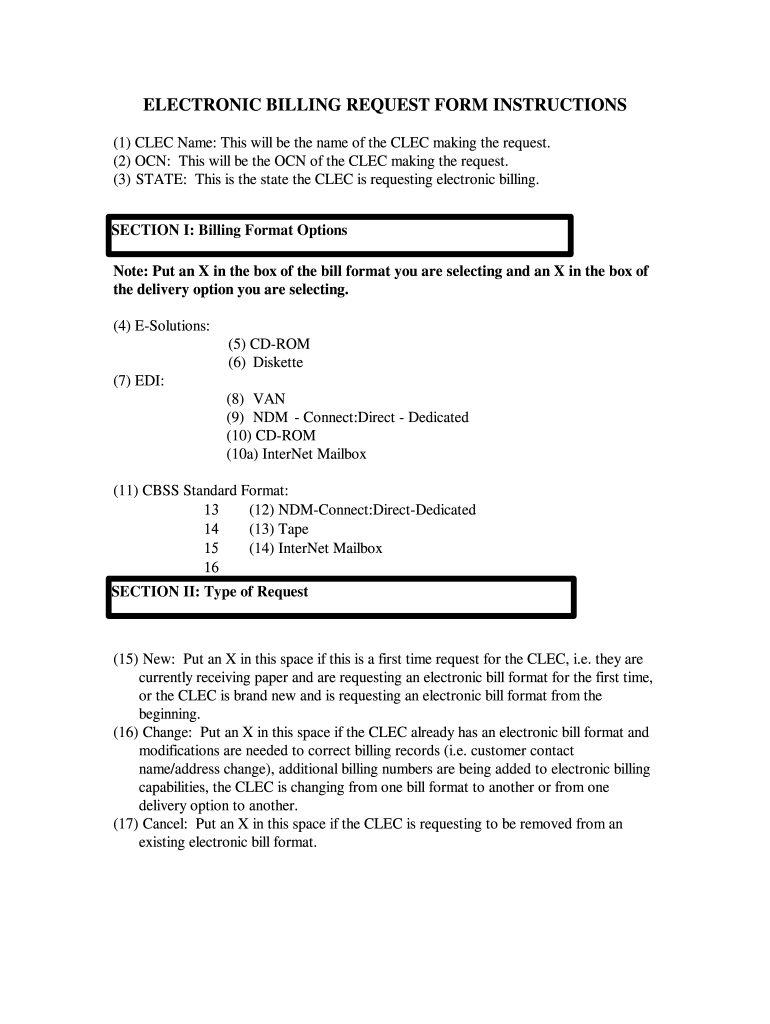
state the CLEC is requesting electronic billing. SECTION I: Billing Format Options Note: Put an X in the box of the bill format you are selecting and an X in the box of the delivery option you are selecting. (4) E-Solutions: (5) CD-ROM (6) Diskette (7) EDI: (8) VAN (9) NDM - Connect:Direct - Dedicated (10) CD-ROM (10a) InterNet Mailbox (11) CBSS Standard Format: 13 (12) NDM-Connect:Direct-Dedicated 14 (13) Tape 15 (14) InterNet Mailbox 16 SECTION II: Type of Request (15) New: Put an X in this .

Open form follow the instructions

Easily sign the form with your finger

Send filled & signed form or save
How to fill out the Electronic Billing Request Form Instructions online
Filling out the Electronic Billing Request Form is a straightforward process that enables the requesting CLEC to switch to or modify their electronic billing preferences. This guide provides a comprehensive overview of each section in the form, ensuring clarity and ease of understanding for all users.
Follow the steps to successfully complete the form online.
- Press the ‘Get Form’ button to access the Electronic Billing Request Form and open it in your preferred online editor.
- In the first section, 'CLEC Name,' enter the name of the CLEC making the request, and in 'OCN,' provide the associated OCN.
- Indicate the state where the CLEC is requesting the electronic billing by filling out the 'STATE' field.
- Move to Section I, 'Billing Format Options.' Mark an X in the box for your chosen billing format and delivery option.
- In Section II, 'Type of Request,' check the appropriate box for 'New,' 'Change,' or 'Cancel' based on your request.
- In Section III, note your current delivery type by marking the box that corresponds to the format you are currently receiving.
- Proceed to Section IV. Fill in the originator’s name, title, telephone number, and Bmail ID, as well as the Account Manager's contact information.
- In Section V, 'CLEC Bill Mailing Address and Contact,' enter the account name, street address, city, state, zip code, and contact details for the person who will receive the bill.
- Section VI requires you to specify the technical contact's information in case there are technical issues regarding the bill format.
- If applicable, fill out Section VII regarding COPS order processing information, including the account number and delivery address.
- In Section VIII, you may add comments relevant to your request as indicated.
- For Section IX, indicate your paper bill requirements by checking the appropriate box regarding stopping or continuing paper bills after 90 days.
- Finally, complete Section X with the necessary company name, CCNA, area code, and other details required for billing cycles.
- Once all sections are filled, review your entries for accuracy. You can then save changes, download, print, or share the completed form.
Complete your Electronic Billing Request Form online today!
Experience a faster way to fill out and sign forms on the web. Access the most extensive library of templates available.
Related content
You must submit 1) a Form W‐9 and 2) a voided check or official letter from your bank...
Department Routing Information: a. Person requesting invoice b. Extension of person...
2.4.2 UB-04 Claim Form Field Instructions. Provider Name, Address, and Telephone Number...
Get answers to your most pressing questions about US Legal Forms API.
Who completes the CMS 1500 form?
The CMS 1500 form is usually completed by the healthcare provider or their office staff. Those handling billing must ensure that all sections are filled out accurately and comprehensively. By referring to the Electronic Billing Request Form Instructions, you can make this process easier and less prone to errors.
Who submits Medicare Part A claims?
Medicare Part A claims are typically submitted by hospitals and inpatient facilities that provide care to eligible patients. These providers must follow specific guidelines to ensure their claims are accepted. Following the Electronic Billing Request Form Instructions will help in accurately submitting these claims to Medicare.
What are EDI submissions?
EDI submissions refer to claims sent electronically using the EDI format outlined by CMS. This method allows for quicker processing and payment of claims, reducing administrative burdens. By adhering to the Electronic Billing Request Form Instructions, you can ensure that your EDI submissions are compliant and efficiently submitted.
Who fills out the CMS 1500?
Typically, the healthcare provider or their administrative staff fills out the CMS 1500 form. This role may also be handled by billing specialists who ensure that all required information is accurate and complete. Utilizing the Electronic Billing Request Form Instructions can help streamline the completion of this form and minimize errors.
Which providers submit the CMS 1500 claim form?
The CMS 1500 claim form is primarily utilized by non-institutional providers, such as physicians and other healthcare professionals. These providers submit claims for various services rendered to patients. Ensuring that you correctly fill out the CMS 1500 is crucial, and following the Electronic Billing Request Form Instructions provides guidance for accurate submissions.
What is EDI in electronic billing?
EDI stands for Electronic Data Interchange, a method that allows the electronic exchange of business information, including billing data. It simplifies the communication process between healthcare providers and payers. Using EDI is essential for complying with the Electronic Billing Request Form Instructions, as it enhances efficiency and reduces paperwork.
What is the format required by CMS for electronic claim submission?
The CMS requires the use of the 837 format for electronic claim submissions. This structured data format allows healthcare providers to submit claims efficiently and reduces the chances of errors. By following the Electronic Billing Request Form Instructions, you can ensure that your submissions meet all necessary requirements and streamline the process.
What billing format is the electronic equivalent of the CMS 1500 form?
The electronic equivalent of the CMS 1500 form is the 837P format. This format is used for submitting health care claim information electronically, ensuring that all billing details are accurately conveyed to payers. Using the 837P format helps reduce errors and accelerates processing times, which is beneficial for healthcare providers. If you are looking to implement these processes, the Electronic Billing Request Form Instructions could guide you effectively.
What does EDI stand for in customs clearance?
EDI stands for Electronic Data Interchange. In the context of customs clearance, it simplifies the process of exchanging data between trade partners, such as importers and customs authorities. EDI allows the submission of necessary documents electronically, making the customs process faster and more efficient. For those interested in streamlining their billing processes, understanding EDI can be crucial, especially when considering Electronic Billing Request Form Instructions.
What is the CMS 1500 billing form?
The CMS 1500 billing form is a paper form used by healthcare providers to submit claims for reimbursement to Medicare and other payers. While it's a traditional method, many providers are transitioning to electronic forms for efficiency. Understanding the Electronic Billing Request Form Instructions will help you navigate both traditional and electronic submissions.
Use professional pre-built templates to fill in and sign documents online faster. Get access to thousands of forms.
If you believe that this page should be taken down, please follow our DMCA take down process here.