selected alternative and on separate sheet: • Describe VAR process used • Describe operational parameters met (e.g. pH & time) • Attach monitoring data and certification statement Part 503.33 Vector Reduction Alternatives In-plant alternatives 1. 38% min. reduction of volatile solids 2. anaerobic bench scale digestion 3. aerobic bench scale digestion 4. SOUR aerobic 1.5mg O2/hr/g TS (dw) 5. aerobic 14 days>45°C average temp. 6. pH ≥ 12 for 2 hr, + 22 hr ≥ 11.5 pH 7. secondary solids .

Open form follow the instructions

Easily sign the form with your finger

Send filled & signed form or save
How to fill out the DEQ Biosolids Annual Report Form online
Filling out the DEQ Biosolids Annual Report Form accurately is essential for compliance and environmental reporting. This guide provides clear instructions for users, regardless of their experience level, on how to effectively complete the form online.
Follow the steps to complete the form with confidence.
- Click ‘Get Form’ button to obtain the form and open it in the editor.
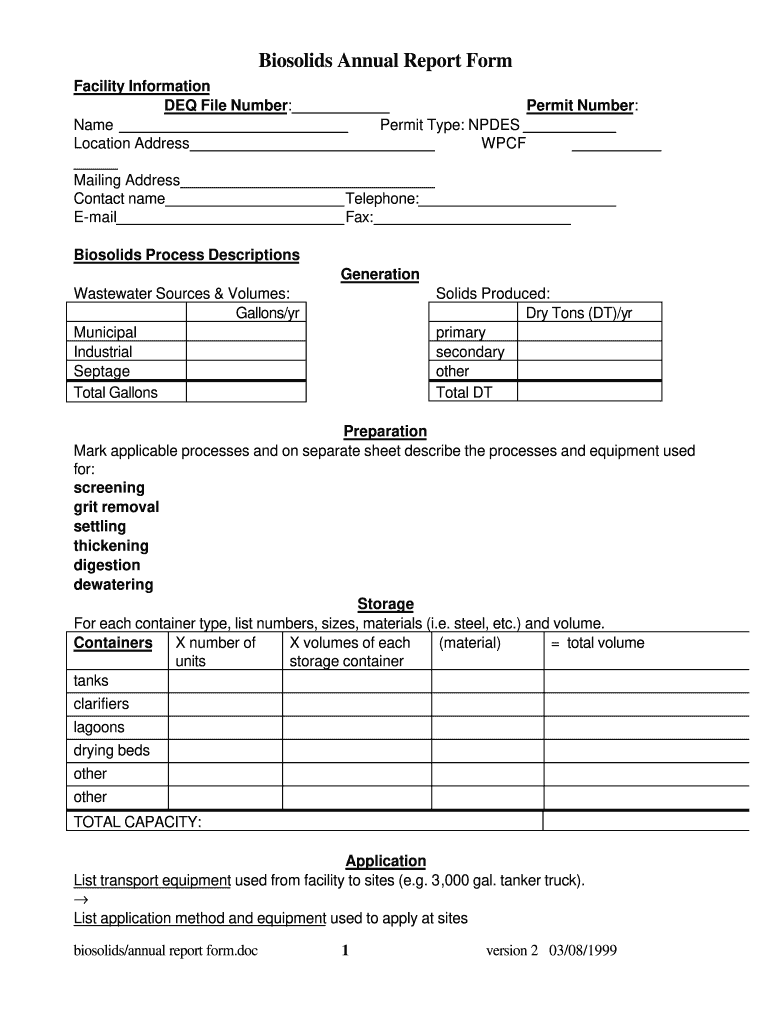
- Begin by entering facility information such as the DEQ file number, name, location address, mailing address, contact name, email, telephone, and fax. Ensure that each field is filled out completely and accurately.
- Under the permit section, indicate the permit number and select the correct permit type (NPDES or WPCF) applicable to your facility.
- In the biosolids process descriptions section, document the generation details. Provide information on wastewater sources and volumes, including municipal and industrial gallons per year. Also, report the solids produced in dry tons per year, detailing primary, secondary, and other types.
- Mark applicable preparation processes for biosolids and describe the associated equipment used for screening, grit removal, settling, thickening, digestion, dewatering, and storage on a separate sheet.
- For storage capacity, list the various containers you utilize, including number, sizes, materials (e.g., steel), and estimate the total volume for each type (storage container, tanks, clarifiers, lagoons, drying beds).
- In the application section, note the transport equipment used to transfer biosolids from your facility to application sites. Describe the method and equipment employed for applying biosolids at these sites.
- Indicate the biosolids quality class (Class A or Class B) and testing frequency. Document test data for nutrient monitoring and pollutant monitoring using the provided tables, making sure to express data in the appropriate units.
- For pathogen reduction, circle the selected alternatives and describe the processes and parameters met. Attach any required monitoring data and certification statements.
- In the vector attraction reduction monitoring section, choose your alternative and provide descriptions of the methods used along with any pertinent operational parameters.
- Complete the land application site information for all sites used during the reporting period, including site name, ID number, location, crops, acres applied, application rates, and total dry tons at each site.
- Finally, attach any additional required documents such as soil test data for sites applied to for the consecutive years and cumulative loadings information if needed.
- Once all sections are thoroughly completed and reviewed, you can save your changes, download, print, or share the form as necessary.
Start filling out the DEQ Biosolids Annual Report Form online today to ensure compliance and proper reporting.
Experience a faster way to fill out and sign forms on the web. Access the most extensive library of templates available.
Related content
Oct 26, 2018 — 1. Information DEQ requests with all annual reports: Analytical...
by H Zhang · 2012 · Cited by 10 — To obtain a representative sample of biosolids, the...
Aug 14, 2018 — The findings and conclusions in this report are those of the authors and...
Get answers to your most pressing questions about US Legal Forms API.
What is the process of biosolids?
HOW ARE BIOSOLIDS PROCESSED? Biosolids are developed from treated domestic wastewater. Prior to the cleaning of the wastewater, harmful contaminants are removed in a pre-treating process. The solids are removed from the wastewater, pH levels are increased to eliminate odor and sanitization processes control pathogens.
Why are biosolids important?
Biosolids have been used successfully to establish sustainable vegetation, reduce the bioavailability of toxic substances often found in soils, control soil erosion, and regenerate soil layers at sites that have damaged soils. Soil regeneration is very important for reclaiming sites with little or no topsoil.
What is the basic information about biosolids?
Biosolids are the nutrient-rich organic materials resulting from the treatment of domestic sewage in a wastewater treatment facility (i.e., treated sewage sludge). Biosolids are a beneficial resource, containing essential plant nutrients and organic matter and are recycled as a fertilizer and soil amendment.
What percent of biosolids are used on agricultural fields as fertilizer and as animal feed in the US?
About 60% of all biosolids are beneficially used as a fertilizer on farm land following treatment; 17% ends up buried in a landfill; 20% is incinerated; and about 3% is landfill or mine reclamation cover. Only a small percentage (much less than 1 percent) of the total food supply has been fertilized with biosolids.
What is required for a biosolids to be classified as Class A biosolids?
The EPA claims that Class A biosolids must "contain no detectible levels of pathogens" but the only pathogens actually measured and regulated in the law are fecal coliform and salmonella.
How do you make Class A biosolids?
Class A biosolids are often produced through anaerobic digestion and additional treatment, such as heating, pasteurisation, composting, or newer complementary technologies.
What are the different types of biosolids?
Biosolids can be classified into two classes, class A or class B. Class B biosolids undergo a treatment “process to significantly reduce pathogens.” This material has additional regulations for distribution and use, including a requirement for state approval of a site permit for class B biosolids to be land applied.
What are the contents of biosolids?
Biosolids provide nitrogen (N), phosphorus (P), potassium (K), calcium, magnesium, sulfur, and micronutrients for plant growth. Applying biosolids to soil has been shown to increase water holding capacity, lessen wind and water erosion, and improve aeration due to the addition of organic matter.
Use professional pre-built templates to fill in and sign documents online faster. Get access to thousands of forms.
If you believe that this page should be taken down, please follow our DMCA take down process here.