Loading
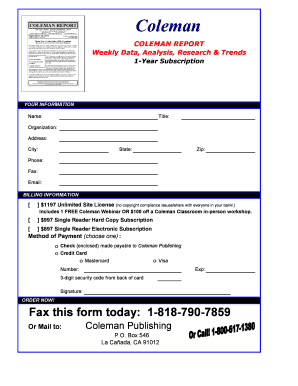
Get Coleman Report
How it works
-

Open form follow the instructions
-

Easily sign the form with your finger
-

Send filled & signed form or save
How to fill out the Coleman Report online
Filling out the Coleman Report online is a straightforward process that can be completed in just a few steps. This guide will help you navigate each section of the form, ensuring that you provide all necessary information accurately and efficiently.
Follow the steps to complete the Coleman Report accurately.
- Click ‘Get Form’ button to obtain the Coleman Report form and open it in the editing interface.
- Begin by entering your information in the 'Your Information' section. Fill in your name, title, organization, address, city, state, zip code, phone number, fax number, and email address. Ensure that all details are accurate and up-to-date to avoid any communication issues.
- Next, move to the 'Billing Information' section. Choose the appropriate subscription plan by checking the corresponding box. You can select from the Unlimited Site License, Single Reader Hard Copy Subscription, or Single Reader Electronic Subscription. Make sure you understand the benefits of each plan before making a selection.
- Provide your method of payment. Select your preferred payment option by checking the corresponding box for either check, credit card, Mastercard, or Visa. If you choose credit card, enter your card number, expiration date, and the 3-digit security code found on the back of your card.
- Finally, review all the information you have entered to ensure accuracy. After confirming that all details are correct, provide your signature to authorize the payment.
- Upon completion, you can choose to save changes, download a copy of the form, print it, or share it as needed. Keep a copy for your records.
Start filling out the Coleman Report online today to access valuable insights and research.
One important finding from the Coleman Report was that schools attended by peers from similar socioeconomic backgrounds tended to yield better educational outcomes. This was a pivotal revelation, as it highlighted the role of peer groups in shaping learning experiences. It suggested that addressing disparities in peer influences could help improve academic performance across various demographics.