Loading
Form preview
  • US Legal Forms
  • Form Library
  • Miscellaneous Forms
  • Multi-State Miscellaneous Forms
  • Classroom Observation Protocol For Project Injury

Get Classroom Observation Protocol For Project Injury

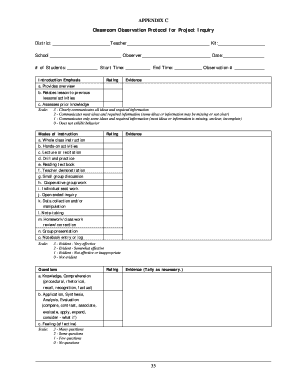
______________________ Date:_______________ # of Students: ___________ Start Time: _________ End Time: __________ Observation # ___________ Introduction Emphasis Rating Evidence a. Provides overview b. Relates lesson to previous lessons/activities c. Assesses prior knowledge Scale: 3 - Clearly communicates all ideas and required information 2 - Communicates most ideas and required information (some ideas or information may be missing or not clear) 1 - Communicates only some ideas and required.

How it works

  1. Open form

    Open form follow the instructions

  2. Easily sign form

    Easily sign the form with your finger

  3. Share form

    Send filled & signed form or save

How to fill out the Classroom Observation Protocol for Project Injury online

The Classroom Observation Protocol for Project Injury is an essential tool for evaluating classroom instruction. This guide provides clear and step-by-step instructions on how to effectively fill out this protocol online, ensuring that you capture all necessary observations and insights.

Follow the steps to complete the Classroom Observation Protocol accurately.

  1. Click the 'Get Form' button to access the Classroom Observation Protocol and open it in your preferred editor.
  2. Begin by filling out the header information: Enter the district, teacher's name, kit name, school name, observer’s name, and the date of the observation. Additionally, fill in the number of students present, start time, end time, and observation number.
  3. In the 'Introduction Emphasis' section, assess how the teacher introduces the lesson. Rate this on the provided scale from 0 to 3, and provide evidence to support your rating.
  4. Move to the 'Questions' section to record the quality and quantity of questions posed by the teacher during the lesson. Rate this section on a scale from 0 to 3 based on your observations and tally any necessary evidence.
  5. Document the 'Materials Used' by checking whether each item was present during the observation. Offer evidence of how materials supported the lesson.
  6. Once all sections are completed, save your changes to the document. You may also download, print, or share the completed form as needed.

Start completing the Classroom Observation Protocol for Project Injury online to enhance your observation skills and improve classroom instruction.

Get form

Experience a faster way to fill out and sign forms on the web. Access the most extensive library of templates available.
Get form

Related content

classroom observation protocol: Topics by ...
This classroom observation manual (Fall 1976) was developed for use in the evaluation of...
Learn more
(PDF) An Introduction to Classroom Observation
This completely revised and updated second edition takes into account the latest changes...
Learn more
Education
By reading an actual protocol for ELISA, the students can take a closer look into an...
Learn more

Related links form

Ucc 1 Form Louisiana Sunshine Society, PO Box 368, Crawfordsville, IN ... - TownNews.com Mccx Florida Non Profit Corporation Articles Of Dissolution - Wikiform

Questions & Answers

Get answers to your most pressing questions about US Legal Forms API.

Contact support

To write an observation note, focus on clear and concise descriptions of events or actions seen during the observation period. For instance, you might note 'The teacher asked questions that prompted critical thinking among students.' Using the Classroom Observation Protocol for Project Injury can help structure your notes for clarity and better communication.

An observation letter is a formal document that summarizes what you observed during a classroom visit. This letter outlines specific behaviors, teaching techniques, and student responses, and should include actionable feedback. By structuring your letter in accordance with the Classroom Observation Protocol for Project Injury, you can ensure it serves as a supportive resource.

Examples of observations include noting student participation in discussions, evaluating the effectiveness of instructional strategies, assessing classroom management techniques, observing group work dynamics, and reviewing the use of educational materials. Each of these elements can enrich the insights gathered through the Classroom Observation Protocol for Project Injury.

To write an observation report, start with a summary of the context and learning objectives. Document the specific observations, organized by categories such as student behavior, teaching methods, and classroom environment. Integrating the Classroom Observation Protocol for Project Injury can help you provide a comprehensive report that supports educational improvements.

When writing a letter of observation, begin with a clear introduction stating the purpose of your observation. Include specific examples of what you observed, using precise language, and conclude with constructive feedback. This process aligns with the Classroom Observation Protocol for Project Injury to ensure you provide meaningful insights.

A written observation typically records specific actions or behaviors occurring in a classroom setting. For instance, if a teacher uses active learning techniques during a lesson, the observer may note how students engage in discussions or activities. These details help inform the Classroom Observation Protocol for Project Injury by highlighting effective teaching strategies.

An observation statement should be clear, specific, and relevant to the observed behaviors. For instance, 'The teacher successfully engaged students in a group discussion about project injury concepts' exemplifies an effective observation statement. Using the Classroom Observation Protocol for Project Injury can further refine these statements for clarity.

Writing an observation protocol involves outlining clear objectives and defining specific behaviors to look for during observations. Incorporate elements of the Classroom Observation Protocol for Project Injury to create a coherent and focused instrument. Make sure it is user-friendly and easily understood by all stakeholders involved.

Effective observation requires adherence to several key guidelines. Observers should remain objective, taking notes without personal bias, and utilize the Classroom Observation Protocol for Project Injury as a framework. Additionally, providing constructive feedback afterwards promotes growth and development in teaching practices.

To write an observation guide, clearly define your objectives and the aspects you wish to evaluate. Include specific criteria based on the Classroom Observation Protocol for Project Injury, ensuring it aligns with your evaluation goals. A well-organized guide will help observers focus on key areas during the observation process.

Get This Form Now!

Use professional pre-built templates to fill in and sign documents online faster. Get access to thousands of forms.
Get form
If you believe that this page should be taken down, please follow our DMCA take down processhere.

Industry-leading security and compliance

US Legal Forms protects your data by complying with industry-specific security standards.
  • In businnes since 1997
    25+ years providing professional legal documents.
  • Accredited business
    Guarantees that a business meets BBB accreditation standards in the US and Canada.
  • Secured by Braintree
    Validated Level 1 PCI DSS compliant payment gateway that accepts most major credit and debit card brands from across the globe.
Get Classroom Observation Protocol for Project Injury
Get form
  • Adoption
  • Bankruptcy
  • Contractors
  • Divorce
  • Home Sales
  • Employment
  • Identity Theft
  • Incorporation
  • Landlord Tenant
  • Living Trust
  • Name Change
  • Personal Planning
  • Small Business
  • Wills & Estates
  • Packages A-Z
  • Affidavits
  • Bankruptcy
  • Bill of Sale
  • Corporate - LLC
  • Divorce
  • Employment
  • Identity Theft
  • Internet Technology
  • Landlord Tenant
  • Living Wills
  • Name Change
  • Power of Attorney
  • Real Estate
  • Small Estates
  • Wills
  • All Forms
  • Forms A-Z
  • Form Library
  • Legal Hub
  • About Us
  • Help Portal
  • Legal Resources
  • Blog
  • Affiliates
  • Contact Us
  • Delete My Account
  • Site Map
  • Industries
  • Forms in Spanish
  • Localized Forms
  • State-specific Forms
  • Forms Kit
  • Real Estate Handbook
  • All Guides
  • Notarize
  • Incorporation services
  • For Consumers
  • For Small Business
  • For Attorneys
  • USLegal
  • FormsPass
  • pdfFiller
  • signNow
  • altaFlow
  • DocHub
  • Instapage
Form Packages
  • Adoption
  • Bankruptcy
  • Contractors
  • Divorce
  • Home Sales
  • Employment
  • Identity Theft
  • Incorporation
  • Landlord Tenant
  • Living Trust
  • Name Change
  • Personal Planning
  • Small Business
  • Wills & Estates
  • Packages A-Z
Form Categories
  • Affidavits
  • Bankruptcy
  • Bill of Sale
  • Corporate - LLC
  • Divorce
  • Employment
  • Identity Theft
  • Internet Technology
  • Landlord Tenant
  • Living Wills
  • Name Change
  • Power of Attorney
  • Real Estate
  • Small Estates
  • Wills
  • All Forms
  • Forms A-Z
  • Form Library
Customer Service
  • Legal Hub
  • About Us
  • Help Portal
  • Legal Resources
  • Blog
  • Affiliates
  • Contact Us
  • Delete My Account
  • Site Map
  • Industries
  • Forms in Spanish
  • Localized Forms
  • State-specific Forms
  • Forms Kit
Legal Guides
  • Real Estate Handbook
  • All Guides
Prepared for you
  • Notarize
  • Incorporation services
Our Customers
  • For Consumers
  • For Small Business
  • For Attorneys
Our Sites
  • USLegal
  • FormsPass
  • pdfFiller
  • signNow
  • altaFlow
  • DocHub
  • Instapage
Social Media
Call us now toll free:
+1 833 426 79 33
As seen in:
© Copyright 1999-2026 airSlate Legal Forms, Inc. 3720 Flowood Dr, Flowood, Mississippi 39232
  • Your Privacy Choices
  • Terms of Service
  • Privacy Notice
  • Content Takedown Policy
  • Bug Bounty Program