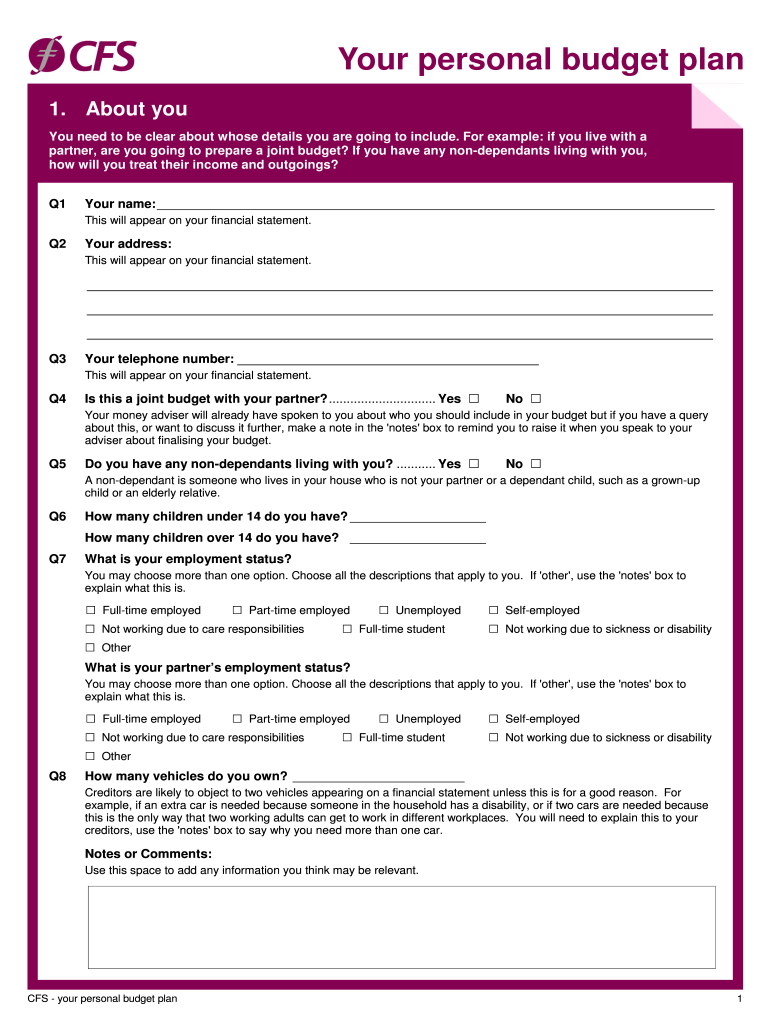
Re a joint budget? If you have any non-dependants living with you, how will you treat their income and outgoings? Q1 Your name: ______________________________________________________________________________ This will appear on your financial statement. Q2 Your address: This will appear on your financial statement. _______________________________________________________________________________ _______________________________________________________________________________ ____________________.
Loading

Open form follow the instructions

Easily sign the form with your finger

Send filled & signed form or save
How to fill out the CFS Your Personal Budget Plan online
This guide provides detailed instructions on how to complete the CFS Your Personal Budget Plan online. It aims to assist users in compiling their personal budget information accurately and efficiently.
Follow the steps to fill out your personal budget plan seamlessly.
- Press the ‘Get Form’ button to acquire the online form and have it opened in the designated editor.
- Begin with the 'About you' section. Fill in your personal details including your name, address, and telephone number. Indicate whether this is a joint budget and if you have any non-dependants living with you.
- In the 'Your income' section, detail all forms of income. Break it down into categories such as salary, other income, benefits, and pensions. Be as detailed as possible in indicating monthly or weekly amounts.
- Proceed to the 'Your Assets' section. Provide information about your home and any other assets such as vehicles and savings. Be sure to estimate values reasonably.
- Next, fill out the 'Your spending' section. List all essential and non-essential expenditures. Capture all necessary expenses to present a clear picture of your financial obligations.
- Include information on 'Your priority debts'. Document any balances owed on priority payments like rent or utility bills and indicate if repayment arrangements have been made.
- Complete the 'Your non-priority debts' section by outlining any credit-related debts you hold. This includes personal loans or credit card debts.
- Once all sections are filled, review your details for accuracy. After confirming everything is correct, you can save your changes, download, print, or share the form as per your needs.
Start filling out your CFS Your Personal Budget Plan online today to take control of your financial situation.
Experience a faster way to fill out and sign forms on the web. Access the most extensive library of templates available.
Related content
After completing chapters. CFS 7 and CFS 8, you will be prepared to complete your own...
Start with your budget! • Understand the approach to budgeting. We suggest zero-based...
At Samsung Electronics, we firmly believe that we can deliver the best value by protecting...
Get answers to your most pressing questions about US Legal Forms API.
How to fill out a monthly budget sheet?
Filling out a monthly budget sheet requires a clear understanding of your finances. Start by detailing your income sources at the top and follow with a list of your fixed expenses, like rent or utilities, and variable expenses, such as groceries and entertainment. Once you have detailed each category, compare your total income with expenses to see your financial standing. Tools like the CFS Your Personal Budget Plan can simplify this process and help you stay on track.
How should a beginner start a budget?
A beginner should start a budget by assessing their income and tracking their expenses. Begin with a simple outline: list your total income and document all spending categories, no matter how small. Afterward, use the CFS Your Personal Budget Plan to ensure you allocate funds effectively, create financial goals, and adjust your spending habits accordingly. Remember, the first steps might feel overwhelming, but consistency leads to better budgeting skills.
How do you fill out a personal monthly budget?
Filling out a personal monthly budget involves inputting your income and categorizing your expenses. Start by entering your total income at the top of your budget sheet. Then, move down to list each expense category, ensuring you account for both necessary bills and discretionary spending. By following these steps and utilizing the CFS Your Personal Budget Plan, you can maintain clarity and control over your financial situation.
How do you work out a personal budget?
To work out a personal budget, start by gathering your income statements and listing your monthly expenses. Analyze past spending patterns to forecast future expenses, and then construct your CFS Your Personal Budget Plan based on these insights. Regularly reviewing and adjusting your budget will help you stay on track with your financial goals.
How do you fill out a budget plan?
To fill out a budget plan, begin with an overview of your monthly income and expenses. Document your necessary expenses like housing and transportation first, then allocate funds for savings and discretionary spending. By regularly updating your CFS Your Personal Budget Plan, you allow yourself a clear view of your financial health and help identify areas for improvement.
How do you write a personal budget example?
To write a personal budget example, start by listing your income sources, such as salary or freelance work. Next, categorize your expenses into fixed and variable costs, like rent, utilities, groceries, and entertainment. Finally, compare your total income against your expenses to ensure that your CFS Your Personal Budget Plan is balanced, indicating that your spending does not exceed your earnings.
What is a good monthly personal budget?
A good monthly personal budget ensures your income covers all necessary expenses, while also allowing room for savings and discretionary spending. Generally, it should align with your financial goals and reflect your personal values. With the CFS Your Personal Budget Plan, you can create a customized budget that works for you, promoting financial growth and peace of mind.
What is the 50 30 20 rule in your financial plan?
The 50 30 20 rule is a budgeting guideline suggesting you allocate 50% of your income to needs, 30% to wants, and 20% to savings and debt repayment. This simple structure helps you balance essential expenses with personal desires while also promoting long-term financial health. Utilizing the CFS Your Personal Budget Plan alongside this rule can enhance your budgeting effectiveness.
What is the 50 20 30 rule?
The rule states that you should spend up to 50% of your after-tax income on needs and obligations that you must-have or must-do. The remaining half should be split up between 20% savings and debt repayment and 30% to everything else that you might want.
What is one negative thing about the 50 30 20 rule of budgeting?
Overall, the 50 30 20 rule is a simple guideline for budgeting, but it may not be the right fit for everyone's financial situation. For example, you may have a lot of expenses to pay each month, that take up more than 50% of your monthly income, leaving little to allocate towards "wants" and savings.
Use professional pre-built templates to fill in and sign documents online faster. Get access to thousands of forms.
If you believe that this page should be taken down, please follow our DMCA take down process here.