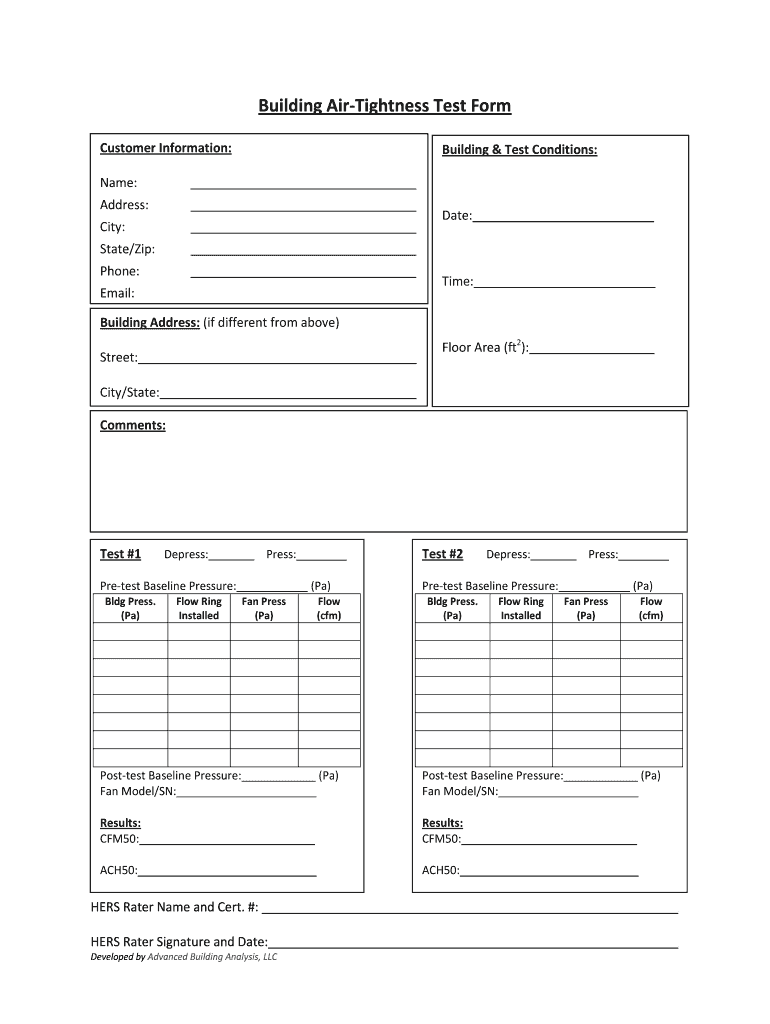
Low (cfm) Post-test Baseline Pressure: Fan Model/SN: Results: CFM50: ACH50: HERS Rater Name and Cert. #: HERS Rater Signature and Date: Developed by Advanced Building Analysis, LLC (Pa) . Test #2 . . Press: Pre-test Baseline Pressure: Bldg Press. (Pa) Flow Ring Installed . (Pa) Fan Press (Pa) Flow (cfm) Post-test Baseline Pressure: Fan Model/SN: Results: CFM50: . Depress: ACH50: (Pa) . . . . . .

Open form follow the instructions

Easily sign the form with your finger

Send filled & signed form or save
How to fill out the Building Air-Tightness Test Form online
Filling out the Building Air-Tightness Test Form online is a straightforward process that helps you ensure compliance with air-tightness standards. This guide will provide you with clear, step-by-step instructions for completing each section of the form effectively.
Follow the steps to fill out the form online:
- Press the ‘Get Form’ button to access the Building Air-Tightness Test Form and open it in your preferred document editor.
- Provide your customer information in the designated fields, including your name, address, city, state/zip, phone number, email, and date.
- If the building address differs from the previously provided address, enter the building address in the specified section.
- Input the floor area of the building in square feet (ft²) in the appropriate field.
- Make detailed notes on the test conditions in the comments section, describing any relevant information pertaining to the testing environment.
- For Test #1, fill in the depress and press measurements, as well as the pre-test baseline pressure and fan pressure fields. Document the flow in cubic feet per minute (cfm) accurately.
- Continue to fill in the post-test baseline pressure, fan model/serial number, and results, including CFM50 and ACH50.
- Provide the HERS rater’s name and certification number, followed by their signature and the date.
- Repeat the information entry for Test #2 following the same structure as Test #1.
- Once you have completed all sections of the form, review your entries for accuracy. Then, save your changes, and you may choose to download, print, or share the completed form.
Complete your Air-Tightness Test Form online today to stay compliant and efficient.
Experience a faster way to fill out and sign forms on the web. Access the most extensive library of templates available.
Related content
Building Air-Tightness Test Form. Customer Information: Name: . Address: . City:...
Aug 1, 2007 — Both techniques use an orifice blower door to induce pressure differences...
by WIS AN — For attic pull-down stairs, make stairs airtight using latch bolts and...
Get answers to your most pressing questions about US Legal Forms API.
Who does air tightness testing?
Air tightness testing is typically performed by qualified professionals, such as certified energy assessors or building inspectors. These experts use specialized equipment and techniques to assess a building's air leakage. Platforms like uslegalforms can facilitate the process by providing the necessary Building Air-Tightness Test Form and resources to streamline the testing procedure.
How to do an air tightness test?
To perform an air tightness test, start by sealing all openings, including doors and windows. Next, use a blower door to create a difference in pressure, allowing you to measure air movement. Following the procedures outlined in the Building Air-Tightness Test Form ensures you gather accurate data, helping clients improve their building's energy efficiency.
How do you calculate air tightness?
Calculating air tightness involves measuring the volume of air that leaks from a building under controlled conditions. Typically, a blower door test is used to determine the air change rate. By filling out the Building Air-Tightness Test Form accurately, you can document these results and analyze the overall energy efficiency of a property.
How do I become an air tightness tester?
To become an air tightness tester, you typically need to obtain the relevant qualifications, such as the Attma Level 1 certification. Completing a training course will provide you with the necessary knowledge and practical skills. Once qualified, you can confidently administer the Building Air-Tightness Test Form and offer your services to clients seeking compliance.
What is the building regulation for air tightness test?
Building regulations regarding air tightness testing focus on energy efficiency and reducing air leakage in structures. These regulations often require builders to complete the Building Air-Tightness Test Form to verify compliance. Understanding these regulations helps ensure that your project meets the necessary standards for sustainability and energy conservation.
What is Attma Level 1 qualification?
Attma Level 1 qualification is a certification that demonstrates a professional's ability to conduct air tightness testing in buildings. This qualification ensures testers have the skills needed to accurately perform tests and understand building regulations. By earning this certification, you can effectively complete projects involving the Building Air-Tightness Test Form, ensuring compliance and accuracy.
What is a normal air tightness level?
A normal air tightness level can range widely, but generally, a rate of 0.5 ACH is commonly accepted for efficient homes. This level indicates a balance between comfort and energy efficiency while minimizing heating and cooling costs. Using the Building Air-Tightness Test Form facilitates comparison with established norms. This comparison empowers homeowners to make necessary enhancements to their buildings.
What is standard air tightness test?
A standard air tightness test refers to established procedures used to determine how airtight a building is. This test ensures that buildings comply with energy efficiency standards and can prevent excessive energy loss. By filling out a Building Air-Tightness Test Form, you ensure comprehensive data capture, which aids in validation and compliance. Adhering to these standards ultimately enhances your building's performance.
How do you test building tightness?
To test building tightness, the most common method is a blower door test, which calculates air leakage through the building envelope. This method creates a pressure difference to measure airflow accurately. Completing a Building Air-Tightness Test Form can streamline this process and document important details. Proper documentation is key for compliance and future reference.
What is a good air tightness score?
A good air tightness score typically falls between 0.3 to 0.5 ACH for homes, indicating a well-sealed building. However, the ideal score may vary based on specific local regulations and energy efficiency goals. By using the Building Air-Tightness Test Form, you can easily evaluate your results compared to these standards. This evaluation helps you make informed decisions regarding energy efficiency improvements.
Use professional pre-built templates to fill in and sign documents online faster. Get access to thousands of forms.
If you believe that this page should be taken down, please follow our DMCA take down process here.