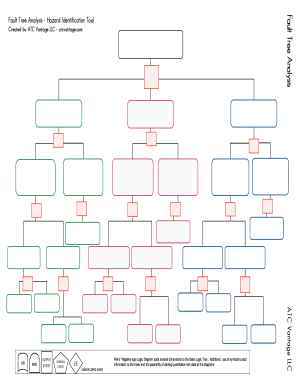
Fault Tree Analysis Fault Tree Analysis Hazard Identification Tool C reated by ATC Vantage LLC atcvantage.com AND OUTPUT EVENT NORMAL EVENT FAAs Negative type Logic Diagram adds several dimensions.

How it works
  • Open form

    Open form follow the instructions

  • Easily sign form

    Easily sign the form with your finger

  • Share form

    Send filled & signed form or save

How to fill out the ATC Vantage Fault Tree Analysis Hazard Identification Tool online

The ATC Vantage Fault Tree Analysis Hazard Identification Tool is designed to assist users in identifying and analyzing potential hazards through a structured online form. This guide provides clear, step-by-step instructions tailored to support users in successfully completing the form.

Follow the steps to complete the ATC Vantage Fault Tree Analysis Hazard Identification Tool

  1. Press the ‘Get Form’ button to access the form and open it in your preferred editor.
  2. Begin by entering the basic information required in the designated fields at the top of the form. This may include the name of the project, date of analysis, and the person responsible for completing the analysis.
  3. Review the sections labeled as 'Events' where you will categorize the events that may lead to hazards. This includes identifying both normal events and undeveloped events.
  4. Proceed to the 'Logic Diagram' section, where you can utilize symbols to depict relationships and interactions between different events. Ensure that you are clear on how each symbol represents the connection.
  5. Incorporate any quantitative risk data if applicable, as this can enhance your analysis. Fill in the associated fields with accurate information.
  6. Once you have completed all necessary sections and reviewed your entries for accuracy, continue to the final options where you can save your changes, download the document, print it, or share it as needed.

Start filling out the ATC Vantage Fault Tree Analysis Hazard Identification Tool online today!

Get form

Experience a faster way to fill out and sign forms on the web. Access the most extensive library of templates available.

Related content

Safety Management System (SMS) Manual version 4.0

Sep 1, 2014 — Its broad scope guides the identification of issues that may require...

Learn more
Safety Management System Manual, version 4.0

Its broad scope guides the identification of issues that may require analysis with more...

Learn more
Hints and Principles for Computer System Design

by B Lampson · 2019 · Cited by 12 — For security this analysis yields a threat model...

Learn more
Questions & Answers

Get answers to your most pressing questions about US Legal Forms API.

Contact support

What are the color codes for fault tree analysis?

Color codes in fault tree analysis serve as visual aids to differentiate between various types of events and gates. Typically, specific colors represent failures, processes, and conditions within the analysis. The ATC Vantage Fault Tree Analysis Hazard Identification Tool offers customizable color coding options to enhance your visual presentation. Using consistent colors helps improve clarity and comprehension for all stakeholders involved in the analysis.

Preparing a fault tree analysis (FTA) requires a structured approach, starting with the selection of a specific undesired event to analyze. Gather all relevant data and insights, then utilize the ATC Vantage Fault Tree Analysis Hazard Identification Tool to create a visual representation of possible causes. Make sure to engage team members who are familiar with the system to ensure no potential factors are overlooked. This collaborative approach strengthens the reliability of your FTA.

Fault tree analysis hazard identification is the process of pinpointing potential hazards that could lead to undesirable events in a system. By utilizing the ATC Vantage Fault Tree Analysis Hazard Identification Tool, you can systematically uncover these hazards and assess their implications. This proactive approach allows you to prioritize risks and develop strategies for mitigation. Effective hazard identification is essential for safeguarding your operations.

The method of fault tree analysis involves defining a top event, which represents a failure, and working downwards to identify its causes. You'll use logical operators to connect different events and create a structured analysis. The ATC Vantage Fault Tree Analysis Hazard Identification Tool simplifies this process, enabling you to capture complex relationships easily. This structured approach helps in identifying vulnerabilities in your systems effectively.

The best way to think of a fault tree analysis is as a map that outlines the various pathways leading to a potential failure. This visualization helps you see how different factors contribute to an undesired event. With the ATC Vantage Fault Tree Analysis Hazard Identification Tool, you can meticulously chart these pathways. This tool also aids in understanding the interactions between different hazards, providing a comprehensive view of potential risks.

Filling out a fault tree analysis involves systematically documenting the identified events and their causes. With the ATC Vantage Fault Tree Analysis Hazard Identification Tool, you can easily categorize each cause and link them logically. Be diligent about using appropriate symbols for events and gates, ensuring clarity in your representation. Regularly refer to your defined undesired event to stay focused throughout the process.

To write a fault tree analysis, start by clearly defining the undesired event or failure you aim to analyze. Next, use the ATC Vantage Fault Tree Analysis Hazard Identification Tool to breakdown the causes of this event, identifying both immediate and root causes. Organize these causes hierarchically, using logical symbols to illustrate relationships. Finally, review your analysis for completeness and clarity to ensure you're capturing all potential hazards.

Creating a fault tree analysis in Excel involves outlining your top event and structuring a flowchart that breaks down contributing failures. You can use shapes and connectors to illustrate relationships. For a more sophisticated approach, consider the ATC Vantage Fault Tree Analysis Hazard Identification Tool, which offers features that Excel may lack, ensuring a more detailed and accurate analysis.

To conduct Fault Tree Analysis (FTA), you need to identify the primary failure event and map its pathways of occurrence. The process involves drilling down through layers of contributing faults. The ATC Vantage Fault Tree Analysis Hazard Identification Tool provides a user-friendly interface to document and analyze each step effectively.

Performing a fault tree analysis begins with identifying the main failure event. Then, you decompose it into more manageable faults and causes. The ATC Vantage Fault Tree Analysis Hazard Identification Tool streamlines this process, enabling you to clearly articulate paths of failure in a well-organized diagram.

Get This Form Now!

Use professional pre-built templates to fill in and sign documents online faster. Get access to thousands of forms.

If you believe that this page should be taken down, please follow our DMCA take down process here.

Get ATC Vantage Fault Tree Analysis Hazard Identification Tool