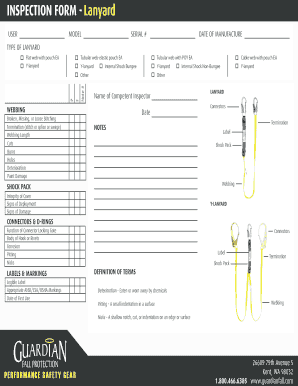
INSPECTION FORM - Lanyard USER MODEL SERIAL # DATE OF MANUFACTURE TYPE OF LANYARD Flat web with pouch EA Y-lanyard Tubular web with POY EA Y-lanyard Internal Shock Bungee F Note # P Y-lanyard Internal.
Open form follow the instructions
Easily sign the form with your finger
Send filled & signed form or save
How to fill out the Associated Scaffolding Inspection Form - Lanyard online
Filling out the Associated Scaffolding Inspection Form - Lanyard online is a straightforward process that enables users to ensure the safety and compliance of lanyards used in scaffolding operations. This guide provides step-by-step instructions to help you accurately complete the form while highlighting critical components and fields.
Follow the steps to successfully complete the form online.
- Click ‘Get Form’ button to obtain the form and open it in the editor.
- Begin by entering the user details, including the name, model, and serial number of the lanyard being inspected. This information should be easily accessible and clearly identified.
- Proceed to the 'Type of Lanyard' section, where you can select the appropriate option from the provided choices, such as 'Flat web with pouch' or 'Y-lanyard.' Ensure you select all applicable types.
- In the 'Webbing' section, assess the condition of the lanyard webbing for any issues such as broken stitches, cuts, or burns. Document the length of the webbing here.
- Move to the 'Lanyard' section, where you will enter details about the connectors, termination, and whether the label is legible.
- In the 'Shock Pack' section, evaluate the integrity of the cover and check for any signs of deployment or damage.
- For the 'Connectors & D-Rings' section, confirm the functionality of the connector locking gate, check for corrosion, pitting, or nicks on the body of the hook.
- In the 'Labels & Markings' area, ensure the labels are legible and that appropriate ANSI/CSA/OSHA markings are present, along with the date of first use.
- Finally, review the 'Notes' section to add any additional observations relevant to the inspection.
- After completing all fields, make sure to save changes, and download, print, or share the form as needed.
Complete your documentation online today to ensure compliance and safety in your operations.
Experience a faster way to fill out and sign forms on the web. Access the most extensive library of templates available.
Related content
Inspections—Before each work shift and after any occurrence that could affect the...
The purpose of Illinois State University's (ISU) Scaffolding Procedure is to protect...
This inspection is to be carried out by a “competent person”. C Belts, harnesses...
Get answers to your most pressing questions about US Legal Forms API.
What is the OSHA standard for scaffold inspection?
The OSHA standard for scaffold inspection requires that scaffolds are inspected before each shift and after any alterations or adverse weather events. Inspections should be conducted by a qualified individual to ensure all safety measures are in place. Following these standards is crucial for project safety. Use the Associated Scaffolding Inspection Form - Lanyard to keep accurate records of these inspections.
What is lanyard in scaffolding?
A lanyard in scaffolding is a flexible line of rope or strap that connects a worker's harness to an anchorage point. This safety device prevents falls by catching workers if they slip or lose their balance. Proper use of lanyards is essential for maintaining safety while working at heights. Ensure your lanyard practices are documented using the Associated Scaffolding Inspection Form - Lanyard.
Does OSHA require tie off on scaffolding?
Yes, OSHA requires that workers tie off when working on scaffolding under certain conditions. Specifically, if employees are at risk of falling from heights of six feet in the construction industry, they must be tied off. This precaution helps prevent serious injuries. Incorporate the use of the Associated Scaffolding Inspection Form - Lanyard to ensure compliance with these safety measures.
What is the 10 foot rule in OSHA?
The 10 foot rule states that workers must use fall protection when working at heights of 10 feet or more. This requirement applies to scaffolding, ensuring that workers remain safe when above this height. Adhering to this guideline is vital for workplace safety. Document all fall protection measures using the Associated Scaffolding Inspection Form - Lanyard.
What is the 4 to 1 rule for scaffolding?
The 4 to 1 rule refers to the requirement that for every four feet of height, there should be at least one foot of base width for stability. This rule helps ensure that the scaffold does not tip over. Maintaining this ratio is crucial for safety on the job site. When managing scaffold inspections, remember to use the Associated Scaffolding Inspection Form - Lanyard for consistent documentation.
What is the proper inspection process for scaffolding?
The inspection process for scaffolding involves a systematic approach. First, assess the setup to ensure it meets safety standards. Check for any damages or wear on components, and verify that all parts are properly connected and secured. Document your findings using the Associated Scaffolding Inspection Form - Lanyard for easy reference.
How often should OSHA inspections be conducted?
OSHA requires that inspections occur whenever necessary and should be conducted by a qualified person. Generally, these inspections should happen at least once every 30 days. However, it is essential to review the specific regulations for your site because conditions may vary. Utilizing the Associated Scaffolding Inspection Form - Lanyard can help ensure you remain compliant.
How often should scaffold components be inspected?
Scaffold components should be inspected regularly. This includes daily inspections before use and more thorough checks every week. Additionally, anytime there is a change in working conditions, an inspection must take place. You can document these inspections using the Associated Scaffolding Inspection Form - Lanyard.
Are harnesses required on scaffolding?
Harnesses are required on scaffolding when workers are exposed to fall hazards. This safety measure is vital for protecting individuals working at heights. By using the Associated Scaffolding Inspection Form - Lanyard, companies can document harness usage and demonstrate their commitment to worker safety.
Are scaffold inspection tags required by OSHA?
Yes, scaffold inspection tags are a requirement by OSHA to ensure safety on job sites. These tags provide essential information about the scaffold's safety status and any necessary precautions. The Associated Scaffolding Inspection Form - Lanyard can serve as a valuable resource to ensure compliance and safety in scaffold usage.
Use professional pre-built templates to fill in and sign documents online faster. Get access to thousands of forms.
If you believe that this page should be taken down, please follow our DMCA take down process here.