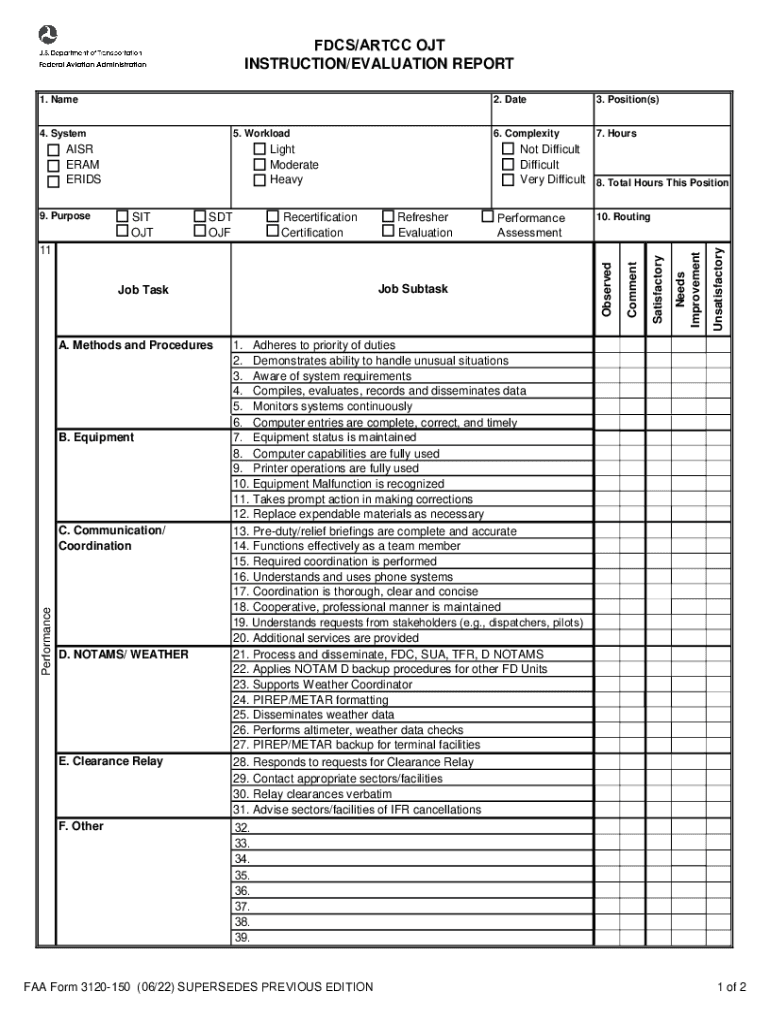
On Performance Assessment 10. Routing A. Methods and Procedures B. Equipment Performance C. Communication/ Coordination D. NOTAMS/ WEATHER E. Clearance Relay F. Other Comment Job Subtask Job Task Observed 11 Unsatisfactory 9. Purpose Light Moderate Heavy Needs Improvement AISR ERAM ERIDS 3. Position(s) Satisfactory 4. System 2. Date 1. Adheres to priority of duties 2. Demonstrates ability to handle unusual situations 3. Aware of system requirements 4. Compiles, evaluates,.
Loading

Open form follow the instructions

Easily sign the form with your finger

Send filled & signed form or save
How to fill out the FAA 3120-150 online
This guide provides step-by-step instructions for filling out the FAA Form 3120-150 online. Following these detailed instructions will help you complete the form accurately and efficiently.
Follow the steps to successfully fill out the form.
- Click ‘Get Form’ button to obtain the form and open it in the editor.
- Enter the name of the person being evaluated in the 'Name' field.
- Select the appropriate position(s) from the 'Position(s)' field.
- Input the date in the 'Date' field to specify when the evaluation takes place.
- Indicate the workload using the given options: 'Light', 'Moderate', or 'Heavy' in the 'Workload' section.
- In the 'Complexity' section, mark whether the task performed is categorized as 'Not Difficult', 'Difficult', or 'Very Difficult'.
- Record the total hours for this position in the 'Total Hours This Position' field.
- Evaluate performance, checking the statements provided under the assessment criteria as applicable.
- Fill in the relevant routing methods and procedures by choosing options under 'Routing'.
- Provide comments and notes regarding the performance in the 'Comment' section.
- Instructor comments can be entered in the 'Instructor Comments' section.
- Choose the appropriate recommendation type in the 'Recommendation' field based on the employee's performance.
- Have the employee provide feedback in the 'Employee's Comments' section and sign in the designated area.
- As a certifier, sign and date the certification field to confirm the employee's qualifications.
- Once all fields are completed, save changes, and download or print the completed form for your records.
Complete the FAA 3120-150 online for streamlined documentation.
Experience a faster way to fill out and sign forms on the web. Access the most extensive library of templates available.
Related content
This form is restricted to internal-use only by FAA employees and is not accessible to the...
3,120-150 cm. SMEAR SLIDE SUMMARY (%): COMPOSITION: Foraminifers. Nannofossils. Micrite...
... 3120-150-4. 3110-120-10. 3100-125. 550. 560. 570 bestehend aus: consisting of: 29006...
Get answers to your most pressing questions about US Legal Forms API.
Who is responsible for the pilot's fitness to fly?
A surprising number of pilots don't understand they have this responsibility even if they don't hold an FAA medical certificate. All pilots, including those who fly ultralights or operate drones, have an obligation to ensure that they are medically fit to fly before operating the controls as a required crew member.
What is the requirement for supplemental oxygen?
When the oxygen saturation falls below 89 percent, or the arterial oxygen pressure falls below 60 mmHg — whether during rest, activity, sleep or at altitude — then supplemental oxygen is needed.
What is the FAA recommendation for supplemental oxygen?
For optimum protection, pilots are encouraged to use supplemental oxygen above 10,000 feet during the day, and above 5,000 feet at night.
What is tunnel vision and cyanosis?
Tunnel vision and cyanosis are two symptoms of hypoxia. Symptoms of hypoxia may be difficult to recognize in a single-pilot operation before the pilot's reactions are affected. If symptoms of hypoxia occur, promptly descend to a lower altitude.
Can you fly with supplemental oxygen?
Obtaining oxygen for air travel — The Federal Aviation Administration (FAA) does not allow travelers to carry their own oxygen tanks or liquid oxygen aboard commercial aircraft. Instead, most patients can use a FAA Department of Transportation approved battery-powered portable oxygen concentrator.
What are the rules for oxygen in aviation?
FAA encourages oxygen use for pilots on flights operating above 10,000 feet mean sea level (MSL). The regulations for flying above an altitude of 12,500 up to and including 14,000 are fairly simple. At that altitude, all crew must use supplemental oxygen continuously if the flight is over thirty minutes.
What are the FAA night lights requirements?
The approved aircraft lights for night operations are a green light on the right cabin side or wingtip, a red light on the left cabin side or wingtip, and a white position light on the tail. In addition, flashing aviation red or white anticollision lights are required for night flights.
Which form of oxygen is FAA approved for taking on a flight?
The Inogen One meets FAA guidelines for use onboard all commercial aircrafts for flights starting or stopping within the United States.
Use professional pre-built templates to fill in and sign documents online faster. Get access to thousands of forms.
If you believe that this page should be taken down, please follow our DMCA take down process here.