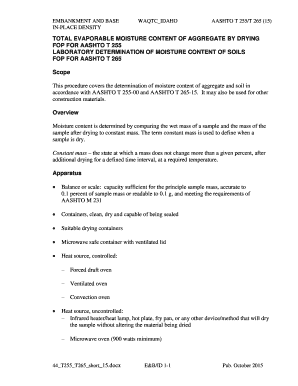
OILS FOP FOR AASHTO T 265 Scope This procedure covers the determination of moisture content of aggregate and soil in accordance with AASHTO T 255-00 and AASHTO T 265-15. It may also be used for other construction materials. Overview Moisture content is determined by comparing the wet mass of a sample and the mass of the sample after drying to constant mass. The term constant mass is used to define when a sample is dry. Constant mass the state at which a mass does not change more than a given.

How it works
  • Open form

    Open form follow the instructions

  • Easily sign form

    Easily sign the form with your finger

  • Share form

    Send filled & signed form or save

How to fill out the ID AASHTO T 255/T 265 online

The ID AASHTO T 255/T 265 documents procedures for determining the moisture content of aggregate and soil. This guide provides a comprehensive step-by-step approach for users to effectively complete this form online, ensuring accuracy and compliance with the guidelines.

Follow the steps to fill out the ID AASHTO T 255/T 265 online

  1. Click the ‘Get Form’ button to obtain the form and open it for editing.
  2. Familiarize yourself with the sections of the form. The document will require details about the sample type, including its wet and dry mass.
  3. In the section for sample identification, clearly input the sample ID and related information provided by your agency.
  4. Next, record the wet mass of the sample by subtracting the mass of the container from the mass of the container with the wet sample.
  5. Fill out the mass determinations as specified, ensuring you are accurate to the nearest 0.1 g for both wet and dry samples.
  6. Calculate the moisture content using the appropriate formulas provided in the document and enter this information in the designated section.
  7. Finally, review all entries for accuracy, then save your changes, download the completed form, and print or share it as necessary.

Complete your documents online to ensure efficient and accurate data submission.

Get form

Experience a faster way to fill out and sign forms on the web. Access the most extensive library of templates available.

Related content

TOTAL EVAPORABLE MOISTURE CONTENT OF ...

This procedure covers the determination of moisture content of aggregate and soil in...

Learn more
References | Moisture Measurement for Pavement ...

45Â Â AASHTO T 265. (2015). Laboratory Determination of Moisture Content of Soils...

Learn more
Publication 242 Pavement Policy Manual, May 2015...

Dec 1, 2019 — Forms, and place the form, along with ... AASHTO T 265. Sieve Analysis...

Learn more
Questions & Answers

Get answers to your most pressing questions about US Legal Forms API.

Contact support

What do you mean by drying to constant weight?

“Dried to constant weight” means that drying shall be continued until two consecutive weighings, the second of which is taken after an additional drying period appropriate to the nature and quantity of the residue, do not differ by more than 0.50 mg per g of substance taken.

AASHTO T 99 is the appropriate standard for compaction of cohesive soils, particularly if there is the potential for swelling when saturated. AASHTO T 180 is appropriate for granular soils, such as aggregate base course and Structure Backfill, Class 1.

The term constant mass is used to define when a sample is dry. Constant mass – the state at which a mass does not change more than a given percent, after additional drying for a defined time interval, at a required temperature.

To heat to constant mass: • Weigh the solid and container; • Heat for a few minutes, cool then weigh; Repeat this until the mass does not change (at this point all of the water of crystallisation has been removed). In an experiment to find the mass of water of crystallisation in hydrated magnesium chloride MgCl2.

Heating a substance to constant mass is a quantitative chemistry technique where a single chemical species or group of reactants is heated with constant weighing ensuring that the substance mass gets to a point that is constant meaning the reaction is complete.

For quantitative work, it is often necessary to dry samples to constant weight. This is required, for example, when expressing nitrate content as a percentage of the weight of the sample. Constant weight is obtained by removing the water from the sample - that is, by drying it.

Get This Form Now!

Use professional pre-built templates to fill in and sign documents online faster. Get access to thousands of forms.

If you believe that this page should be taken down, please follow our DMCA take down process here.

Get ID AASHTO T 255/T 265