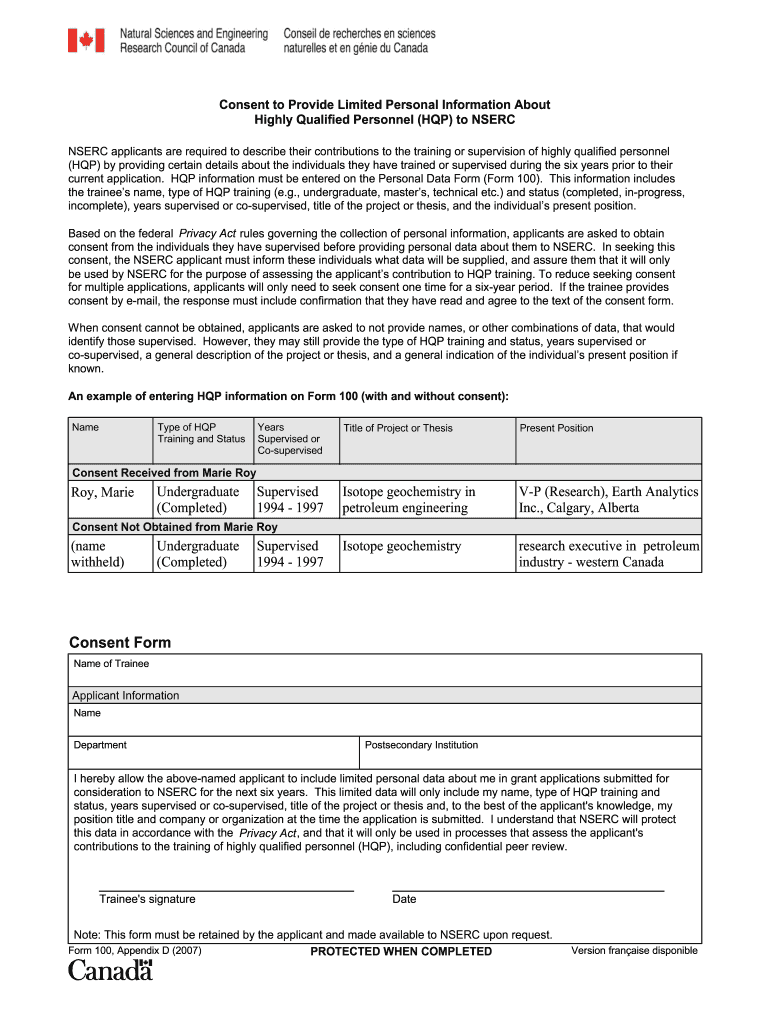
Ied personnel (HQP) by providing certain details about the individuals they have trained or supervised during the six years prior to their current application. HQP information must be entered on the Personal Data Form (Form 100). This information includes the trainee s name, type of HQP training (e.g., undergraduate, master s, technical etc.) and status (completed, in-progress, incomplete), years supervised or co-supervised, title of the project or thesis, and the individual s present posi.

Open form follow the instructions

Easily sign the form with your finger

Send filled & signed form or save
How to fill out the Canada Form 100 Appendix D online
This guide aims to provide clear instructions on how to complete the Canada Form 100 Appendix D online. By following the steps outlined below, users can efficiently provide the necessary personal information about highly qualified personnel as required by NSERC.
Follow the steps to successfully complete the form.
- Click ‘Get Form’ button to access the form and open it in your preferred viewing tool.
- Begin by entering your personal information. This includes your name, department, and postsecondary institution in the designated fields. Ensure that all details are accurate as they are essential for identification.
- Next, proceed to input details about the highly qualified personnel you have trained or supervised. Record the trainee's name in the appropriate field.
- Specify the type of HQP training provided, such as undergraduate or master’s training. Also, indicate the current status of the training, whether completed, in progress, or incomplete.
- Document the years during which you supervised or co-supervised the individual by entering the relevant dates. This may range from specific years to starting and ending years.
- Provide the title of the project or thesis completed by the trainee. This title should reflect the work undertaken during their training period.
- Include the present position of the trainee, if known. This information aids in understanding their current professional status.
- Before submitting the form, ensure that you have obtained consent from the individuals mentioned. Consent can be documented through email communication, confirming the trainee's agreement to the use of their data.
- Once all sections are filled, review the information for completeness and accuracy. Make any necessary edits to ensure that the information is precise.
- Finally, you can choose to save your changes, download, print, or share the completed form as required.
Complete your Canada Form 100 Appendix D online today for a smooth application process.
Experience a faster way to fill out and sign forms on the web. Access the most extensive library of templates available.
Related content
This booklet includes the forms needed for maintaining occupational injury and illness...
May 14, 2017 — Summary. This final rule amends the Pension Benefit Guaranty...
Jun 30, 2011 — 100. Service Documents in ADs ... Appendix D. Examples of How NOT To...
Get answers to your most pressing questions about US Legal Forms API.
What is the citation style for NSERC?
For example, if your research best fits NSERC, you cannot choose to submit your application to CIHR instead. Is there specific type of citation to use for NSERC? There is no required citation style. You can use the citation style most relevant to your specific research discipline.
What is HQP Nserc?
Highly Qualified Personnel (HQP) Advanced training in science and engineering is an integral part of university research and of NSERC's mission to foster the discovery and application of knowledge.
What font size is the Nserc discovery grant?
When you prepare your application, supporting materials and attachments, follow these guidelines: Print must be in black ink and of letter quality. Text must be single-spaced, with no more than six lines per inch. The accepted font is Times New Roman regular 12 pts, or any comparable font – nothing smaller.
Where can I find my NSERC reference number?
The Funding Reference Number (FRN – CIHR) or Application ID (Appl ID – NSERC and SSHRC) is a number that identifies a unique research grant. You can find this number in the Agency letter that acknowledges your successful grant application.
What GPA do you need for NSERC?
Applicant must have a cumulative GPA score (CUM GPA) of at least 3.60 or higher (using 4.00 scale) Preference will be given to applicants with at least 3 terms completed (e.g. U3, U2, U1 with freshman year)
How to find nserc pin?
Personal Identification Number (PIN) It can be found on any official correspondence you have received from NSERC. Refer to your PIN each time you apply for an award and in future correspondence with NSERC. If you have not previously applied to NSERC, or if you cannot remember your PIN, leave the field blank.
How many NSERC scholarships are awarded?
There are a total of 3,000 USRA allocations available each year from the Natural Sciences and Engineering Research Council of Canada (NSERC), and 95 each for the Canadian Institutes of Health Research (CIHR) and the Social Sciences and Humanities Research Council (SSHRC).
Use professional pre-built templates to fill in and sign documents online faster. Get access to thousands of forms.
If you believe that this page should be taken down, please follow our DMCA take down process here.