Gement Manual for Western Washington, is located at http://www.ecy.wa.gov/pubs/0510030.pdf Note: The BMPs that the Contractor selects to address the “Mark Clearing Limits” erosion control element of the project need to be shown or added as a note on the TESC plan. Describe what actions will be taken to accomplish these requirements and objectives, given the unique circumstances of the project and or site. The Applicant must explain the site conditions or project design features that allow th.
Open form follow the instructions
Easily sign the form with your finger
Send filled & signed form or save
How to fill out the WA CSWPPP Worksheet for Construction Projects online
The WA CSWPPP Worksheet for Construction Projects is an essential document for ensuring that construction activities comply with stormwater pollution prevention regulations. This guide provides clear, step-by-step instructions for users on how to fill out the worksheet online effectively.
Follow the steps to successfully complete the WA CSWPPP Worksheet.
- Press the ‘Get Form’ button to access the WA CSWPPP Worksheet and open it in the online editing tool.
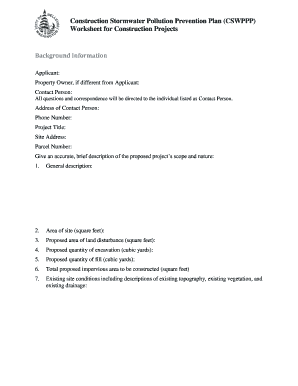
- Begin by filling out the background information section, including the applicant's name, property owner information if different, and contact person's details. This ensures that all correspondence will reach the correct individual.
- Complete the address of the contact person, phone number, project title, site address, and parcel number. Be precise to avoid any delays in processing.
- Provide a brief but comprehensive description of the proposed project’s scope and nature by detailing the project's general description, area of site, and quantity of excavation and fill.
- In the general description section, include existing site conditions, adjacent areas that may be affected, and critical areas present. Address potential erosion problems and plan sequences for construction activities.
- Proceed to the CSWPPP narrative section, where you will mark the clearing limits clearly. Select the Best Management Practices (BMPs) your project will implement to meet erosion control requirements.
- Follow the same process for each erosion control element: establish construction access, control flow rates, install sediment controls, stabilize soils, and protect slopes. For each element, describe your actions and select applicable BMPs.
- Once you have completed all sections and fields, review the information to ensure accuracy. Make any necessary corrections before finalizing.
- After reviewing, you can either save changes, download the completed form for your records, print a physical copy for signature, or share it directly with the necessary parties.
Complete the WA CSWPPP Worksheet online today to ensure compliance with stormwater management regulations for your construction project.
Experience a faster way to fill out and sign forms on the web. Access the most extensive library of templates available.
Related content
This template presents the recommended structure and content for preparation of a...
Mar 25, 2016 — Permanent erosion and sediment control measures to be implemented for the...
Jul 12, 2019 — This manual was written to outline a systematic construction management...
Get answers to your most pressing questions about US Legal Forms API.
What is BMP in construction?
BMP stands for Best Management Practices, which are strategies designed to prevent pollution and manage stormwater effectively during construction. In the context of the WA CSWPPP Worksheet for Construction Projects, these practices may include silt fences, sediment basins, and proper waste disposal methods. Utilizing BMPs not only helps protect the environment but also reduces the risk of regulatory violations. Understanding and implementing these practices is crucial for any construction project.
What is the minimum number of steps for implementing a SWPPP?
Implementing a SWPPP involves several essential steps, starting with a site assessment to identify risks. Next, complete the WA CSWPPP Worksheet for Construction Projects, followed by the development of a plan for Best Management Practices (BMPs). Finally, establish a monitoring schedule to ensure ongoing compliance and make adjustments as needed. Simple implementation helps you start positively and ensures effective environmental management.
Who should maintain the SWPPP?
The designated project manager or environmental compliance officer typically handles the maintenance of the SWPPP. It is crucial that this individual is knowledgeable about the requirements outlined in the WA CSWPPP Worksheet for Construction Projects. They must document any changes to the site and update the plan accordingly to reflect ongoing conditions. This responsibility ensures compliance and minimizes environmental impact throughout the project's duration.
When to do SWPPP inspections?
SWPPP inspections should occur regularly throughout the construction phase, typically every 7 to 14 days, and after any significant rain events. Use the WA CSWPPP Worksheet for Construction Projects to schedule these inspections effectively. Keeping a consistent inspection routine helps you identify and address issues promptly, ensuring compliance and protecting the environment. Always record your findings for reference during the final project review.
What triggers the need for a SWPPP?
A SWPPP is required when certain land-disturbing activities occur, such as construction or redevelopment projects. If your project involves clearing, grading, or excavation that disturbs more than one acre, you must adhere to the WA CSWPPP Worksheet for Construction Projects. Additionally, if you are located near sensitive environments, the need for a SWPPP increases. It's essential to evaluate your project's scope to determine the necessity of a SWPPP.
How to do a SWPPP inspection?
To perform a SWPPP inspection, start by reviewing the WA CSWPPP Worksheet for Construction Projects to ensure compliance with regulations. Next, check the site for visible signs of erosion, sediment control failures, and any other environmental impacts. Record your observations and identify areas needing improvements. Finally, update your SWPPP as necessary to address any issues uncovered during the inspection.
What does SWPPP stand for in construction?
In the context of construction, SWPPP still stands for Stormwater Pollution Prevention Plan. This plan is crucial for minimizing the impact of stormwater runoff from construction sites. Utilizing a WA CSWPPP Worksheet for Construction Projects enables you to create a structured and compliant SWPPP that protects both the environment and your project’s integrity.
What triggers a SWPPP?
A SWPPP is typically triggered by the installation of any construction activity that disturbs the ground. This includes land clearing, grading, and excavation. When your project meets these criteria, incorporating a WA CSWPPP Worksheet for Construction Projects becomes essential to ensure you address potential environmental impacts effectively.
What does SWPPP stand for and what is its purpose?
SWPPP stands for Stormwater Pollution Prevention Plan. Its primary purpose is to prevent water pollution related to construction activities. In conjunction with your WA CSWPPP Worksheet for Construction Projects, a SWPPP outlines the best management practices and strategies to reduce contaminants in stormwater runoff.
How often are SWPPP inspections required?
SWPPP inspections should occur regularly, typically every 7 days, and after each significant rainfall event. By keeping up with this schedule, you can ensure compliance and maintain the effectiveness of your WA CSWPPP Worksheet for Construction Projects. Regular inspections help identify potential issues early, safeguarding your project and the environment.
Use professional pre-built templates to fill in and sign documents online faster. Get access to thousands of forms.
If you believe that this page should be taken down, please follow our DMCA take down process here.