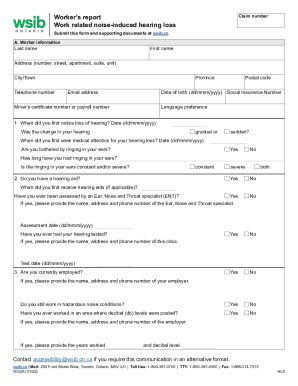
Apartment, suite, unit) City/Town Telephone number Province Email address Postal code Date of birth (dd/mmm/yyyy) Social Insurance Number Miner s certificate number or payroll number Language preference 1. When did you first notice loss of hearing? Date (dd/mmm/yyyy) Was the change in your hearing gradual or sudden? When did you first seek medical attention for your hearing loss? Date (dd/mmm/yyyy) Are you bothered by ringing in your ears? Yes No How long have you had ringing in y.

How it works
  • Open form

    Open form follow the instructions

  • Easily sign form

    Easily sign the form with your finger

  • Share form

    Send filled & signed form or save

How to fill out the Making A Claim For Noise-induced Hearing Loss WSIB online

This guide aims to assist users in effectively completing the Making A Claim For Noise-induced Hearing Loss WSIB form online. By following these instructions, individuals will be able to provide all necessary information in a structured manner to support their claim.

Follow the steps to properly complete your claim form.

  1. Press the ‘Get Form’ button to access the Making A Claim For Noise-induced Hearing Loss WSIB form and open it in the editor.
  2. Begin by filling in the 'Worker Information' section. Provide your last name, first name, address (including number, street, apartment, suite, unit), city or town, province, postal code, telephone number, email address, date of birth, social insurance number, and miner’s certificate number or payroll number. Indicate your language preference.
  3. In the hearing information section, specify when you first noticed a loss of hearing by entering the date. Indicate whether the change in hearing was gradual or sudden, and when you first sought medical attention, including the date.
  4. Respond to the questions regarding ringing in your ears, including whether you are affected and how long you have experienced this condition. Indicate if the ringing is constant or severe.
  5. Answer whether you use a hearing aid and if you have been assessed by an Ear, Nose and Throat (ENT) specialist. If applicable, provide the contact details for the specialist.
  6. Include details about your current employment status. If employed, provide your employer's name, address, and phone number along with years worked and decibel levels experienced.
  7. Fill out your prior work history, starting with the most recent employer and including details such as the employer’s name, address, job title, employment dates, equipment used, and whether ear protection was utilized.
  8. Complete the declaration and consent section by confirming the accuracy of the information provided. Sign, date, and upload the form accordingly.
  9. Finally, review all the information for completeness and accuracy before saving the changes. You can download, print, or share the completed form as needed.

Complete your claim form online today to ensure a thorough and timely submission.

Get form

Experience a faster way to fill out and sign forms on the web. Access the most extensive library of templates available.

Related content

Use of Workers' Compensation Data for Occupational...

The National Academies has urged greater use of occupational injury and illness tracking...

Learn more
WSIB REPRESENTATIVE

The Workplace Safety and Insurance Board (WSIB) have developed a policy that outlines...

Learn more
Approach to tinnitus management - PMC

by V Wu · 2018 · Cited by 58 — Bilateral tinnitus is most commonly caused by...

Learn more
Questions & Answers

Get answers to your most pressing questions about US Legal Forms API.

Contact support

What are the classification of hearing impairment?

The three basic categories of hearing loss are sensorineural hearing loss, conductive hearing loss and mixed hearing loss. Here is what patients should know about each type.

To make a claim for lump sum compensation for permanent impairment based on hearing loss, you must provide to the employer or insurer with a completed permanent impairment claim form; or if you're an exempt worker, an exempt claimant permanent impairment claim form. You will also need to provide an ENT assessment.

Most personal injury claims for tinnitus arise in car accident cases. There is no payout calculator where you can punch in your injuries and get a settlement amount. But the average settlement compensation payout range for tinnitus or hearing loss claims in an auto tort case seems to be $50,000 to $250,000.

Audiometric testing is the only diagnostic evaluation relevant to diagnosis of noise-induced hearing loss (NIHL). Pure-tone audiometry at the usual octave intervals should be performed.

If you have a noise-induced hearing loss averaging at least 22.5 dB in each ear in the 4 speech frequencies, you will be entitled to health care and rehabilitation benefits.

If you have hearing loss you qualify as disabled if have: An average air conduction hearing threshold of 90 decibels or more in the good ear. An average bone conduction hearing threshold of 60 decibels in the better ear. A word recognition score of 40% or less in the better ear, as determined by standardized tests.

Pre- and post-1990 guidelines for adjudicating NIHL claims. Entitlement provisions stated in 1988 NIHL policy apply. A worker is entitled to health care and rehabilitation benefits when the minimum level of bilateral hearing loss is 25dB in each ear (readings as low as 22.5 dB are accepted as 25 dB).

Hearing Loss Ranges (in decibels) There are different levels of hearing loss. Some forms of hearing loss can be treated with a hearing aid. If your hearing falls into the 26-70 dB range (mild to moderate), a hearing aid can be very effective in restoring sounds for your daily life.

Get This Form Now!

Use professional pre-built templates to fill in and sign documents online faster. Get access to thousands of forms.

If you believe that this page should be taken down, please follow our DMCA take down process here.

Get Making A Claim For Noise-induced Hearing LossWSIB